Foram encontradas 560 questões.
Sobre a Teoria dos Jogos, analise as afirmativas.
I- Todo equilíbrio em estratégias dominantes é equilíbrio de Nash.
II- Todo equilíbrio de Nash é equilíbrio em estratégias dominantes.
III- Todo jogo possui pelo menos uma estratégia dominante.
IV- Estratégias mistas podem conduzir ao equilíbrio de Nash.
Está correto o que se afirma em
Provas
Questão presente nas seguintes provas

Sobre Ética em Turismo e Hotelaria, analise as afirmativas.
I- Muitos problemas podem ser evitados com bons métodos operacionais e supervisão de alta qualidade, paralelamente a treinamentos eficazes, mas isso pode diluir-se na medida em que a dimensão da empresa começa a alcançar o gigantismo.
II- As questões éticas no campo profissional e empresarial podem ser agravadas em face da dimensão empresarial, por exemplo, o zelo, a pontualidade, o sigilo nem sempre são atitudes que se fazem presentes, quando as estruturas empresariais se desenvolvem, crescem ou alcançam divisões espaciais de maior ponta.
III- A corrupção, a ineficiência, a ineficácia, a negligência, a omissão, o egoísmo, a mentira, entre outros fatores, são lesões às virtudes que se encontram em quase todas as empresas, inclusive turísticas, e o meio de evitá-las é utilizar um sistema rígido de seleção.
IV- Os equipamentos turísticos representados pelo trade turístico (agências de viagens, operadoras, meios de transporte, hotéis, bares, restaurantes, museus etc.) necessitam ser continuamente dimensionados sob o enfoque da gestão da qualidade total, do comportamento ético, da conduta moral, visando à melhoria de produtos, de serviços oferecidos e prestados.
Estão corretas as afirmativas
Provas
Questão presente nas seguintes provas
A compreensão do movimento através da dança pode estar associada ao universo pedagógico da Educação Física, pois a dança além de atividade física é "educação", sendo indispensável para que o indivíduo entenda o quê e porquê fazer o movimento, pois o movimento expressivo antes de tudo deve ser consciente.
(GARIBA, C. M. S. Dança escolar: uma linguagem possível na Educação Física.
http://www.efdeportes.com/Revista Digital - Buenos Aires - Año 10 - N° 85 - Junio de 2005.)
Segundo o texto, é pertinente afirmar que a dança
Provas
Questão presente nas seguintes provas
INSTRUCTION: Read the text and answer the item.
READING AS PROCESS
A reader-centered approach is evidenced in reading instruction which focuses, first, on what the reader brings to reading in schematic world knowledge and language knowledge and, second, on their ability and willingness to draw on productive strategies in the course of reading. More traditional reading pedagogy emphasized comprehension in the form of the presentation of text followed by post-reading questions on the text. Process approaches attend, first, to the need to prime the reader with new knowledge or prompt the reader to recover existing knowledge (in advance of reading the text) and, second, to make maximum use of cognitive and linguistic resources during text processing. This involves providing 'pre-reading' tasks (such as brainstorming, semantic mapping, true-false or agree-disagree tasks), as well as 'while-reading' tasks (such as margin prompts, encouraging the linking or cross-referencing of one part of a text to another, or encouraging first skim readings followed by closer, more focused ones). Many contemporary coursebooks (e.g. Rossner 1988; Murphy and Cooper 1995) offer a range of such tasks.
A key principle in the design of these tasks is the encouragement of flexible and reflective reading. Flexibility might be promoted by devising tasks encouraging readers to read a range of texts in different ways (e.g. a close detailed reading for some genres and a scanned and later more focused reading for others). Reflective reading, where the reader is engaged with the text, might be encouraged by the interspersion of questions or prompts during the text to encourage interrogation of text. More recent studies of reader strategies (e.g. Janzen and Stoller 1998) invite readers to reflect more specifically on their own reading strategies and to judge the effectiveness of those of other readers.
(WALLACE, C. Reading. In: Carter, R. and Nunan, D. (Eds.) Teaching English to Speakers of Other Languages. 2001, Cambridge, CUP.)
In the following extract: (…encouraging first skim readings followed by closer, more focused ones)., the pronoun ones refers to
Provas
Questão presente nas seguintes provas
INSTRUCTION: Read the text and answer the item.
READING AS PROCESS
A reader-centered approach is evidenced in reading instruction which focuses, first, on what the reader brings to reading in schematic world knowledge and language knowledge and, second, on their ability and willingness to draw on productive strategies in the course of reading. More traditional reading pedagogy emphasized comprehension in the form of the presentation of text followed by post-reading questions on the text. Process approaches attend, first, to the need to prime the reader with new knowledge or prompt the reader to recover existing knowledge (in advance of reading the text) and, second, to make maximum use of cognitive and linguistic resources during text processing. This involves providing 'pre-reading' tasks (such as brainstorming, semantic mapping, true-false or agree-disagree tasks), as well as 'while-reading' tasks (such as margin prompts, encouraging the linking or cross-referencing of one part of a text to another, or encouraging first skim readings followed by closer, more focused ones). Many contemporary coursebooks (e.g. Rossner 1988; Murphy and Cooper 1995) offer a range of such tasks.
A key principle in the design of these tasks is the encouragement of flexible and reflective reading. Flexibility might be promoted by devising tasks encouraging readers to read a range of texts in different ways (e.g. a close detailed reading for some genres and a scanned and later more focused reading for others). Reflective reading, where the reader is engaged with the text, might be encouraged by the interspersion of questions or prompts during the text to encourage interrogation of text. More recent studies of reader strategies (e.g. Janzen and Stoller 1998) invite readers to reflect more specifically on their own reading strategies and to judge the effectiveness of those of other readers.
(WALLACE, C. Reading. In: Carter, R. and Nunan, D. (Eds.) Teaching English to Speakers of Other Languages. 2001, Cambridge, CUP.)
Considering what the author says about reading as a process, mark T for the true statements and F for the false ones.
( ) In a reader-centered approach, the tasks encourage the students to reflect, thus they become actively involved in the process.
( ) If the students reflect on what they are doing, they probably will feel encouraged.
( ) Process approaches are not suitable for beginners because students must have existing knowledge of the foreign language.
( ) Reader-centered approaches rely heavily on what the student brings to the classroom, both in terms of language (native and foreign) and all other experiences.
Mark the correct sequence.
Provas
Questão presente nas seguintes provas
Assinale o composto do cimento responsável pelo aumento da resistência mecânica de longo prazo.
Provas
Questão presente nas seguintes provas
INSTRUÇÃO: Leia atentamente o texto a seguir para responder à questão.
A figura abaixo representa uma placa de sombreamento horizontal infinita (ideal), instalada acima de uma abertura, e o respectivo gráfico de desempenho de sombreamento, em função do ângulo (α1) que a placa forma com a parede, do ângulo de sombra vertical (α) e do ângulo de incidência solar.
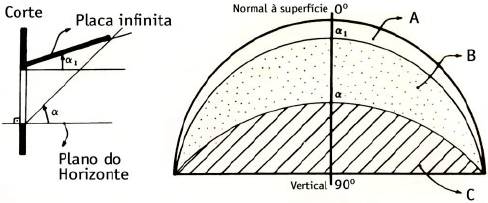
(FROTA, A. B. Manual de conforto térmico. São Paulo: Studio Nobel, 2001.)
Para essa determinada configuração, as áreas do gráfico indicadas pelas letras A, B e C são respectivamente zonas de eficiência
Provas
Questão presente nas seguintes provas
Sobre termos técnicos relativos à área de eventos, assinale a afirmativa correta.
Provas
Questão presente nas seguintes provas
Avaliar a carga do treinamento das artes marciais é dificultado pelas variações de volume, intensidade e técnicas dos treinamentos. Estes são fatores complexos inerentes a uma prática esportiva pouco precisa, sendo necessários estudos específicos de cada caso e condições.
(FETT, C. A. e FETT, W. C. R. Filosofia, ciência e a formação do profissional
de artes marciais. Motriz, Rio Claro, v.15, n.1, p.173-184, jan./mar. 2009.)
A partir da leitura do texto, analise as afirmativas.
I- Analisando a intensidade de movimentos e o tempo de duração, uma luta de boxe gasta menos energia por minuto que uma de judô.
II- Em uma luta de boxe de 12 rounds de 3 min cada, que dure os 12 rounds, o principal sistema de energia é o sistema oxidativo.
III- Em uma luta de judô, com a duração de 5 min em que o atleta utiliza surtos explosivos de contração muscular, intercalados com intervalos de recuperação, o tipo de energia é misto.
IV- Em um treinamento de karatê, em que se busque o aumento da velocidade, mantendo-se o tempo da luta, há diminuição da participação da produção de energia anaeróbia.
Estão corretas as afirmativas
Provas
Questão presente nas seguintes provas
INSTRUÇÃO: A questão é baseada no endereço IP abaixo.
IP: 200.129.244.9
Máscara: 255.255.255.244
Máscara: 255.255.255.244
Quantos hosts são possíveis endereçar na sub-rede a que pertence esse IP?
Provas
Questão presente nas seguintes provas
Cadernos
Caderno Container