Foram encontradas 600 questões.
Texto 02
Standard Englishes and World Englishes: Living with a Polymorph Business Language
By Jeanette Gilsdorf
Many who teach business communication observe gradual changes in Standard English. As do other languages, English changes through contact with other languages and through several other wellunderstood avenues of language evolution, such as compounding, adding affixes, functional shift, coinage, and so on. As the third millennium begins, new factors are converging to influence Standard English: U.S. work environments are becoming more richly intercultural, newcomers to the United States are increasing their fluency in English, and international business is using English increasingly as a global language of business. Throughout these remarks, my perspective is that of a native-born Anglo-American speaker of English. Speakers of other Englishes will have different but comparable perspectives.
Helping my English as Second Language (L2) students gradually master English, I’ve seen my practical understanding of L2 learning grow, along with my respect for the major language task these students have taken on. I’ve also sensed Americans’ unmerited good luck that English has become the language of international business. Yet the internationality of English is to us a mixed blessing because of our presumptions about what comes with it. As Dennett says, “English may be the language of the global village but the villagers are far from agreement on what is good use of the language” (1992, p. 13). Many communicators mistakenly assume a commonality of understanding when both speakers use the same English words. We know that even two speakers born to the same language experience only approximate commonality of meaning; yet we routinely forget to compensate for that fact and end up with cases of bypassing. Internationally, the commonality of understanding can be far more sketchy, and the contextual issues much more complex, than most of us realize.
A truism says that staying with good Standard English will hold problems to a minimum. But what is Standard English, and what is the place of Standard English in teaching business communication in contexts that are more and more international? How, as teachers, do we make our peace with the multiple, competing standards and values affecting what is “acceptable English”? These questions trouble us in part because business persons approve of others’ use of English—or disparage it— depending on their view of what English is and what it’s supposed to be used for. Most U.S. business persons say that they expect people who work for them to be highly competent in Standard English. It seems a simple issue to these business persons. To teachers it is far from simple.
[…]
(Disponível em http://web.csulb.edu/~gilsdorf/st%20eng%20world%20eng%20jbc.htm / Journal of Business Communication, volume 39, number 3, July 2002, pages 364-378).
Provas

Texto 03
How is English Used as a Lingua Franca Today?
By Maria Khodorkovsky on August 19, 2013
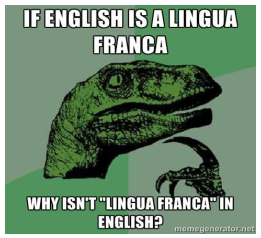
The term lingua franca was first coined in the beginning of the 17th century by the Italians. At that time, it represented a conglomeration of mostly Italian, with a smattering of French, Portuguese, Spanish, Turkish, Greek, and Arabic, and was used primarily as the language of commerce. The term literally means “Frankish language”, as “Frank” was a common designation for all western Europeans since approximately the 12th century.
Today, English is a common lingua franca across the globe. According to some estimates, almost 80 percent of English speakers in the world are non-native speakers. Below you will find more information about a phenomenon that bears on language, culture, commerce, and diplomacy.
Where is it used?
Apart from serving as a useful heuristic in Europe, where a Spaniard, a Frenchmen, and a German might all carry on a conversation in English, English as a lingua franca (ELF) plays an important role in former Anglophone colonies such as India, Pakistan, Nigeria, Uganda, and Zimbabwe, among many others.
How is it used?
ELF differs from Standard English in a number of ways. Several documented overarching similarities are variances in article usage (or no article usage at all), variances in preposition usage, and novel use of morphemes (such as importancy and smoothfully). Many instances of ELF also incorporate across-the-board third-person singular usage (such as “He go to the store.”), using “who” and “which” interchangeably, and a lack of gerunds. Verbally, noted differences include the omission of some consonants and addition of extra vowels, as well as a general tendency towards efficient communication over grammatically normative English.
Criticisms
While ELF is a widespread and useful mode of communication for many, some scholars and linguists have criticized its proliferation as a form of linguistic imperialism. This term became popular in 1992 with the publication of Robert Phillipson’s influential book of the same name. In it, Phillipson argues that English has long been a tool of submission and cultural domination of colonies. Contemporary critics of ELF cite the problems associated with studying a language in a disorganized, unstructured way. Speakers of ELF may eventually speak both their native language and English imperfectly, leading to issues with effective communication. In spite of these criticisms, ELF continues to flourish in many countries, oftentimes enriching the language with colorful aphorisms and unique turns of phrase.
(Disponível em https://www.altalang.com/beyond-words/how-is-english-used-as-a-lingua-franca-today/)
Provas
Texto 03
How is English Used as a Lingua Franca Today?
By Maria Khodorkovsky on August 19, 2013
The term lingua franca was first coined in the beginning of the 17th century by the Italians. At that time, it represented a conglomeration of mostly Italian, with a smattering of French, Portuguese, Spanish, Turkish, Greek, and Arabic, and was used primarily as the language of commerce. The term literally means “Frankish language”, as “Frank” was a common designation for all western Europeans since approximately the 12th century.
Today, English is a common lingua franca across the globe. According to some estimates, almost 80 percent of English speakers in the world are non-native speakers. Below you will find more information about a phenomenon that bears on language, culture, commerce, and diplomacy.
Where is it used?
Apart from serving as a useful heuristic in Europe, where a Spaniard, a Frenchmen, and a German might all carry on a conversation in English, English as a lingua franca (ELF) plays an important role in former Anglophone colonies such as India, Pakistan, Nigeria, Uganda, and Zimbabwe, among many others.
How is it used?
ELF differs from Standard English in a number of ways. Several documented overarching similarities are variances in article usage (or no article usage at all), variances in preposition usage, and novel use of morphemes (such as importancy and smoothfully). Many instances of ELF also incorporate across-the-board third-person singular usage (such as “He go to the store.”), using “who” and “which” interchangeably, and a lack of gerunds. Verbally, noted differences include the omission of some consonants and addition of extra vowels, as well as a general tendency towards efficient communication over grammatically normative English.
Criticisms
While ELF is a widespread and useful mode of communication for many, some scholars and linguists have criticized its proliferation as a form of linguistic imperialism. This term became popular in 1992 with the publication of Robert Phillipson’s influential book of the same name. In it, Phillipson argues that English has long been a tool of submission and cultural domination of colonies. Contemporary critics of ELF cite the problems associated with studying a language in a disorganized, unstructured way. Speakers of ELF may eventually speak both their native language and English imperfectly, leading to issues with effective communication. In spite of these criticisms, ELF continues to flourish in many countries, oftentimes enriching the language with colorful aphorisms and unique turns of phrase.
(Disponível em https://www.altalang.com/beyond-words/how-is-english-used-as-a-lingua-franca-today/)
Provas
- Gramática - Língua InglesaSubstantivos e compostos | Nouns and compoundsSubstantivos contáveis e incontáveis | Countable and uncountable
Texto 03
How is English Used as a Lingua Franca Today?
By Maria Khodorkovsky on August 19, 2013
The term lingua franca was first coined in the beginning of the 17th century by the Italians. At that time, it represented a conglomeration of mostly Italian, with a smattering of French, Portuguese, Spanish, Turkish, Greek, and Arabic, and was used primarily as the language of commerce. The term literally means “Frankish language”, as “Frank” was a common designation for all western Europeans since approximately the 12th century.
Today, English is a common lingua franca across the globe. According to some estimates, almost 80 percent of English speakers in the world are non-native speakers. Below you will find more information about a phenomenon that bears on language, culture, commerce, and diplomacy.
Where is it used?
Apart from serving as a useful heuristic in Europe, where a Spaniard, a Frenchmen, and a German might all carry on a conversation in English, English as a lingua franca (ELF) plays an important role in former Anglophone colonies such as India, Pakistan, Nigeria, Uganda, and Zimbabwe, among many others.
How is it used?
ELF differs from Standard English in a number of ways. Several documented overarching similarities are variances in article usage (or no article usage at all), variances in preposition usage, and novel use of morphemes (such as importancy and smoothfully). Many instances of ELF also incorporate across-the-board third-person singular usage (such as “He go to the store.”), using “who” and “which” interchangeably, and a lack of gerunds. Verbally, noted differences include the omission of some consonants and addition of extra vowels, as well as a general tendency towards efficient communication over grammatically normative English.
Criticisms
While ELF is a widespread and useful mode of communication for many, some scholars and linguists have criticized its proliferation as a form of linguistic imperialism. This term became popular in 1992 with the publication of Robert Phillipson’s influential book of the same name. In it, Phillipson argues that English has long been a tool of submission and cultural domination of colonies. Contemporary critics of ELF cite the problems associated with studying a language in a disorganized, unstructured way. Speakers of ELF may eventually speak both their native language and English imperfectly, leading to issues with effective communication. In spite of these criticisms, ELF continues to flourish in many countries, oftentimes enriching the language with colorful aphorisms and unique turns of phrase.
(Disponível em https://www.altalang.com/beyond-words/how-is-english-used-as-a-lingua-franca-today/)
Provas
Texto 03
How is English Used as a Lingua Franca Today?
By Maria Khodorkovsky on August 19, 2013
The term lingua franca was first coined in the beginning of the 17th century by the Italians. At that time, it represented a conglomeration of mostly Italian, with a smattering of French, Portuguese, Spanish, Turkish, Greek, and Arabic, and was used primarily as the language of commerce. The term literally means “Frankish language”, as “Frank” was a common designation for all western Europeans since approximately the 12th century.
Today, English is a common lingua franca across the globe. According to some estimates, almost 80 percent of English speakers in the world are non-native speakers. Below you will find more information about a phenomenon that bears on language, culture, commerce, and diplomacy.
Where is it used?
Apart from serving as a useful heuristic in Europe, where a Spaniard, a Frenchmen, and a German might all carry on a conversation in English, English as a lingua franca (ELF) plays an important role in former Anglophone colonies such as India, Pakistan, Nigeria, Uganda, and Zimbabwe, among many others.
How is it used?
ELF differs from Standard English in a number of ways. Several documented overarching similarities are variances in article usage (or no article usage at all), variances in preposition usage, and novel use of morphemes (such as importancy and smoothfully). Many instances of ELF also incorporate across-the-board third-person singular usage (such as “He go to the store.”), using “who” and “which” interchangeably, and a lack of gerunds. Verbally, noted differences include the omission of some consonants and addition of extra vowels, as well as a general tendency towards efficient communication over grammatically normative English.
Criticisms
While ELF is a widespread and useful mode of communication for many, some scholars and linguists have criticized its proliferation as a form of linguistic imperialism. This term became popular in 1992 with the publication of Robert Phillipson’s influential book of the same name. In it, Phillipson argues that English has long been a tool of submission and cultural domination of colonies. Contemporary critics of ELF cite the problems associated with studying a language in a disorganized, unstructured way. Speakers of ELF may eventually speak both their native language and English imperfectly, leading to issues with effective communication. In spite of these criticisms, ELF continues to flourish in many countries, oftentimes enriching the language with colorful aphorisms and unique turns of phrase.
(Disponível em https://www.altalang.com/beyond-words/how-is-english-used-as-a-lingua-franca-today/)
Provas
Texto 03
How is English Used as a Lingua Franca Today?
By Maria Khodorkovsky on August 19, 2013
The term lingua franca was first coined in the beginning of the 17th century by the Italians. At that time, it represented a conglomeration of mostly Italian, with a smattering of French, Portuguese, Spanish, Turkish, Greek, and Arabic, and was used primarily as the language of commerce. The term literally means “Frankish language”, as “Frank” was a common designation for all western Europeans since approximately the 12th century.
Today, English is a common lingua franca across the globe. According to some estimates, almost 80 percent of English speakers in the world are non-native speakers. Below you will find more information about a phenomenon that bears on language, culture, commerce, and diplomacy.
Where is it used?
Apart from serving as a useful heuristic in Europe, where a Spaniard, a Frenchmen, and a German might all carry on a conversation in English, English as a lingua franca (ELF) plays an important role in former Anglophone colonies such as India, Pakistan, Nigeria, Uganda, and Zimbabwe, among many others.
How is it used?
ELF differs from Standard English in a number of ways. Several documented overarching similarities are variances in article usage (or no article usage at all), variances in preposition usage, and novel use of morphemes (such as importancy and smoothfully). Many instances of ELF also incorporate across-the-board third-person singular usage (such as “He go to the store.”), using “who” and “which” interchangeably, and a lack of gerunds. Verbally, noted differences include the omission of some consonants and addition of extra vowels, as well as a general tendency towards efficient communication over grammatically normative English.
Criticisms
While ELF is a widespread and useful mode of communication for many, some scholars and linguists have criticized its proliferation as a form of linguistic imperialism. This term became popular in 1992 with the publication of Robert Phillipson’s influential book of the same name. In it, Phillipson argues that English has long been a tool of submission and cultural domination of colonies. Contemporary critics of ELF cite the problems associated with studying a language in a disorganized, unstructured way. Speakers of ELF may eventually speak both their native language and English imperfectly, leading to issues with effective communication. In spite of these criticisms, ELF continues to flourish in many countries, oftentimes enriching the language with colorful aphorisms and unique turns of phrase.
(Disponível em https://www.altalang.com/beyond-words/how-is-english-used-as-a-lingua-franca-today/)
Provas
Texto 03
How is English Used as a Lingua Franca Today?
By Maria Khodorkovsky on August 19, 2013
The term lingua franca was first coined in the beginning of the 17th century by the Italians. At that time, it represented a conglomeration of mostly Italian, with a smattering of French, Portuguese, Spanish, Turkish, Greek, and Arabic, and was used primarily as the language of commerce. The term literally means “Frankish language”, as “Frank” was a common designation for all western Europeans since approximately the 12th century.
Today, English is a common lingua franca across the globe. According to some estimates, almost 80 percent of English speakers in the world are non-native speakers. Below you will find more information about a phenomenon that bears on language, culture, commerce, and diplomacy.
Where is it used?
Apart from serving as a useful heuristic in Europe, where a Spaniard, a Frenchmen, and a German might all carry on a conversation in English, English as a lingua franca (ELF) plays an important role in former Anglophone colonies such as India, Pakistan, Nigeria, Uganda, and Zimbabwe, among many others.
How is it used?
ELF differs from Standard English in a number of ways. Several documented overarching similarities are variances in article usage (or no article usage at all), variances in preposition usage, and novel use of morphemes (such as importancy and smoothfully). Many instances of ELF also incorporate across-the-board third-person singular usage (such as “He go to the store.”), using “who” and “which” interchangeably, and a lack of gerunds. Verbally, noted differences include the omission of some consonants and addition of extra vowels, as well as a general tendency towards efficient communication over grammatically normative English.
Criticisms
While ELF is a widespread and useful mode of communication for many, some scholars and linguists have criticized its proliferation as a form of linguistic imperialism. This term became popular in 1992 with the publication of Robert Phillipson’s influential book of the same name. In it, Phillipson argues that English has long been a tool of submission and cultural domination of colonies. Contemporary critics of ELF cite the problems associated with studying a language in a disorganized, unstructured way. Speakers of ELF may eventually speak both their native language and English imperfectly, leading to issues with effective communication. In spite of these criticisms, ELF continues to flourish in many countries, oftentimes enriching the language with colorful aphorisms and unique turns of phrase.
(Disponível em https://www.altalang.com/beyond-words/how-is-english-used-as-a-lingua-franca-today/)
Provas
Provas
Provas
Provas
Caderno Container