Foram encontradas 80 questões.
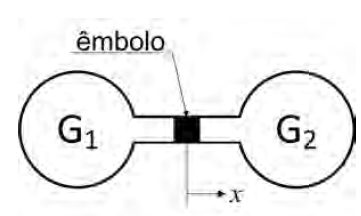
Dois gases perfeitos, G1 e G2, estão contidos em recipientes rígidos, separados por um êmbolo que se move sem atrito por um tubo longo de área de seção transversal \( S \), conforme a figura. Cada um dos gases possui volume inicial \( V \), a uma temperatura de 27 °C. Considere a seguinte transformação isobárica do conjunto: a temperatura de G1 aumenta 100 °C e a de G2 diminui 100 °C. A expressão que representa o deslocamento \( x \) do êmbolo até o novo ponto de equilíbrio é:
Provas

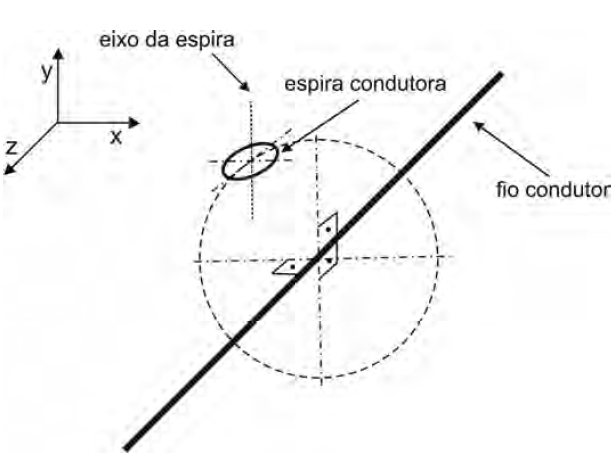
O sistema da figura é montado com o objetivo de determinar a resistência elétrica de uma espira condutora de área \( A \). O centro dessa espira descreve uma trajetória circular de raio \( R \) e período \( t \), à velocidade angular constante, ao redor de um fio também condutor com uma corrente elétrica contínua \( I \). A corrente elétrica na espira é medida e seu valor oscila harmonicamente entre \( +i \) e \( -i \).
Dados:
• área da espira: \( A=1 cm^2 \);
• raio da trajetória do centro da espira: \( R = 10 cm \);
• período da trajetória circular do centro da espira: \( t = 2 s \);
• corrente elétrica contínua do fio condutor: \( I = 50 A \);
• amplitude da corrente elétrica induzida medida na espira: \( i = 1 mA \);
• permeabilidade magnética no vácuo: = \( \mu = 4\pi.10^{-7} T.m/A \).
Observações:
• o sistema segue a orientação dos eixos \( xyz \) desenhados na figura;
• o fio condutor é paralelo ao eixo \( z \);
• o eixo da espira está sempre paralelo ao eixo \( y \);
• o plano da espira é sempre paralelo ao plano \( xz \);
• o plano da trajetória do centro da espira é paralelo ao plano \( xy \);
• considere que as linhas de campo magnético que atravessam a espira estejam paralelas;
• para toda frequência \( f \), considere \( \dfrac{\Delta sen (2\pi ft)}{\Delta t} = 2\pi f cos(2\pi ft) \).
A resistência da espira, em \( \mu \Omega \), é:
Provas
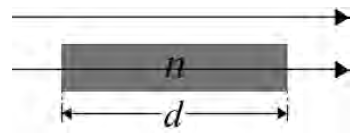
A figura mostra dois raios paralelos de luz que viajam em fase no vácuo até que um deles encontra uma película.
Dados:
• espessura da película: d;
• índice de refração da película: n;
• frequência dos raios de luz: f;
• velocidade da luz no vácuo: c.
Observação:
• a medida de diferença de fase entre os raios tem como referência um plano ortogonal a eles.
A condição necessária e suficiente para que os raios continuem viajando em fase após o raio de baixo deixar a película é:
Provas

Um recipiente vazio de formato cônico está parcialmente imerso na água e em equilíbrio, como geometria apresentada na figura. Insere-se no interior do recipiente uma partícula de massa \( m = K \rho \pi h^3 \), onde \( K \) é uma constante, \( \rho \) é a massa específica da água e \( h \) está indicado na figura. Após essa inserção, o recipiente sofre um pequeno deslocamento, afundando uma altura \( \Delta h \).
Dado:
• aceleração da gravidade: \( g \).
Observações:
• a espessura do recipiente é muito pequena;
• \( \Delta h << h \);
• para \( |\alpha| << 1, (1+ \alpha)^n \approx 1 + n \alpha \).
A altura \( \Delta h \) que o recipiente irá afundar até o novo ponto de equilíbrio é:
Provas
Um projétil de chumbo está a uma temperatura de 175 °C quando atinge uma parede e nela se aloja. Considere que 25% da energia cinética do projétil imediatamente antes da colisão permaneça nele como energia interna.
Dados:
• calor específico do chumbo: 125 J/(kg.°C);
• temperatura de fusão do chumbo: 327 °C;
• calor latente de fusão do chumbo: 26.000 J/kg.
Se a energia interna que permanece após o projétil atingir a parede é justamente a mínima para que ocorra a fusão total do chumbo, a velocidade do projétil imediatamente antes da colisão, em m/s, é:
Provas
Text 2
The climate is changing — the thing is, it isn’t just due to humans
By Tonya T. Neaves
Natural forces beyond 1 human control are also gradually affecting our climate. These geophysical forces are vital to understanding global warming. Man is indeed responsible for a large portion — possibly even a majority — of global warming. But also in play are complex gravitational interactions, including changes in the Earth’s orbit, axial tilt and torque. This fact needs to be included in the public debate. Because these gravitational shifts, occurring over millennia, can influence climate patterns and ultimately lead to noticeable variations in seasons. Interestingly, research suggests climate change can alter the tilt of the Earth, but an unrelated change in tilt can also further change the climate. It is a balance-counterbalance relationship. Changes in seasons can also affect other types of storms, including severe winter snowstorms and tornadoes. The variations in the Earth’s orbit are known as the Milankovitch cycles — after the Serbian geophysicist Milutin Milankovi´c, who hypothesized this phenomenon in the 1920s. He discovered that variations in the Earth’s path around the Sun, axial tilt and torque could together affect our climate. Even a slight change or orientation in the precession of the Earth’s rotating body can cause a wobbling effect shifting torque in different areas since the planet is not a perfect sphere to some people’s surprise. Now would seem a particularly apt time to act. The 2017 Atlantic hurricane season was an intense, record-setting period. With several landfall hurricanes barreling their way through the Caribbean and Gulf of Mexico, devastating parts of the Leeward Islands and United States. Still, even President Donald J. Trump has implied the whole of idea climate change may just be a hoax. Most Republicans seem to agree that it is not a serious problem. Meanwhile, while some Democrats have tried to use the frequency and intensity of storms in the hopes of highlighting the climate change conversation, even this effort has seemed muted. The heightened culture of disaster only feeds our attention on political banter and ideological semantics with no room for informed decision-making. Though climate change is inevitable, we also need to have a healthy appreciation of the fact that climate shifts aren’t just limited to rapidly changing weather patterns. Turning the corner into unexplored territory is always difficult. By having a broader sense of communal resiliency — social, political and economic standing — we can manage this unavoidable pendulum of climate extremes.
Adapted from: THINK - Opinion, Analysis, Essays in: https://www.nbcnews.com/think/opinion/climate-changingnot- just-because-humans-here-s-why-matters-ncna824271 [Accessed on March 10th, 2023
Text 3
Climate of conspiracy: A meta-analysis of the consequences of belief in conspiracy theories about climate change
By Mikey Biddlestone, Flavio Azevedo, Sander van der Linden
Despite widespread scientific consensus on climate change, conspiracy theories about its causes and consequences are flourishing. In response, psychological research has started to investigate the consequences of espousing conspiracy beliefs about climate change. Although some scholars maintain that the evidence for a causal link between belief in conspiracy theories and behavior remains elusive, others have argued that climate change conspiracy theories undermine pro-climate action. Overall, we find clear evidence that climate conspiracy beliefs have moderate-to-large negative correlations with not only acceptance of (climate) science, trust, and pro-environmental concern, but also with behavioural intentions and policy support. Most of these effects were not moderated by design (experimental vs. correlational), political ideology, or prior conspiracy beliefs. After a meta-analysis we find clear evidence that climate change conspiracy beliefs correlate with a host of concerning societal outcomes, including lower acceptance of (climate) science, distrust, lower concern for the environment, and also lower intentions to take action and support pro-environmental policies. An important open question concerns the direction of causality. Although it is possible—and perhaps likely—that people who are skeptical of climate change are more likely to endorse conspiracy theories about global warming, we can also expect that people who are exposed to climate change conspiracy theories become more skeptical and are less likely to take pro-environmental action. In one of the included experiments, people were less likely to sign a petition to counter climate change following exposure to a conspiracy theory about global warming. At the same time, we note that the number of experiments included in the analysis was unbalanced and relatively low compared to the number of correlational designs, which is likely a reflection of the larger literature: most studies do not provide an experimental test of whether exposure to conspiracy theories causes people to disengage from science and politics. Interestingly, our moderation analyses generally did not find that the observed effect sizes were impacted by study design, with the exception of pro-environmental policy-support. Moreover, although publication bias was present in many cases—which is somewhat expected considering our exclusion of the grey literature—the bias-corrected meta-analytic effect sizes were similar to those obtained in the main analyses. Nonetheless, given the fact that only a few experimental studies were available for each outcome variable, we feel that it is premature to make any firm conclusions about the overall absence of moderation effects based on study design. In fact, it is interesting that in the case of policy support, data from the only experimental study did not corrobate the correlational evidence. In all likelihood, both causal pathways are possible and potentially mutually reinforcing so that people with skeptical prior attitudes might seek out conspiracy theories about climate change, whilst those exposed to conspiracy theories also become more skeptical about the issue. Consistent with long30 standing political polarization on the issue of climate change at both elite and mass publics levels—at least in the United States—a large body of work has supported an asymmetrical relationship, such that the endorsement of climate change conspiracy theories appears stronger on the political right. Although conservative ideology itself had a strong positive meta-analytic correlation with belief in climate conspiracies (r = 0.45), it is interesting to note that the effect sizes were not reliably moderated by political orientation for any of the outcome measures. Similarly, we do not find evidence of reliable moderation effects for prior conspiracy beliefs. In addition, contrary to evidence which suggests that climate denial is uniquely prevalent in the United States, the effect-sizes were not moderated by country in our meta-analysis. However, we note that the overwhelming majority of studies (86%) and participants (96%) were US-based.
Although some interventions—such as highlighting scientific consensus and psychological inoculation —have shown promise in combatting conspiracy beliefs, considering that in many countries almost a third of the population endorses the belief that climate change is hoax, future research should urgently evaluate how to counter public belief in climate change conspiracy theories. We note, in many cases, the need to gather more data (from non-WEIRD samples), and the presence of publication bias and effect size heterogeneity.
Adapted from: Climate of conspiracy: A meta-analysis of the consequences of belief in conspiracy theories about climate change in: https://www.sciencedirect.com/science/article/pii/S2352250X22001099 [Accessed on March 10th, 2023].
Which of the following issues is not discussed on Texts 2 and 3?
Provas
Text 2
The climate is changing — the thing is, it isn’t just due to humans
By Tonya T. Neaves
Natural forces beyond 1 human control are also gradually affecting our climate. These geophysical forces are vital to understanding global warming. Man is indeed responsible for a large portion — possibly even a majority — of global warming. But also in play are complex gravitational interactions, including changes in the Earth’s orbit, axial tilt and torque. This fact needs to be included in the public debate. Because these gravitational shifts, occurring over millennia, can influence climate patterns and ultimately lead to noticeable variations in seasons. Interestingly, research suggests climate change can alter the tilt of the Earth, but an unrelated change in tilt can also further change the climate. It is a balance-counterbalance relationship. Changes in seasons can also affect other types of storms, including severe winter snowstorms and tornadoes. The variations in the Earth’s orbit are known as the Milankovitch cycles — after the Serbian geophysicist Milutin Milankovi´c, who hypothesized this phenomenon in the 1920s. He discovered that variations in the Earth’s path around the Sun, axial tilt and torque could together affect our climate. Even a slight change or orientation in the precession of the Earth’s rotating body can cause a wobbling effect shifting torque in different areas since the planet is not a perfect sphere to some people’s surprise. Now would seem a particularly apt time to act. The 2017 Atlantic hurricane season was an intense, record-setting period. With several landfall hurricanes barreling their way through the Caribbean and Gulf of Mexico, devastating parts of the Leeward Islands and United States. Still, even President Donald J. Trump has implied the whole of idea climate change may just be a hoax. Most Republicans seem to agree that it is not a serious problem. Meanwhile, while some Democrats have tried to use the frequency and intensity of storms in the hopes of highlighting the climate change conversation, even this effort has seemed muted. The heightened culture of disaster only feeds our attention on political banter and ideological semantics with no room for informed decision-making. Though climate change is inevitable, we also need to have a healthy appreciation of the fact that climate shifts aren’t just limited to rapidly changing weather patterns. Turning the corner into unexplored territory is always difficult. By having a broader sense of communal resiliency — social, political and economic standing — we can manage this unavoidable pendulum of climate extremes.
Adapted from: THINK - Opinion, Analysis, Essays in: https://www.nbcnews.com/think/opinion/climate-changingnot- just-because-humans-here-s-why-matters-ncna824271 [Accessed on March 10th, 2023].
Based on the tone of Text 2, which of the following options best describes the author’s attitude towards global warming?
Provas
Text 2
The climate is changing — the thing is, it isn’t just due to humans
By Tonya T. Neaves
Natural forces beyond 1 human control are also gradually affecting our climate. These geophysical forces are vital to understanding global warming. Man is indeed responsible for a large portion — possibly even a majority — of global warming. But also in play are complex gravitational interactions, including changes in the Earth’s orbit, axial tilt and torque. This fact needs to be included in the public debate. Because these gravitational shifts, occurring over millennia, can influence climate patterns and ultimately lead to noticeable variations in seasons. Interestingly, research suggests climate change can alter the tilt of the Earth, but an unrelated change in tilt can also further change the climate. It is a balance-counterbalance relationship. Changes in seasons can also affect other types of storms, including severe winter snowstorms and tornadoes. The variations in the Earth’s orbit are known as the Milankovitch cycles — after the Serbian geophysicist Milutin Milankovi´c, who hypothesized this phenomenon in the 1920s. He discovered that variations in the Earth’s path around the Sun, axial tilt and torque could together affect our climate. Even a slight change or orientation in the precession of the Earth’s rotating body can cause a wobbling effect shifting torque in different areas since the planet is not a perfect sphere to some people’s surprise. Now would seem a particularly apt time to act. The 2017 Atlantic hurricane season was an intense, record-setting period. With several landfall hurricanes barreling their way through the Caribbean and Gulf of Mexico, devastating parts of the Leeward Islands and United States. Still, even President Donald J. Trump has implied the whole of idea climate change may just be a hoax. Most Republicans seem to agree that it is not a serious problem. Meanwhile, while some Democrats have tried to use the frequency and intensity of storms in the hopes of highlighting the climate change conversation, even this effort has seemed muted. The heightened culture of disaster only feeds our attention on political banter and ideological semantics with no room for informed decision-making. Though climate change is inevitable, we also need to have a healthy appreciation of the fact that climate shifts aren’t just limited to rapidly changing weather patterns. Turning the corner into unexplored territory is always difficult. By having a broader sense of communal resiliency — social, political and economic standing — we can manage this unavoidable pendulum of climate extremes.
Adapted from: THINK - Opinion, Analysis, Essays in: https://www.nbcnews.com/think/opinion/climate-changingnot- just-because-humans-here-s-why-matters-ncna824271 [Accessed on March 10th, 2023].
Choose the option that best represents the meaning of the underlined word in the sentece below:
“Even a slight change or orientation in the precession of the Earth’s rotating body can cause a wobbling effect shifting torque in different areas since the planet is not a perfect sphere to some people’s surprise.”
Provas
Text 2
The climate is changing — the thing is, it isn’t just due to humans
By Tonya T. Neaves
Natural forces beyond 1 human control are also gradually affecting our climate. These geophysical forces are vital to understanding global warming. Man is indeed responsible for a large portion — possibly even a majority — of global warming. But also in play are complex gravitational interactions, including changes in the Earth’s orbit, axial tilt and torque. This fact needs to be included in the public debate. Because these gravitational shifts, occurring over millennia, can influence climate patterns and ultimately lead to noticeable variations in seasons. Interestingly, research suggests climate change can alter the tilt of the Earth, but an unrelated change in tilt can also further change the climate. It is a balance-counterbalance relationship. Changes in seasons can also affect other types of storms, including severe winter snowstorms and tornadoes. The variations in the Earth’s orbit are known as the Milankovitch cycles — after the Serbian geophysicist Milutin Milankovi´c, who hypothesized this phenomenon in the 1920s. He discovered that variations in the Earth’s path around the Sun, axial tilt and torque could together affect our climate. Even a slight change or orientation in the precession of the Earth’s rotating body can cause a wobbling effect shifting torque in different areas since the planet is not a perfect sphere to some people’s surprise. Now would seem a particularly apt time to act. The 2017 Atlantic hurricane season was an intense, record-setting period. With several landfall hurricanes barreling their way through the Caribbean and Gulf of Mexico, devastating parts of the Leeward Islands and United States. Still, even President Donald J. Trump has implied the whole of idea climate change may just be a hoax. Most Republicans seem to agree that it is not a serious problem. Meanwhile, while some Democrats have tried to use the frequency and intensity of storms in the hopes of highlighting the climate change conversation, even this effort has seemed muted. The heightened culture of disaster only feeds our attention on political banter and ideological semantics with no room for informed decision-making. Though climate change is inevitable, we also need to have a healthy appreciation of the fact that climate shifts aren’t just limited to rapidly changing weather patterns. Turning the corner into unexplored territory is always difficult. By having a broader sense of communal resiliency — social, political and economic standing — we can manage this unavoidable pendulum of climate extremes.
Adapted from: THINK - Opinion, Analysis, Essays in: https://www.nbcnews.com/think/opinion/climate-changingnot- just-because-humans-here-s-why-matters-ncna824271 [Accessed on March 10th, 2023].
The “Milankovitch cycles” are:
Provas
Text 2
The climate is changing — the thing is, it isn’t just due to humans
By Tonya T. Neaves
Natural forces beyond 1 human control are also gradually affecting our climate. These geophysical forces are vital to understanding global warming. Man is indeed responsible for a large portion — possibly even a majority — of global warming. But also in play are complex gravitational interactions, including changes in the Earth’s orbit, axial tilt and torque. This fact needs to be included in the public debate. Because these gravitational shifts, occurring over millennia, can influence climate patterns and ultimately lead to noticeable variations in seasons. Interestingly, research suggests climate change can alter the tilt of the Earth, but an unrelated change in tilt can also further change the climate. It is a balance-counterbalance relationship. Changes in seasons can also affect other types of storms, including severe winter snowstorms and tornadoes. The variations in the Earth’s orbit are known as the Milankovitch cycles — after the Serbian geophysicist Milutin Milankovi´c, who hypothesized this phenomenon in the 1920s. He discovered that variations in the Earth’s path around the Sun, axial tilt and torque could together affect our climate. Even a slight change or orientation in the precession of the Earth’s rotating body can cause a wobbling effect shifting torque in different areas since the planet is not a perfect sphere to some people’s surprise. Now would seem a particularly apt time to act. The 2017 Atlantic hurricane season was an intense, record-setting period. With several landfall hurricanes barreling their way through the Caribbean and Gulf of Mexico, devastating parts of the Leeward Islands and United States. Still, even President Donald J. Trump has implied the whole of idea climate change may just be a hoax. Most Republicans seem to agree that it is not a serious problem. Meanwhile, while some Democrats have tried to use the frequency and intensity of storms in the hopes of highlighting the climate change conversation, even this effort has seemed muted. The heightened culture of disaster only feeds our attention on political banter and ideological semantics with no room for informed decision-making. Though climate change is inevitable, we also need to have a healthy appreciation of the fact that climate shifts aren’t just limited to rapidly changing weather patterns. Turning the corner into unexplored territory is always difficult. By having a broader sense of communal resiliency — social, political and economic standing — we can manage this unavoidable pendulum of climate extremes.
Adapted from: THINK - Opinion, Analysis, Essays in: https://www.nbcnews.com/think/opinion/climate-changingnot- just-because-humans-here-s-why-matters-ncna824271 [Accessed on March 10th, 2023].
A balance - counterbalance relationship refers to:
Provas
Caderno Container