Foram encontradas 50 questões.
Um catalisador é toda e qualquer substância que aumenta a velocidade de uma reação através da diminuição da energia de ativação. Isto ocorre porque o catalisador normalmente fornece um caminho reacional (mecanismo catalítico) diferente daquele da reação sem o catalisador. É importante salientar que um catalisador participa da reação, mas não é consumido por ela, ou seja, ele é completamente restituído ao fim da reação. A utilização de catalisadores em processos industriais é de extrema importância, pois promove a viabilidade de diversas reações em escala industrial, que não seriam economicamente viáveis sem a sua utilização. Analise o esquema reacional, em 3 etapas e em presença de catalisador, a seguir.
XP + Y → YP + X etapa 1
YP + Z → YZ + P etapa 2
YZ + X → YX + Z etapa 3
Assinale a substância que está agindo como catalisador.
Provas

A molécula orgânica contém diversas funções químicas. Assinale as funções orgânicas da estrutura apresentada.
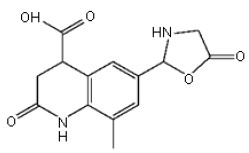
Provas
O ácido acetilsalicílico (AAS) é um fármaco anti-inflamatório não esteroide, utilizado contra inflamação, febre e dor. Em estado puro é um pó cristalino branco. O medicamento mais famoso do AAS é a aspirina, nome comercial registrado e de propriedade do laboratório farmacêutico Bayer que, em 1999, completou 100 anos. A reação de ionização da aspirina em água, mostrada a seguir, apresenta constante de ionização ácida (Ka) igual a 3,23 x 10⁻⁴.
HC9H7O4(aq) + H2O(l) → C9H7O4 –(aq) + H3O+(aq)
Se dois comprimidos de aspirina, contendo 0,125 g de ácido acetilsalicílico, são dissolvidos completamente em um copo de água (450 mL), qual será o pH da solução? (Considere massa molar: AAS = 180,14 g/mol.)
Provas
A cromatografia gasosa é um método físico de separação, cujos componentes voláteis a serem separados são distribuídos entre duas fases: estacionária (sólida ou líquida) e móvel (gás). Essa técnica pode ser utilizada como um potente método de análise química que, dependendo do instrumental utilizado, consegue detectar quantidade de substâncias na ordem de ppm (parte por milhão) ou ppb (parte por bilhão). Acerca da cromatografia gasosa, assinale a afirmativa INCORRETA.
Provas
O nitrito de amônio é um sal inorgânico que pode ser utilizado em fertilizantes, alguns herbicidas e inseticidas, na fabricação de óxido nitroso, além de propelentes sólidos para foguetes e explosivos. O nitrito de amônio (NH4NO2) se decompõe conforme a equação: NH4NO2(s) → N2(g) + 2H2O(l). Sabe-se que um frasco contém 500 g de nitrito de amônio, cujo rótulo informa que o sal possui 90% de pureza. Quando todo nitrito do frasco for decomposto, conforme a reação, a massa de H2O e o volume nas CNTP de N2 produzidos serão, respectivamente,
(Considere: R = 0,082 L.atm/mol.K; massas atômicas (g/mol): N = 14,01; O = 16,00; H = 1,01.)
Provas
Science and the olympics: technology's increasing role in the games
People used to rarely associate science with sports, but increased engineering research and investment in technology by professional sporting organizations have merged the two industries, especially in the 2012 London Olympics.
Scientists and engineers played a significant role in shaping the Great Britain Olympic team, according to BBC News. Though the partnership between sports and science has been a relatively new development, the impact of it can be seen across a number of different events.
Mobile technology, smartphones and tablet computers are found in droves at the London Olympics, as coaches, players and country officials can be seen using these devices to gauge and improve their performance.
According to the news outlet, the ease with which these devices can be integrated into sports has been surprising, but the results are hard to ignore.
(http://why.knovel.com/all-engineering-news/1752-science-and-the-olympics-technologys-increasing-role-in-the-games.html – Com adaptações.)
The conjunction highlighted in “Though the partnership between sports and science has been a relatively new development…” could be replaced, without change of meaning, by
Provas
Science and the olympics: technology's increasing role in the games
People used to rarely associate science with sports, but increased engineering research and investment in technology by professional sporting organizations have merged the two industries, especially in the 2012 London Olympics.
Scientists and engineers played a significant role in shaping the Great Britain Olympic team, according to BBC News. Though the partnership between sports and science has been a relatively new development, the impact of it can be seen across a number of different events.
Mobile technology, smartphones and tablet computers are found in droves at the London Olympics, as coaches, players and country officials can be seen using these devices to gauge and improve their performance.
According to the news outlet, the ease with which these devices can be integrated into sports has been surprising, but the results are hard to ignore.
(http://why.knovel.com/all-engineering-news/1752-science-and-the-olympics-technologys-increasing-role-in-the-games.html – Com adaptações.)
The passive voice in “Mobile technology, smartphones and tablet computers are found in droves at the London Olympics” in the active voice is
Provas
Science and the olympics: technology's increasing role in the games
People used to rarely associate science with sports, but increased engineering research and investment in technology by professional sporting organizations have merged the two industries, especially in the 2012 London Olympics.
Scientists and engineers played a significant role in shaping the Great Britain Olympic team, according to BBC News. Though the partnership between sports and science has been a relatively new development, the impact of it can be seen across a number of different events.
Mobile technology, smartphones and tablet computers are found in droves at the London Olympics, as coaches, players and country officials can be seen using these devices to gauge and improve their performance.
According to the news outlet, the ease with which these devices can be integrated into sports has been surprising, but the results are hard to ignore.
(http://why.knovel.com/all-engineering-news/1752-science-and-the-olympics-technologys-increasing-role-in-the-games.html – Com adaptações.)
The main idea of the first paragraph is that
Provas
Mechanical engineers develop an “intelligent co-pilot” for cars
Semiautonomous system takes the wheel to keep drivers safe.
Jennifer Chu, MIT News Office
July 13, 2012
Barrels and cones dot an open field in Saline, Mich., forming an obstacle course for a modified vehicle. A driver remotely steers the vehicle through the course from a nearby location as a researcher looks on. Occasionally, the researcher instructs the driver to keep the wheel straight – a trajectory that appears to put the vehicle on a collision course with a barrel. Despite the driver’s actions, the vehicle steers itself around the obstacle, transitioning control back to the driver once the danger has passed.
The key to the maneuver is a new semiautonomous safety system developed by Sterling Anderson, a PhD student in MIT’s Department of Mechanical Engineering, and Karl Lagnemma, a principal research scientist in MIT’s Robotic Mobility Group.
The system uses an onboard camera and laser rangefinder to identify hazards in a vehicle’s environment. The team devised an algorithm to analyze the data and identify safe zones – avoiding, for example, barrels in a field, or other cars on a roadway. The system allows a driver to control the vehicle, only taking the wheel when the driver is about to exit a safe zone.
Anderson, who has been testing the system in Michigan since last September, describes it as an “intelligent co-pilot” that monitors a driver’s performance and makes behind-the-scenes adjustments to keep the vehicle from colliding with obstacles, or within a safe region of the environment, such as a lane or open area.
“The real innovation is enabling the car to share (control) with you,” Anderson says. “If you want to drive, it’ll just… make sure you don’t hit anything.”
The group presented details of the safety system recently at the Intelligent Vehicles Symposium in Spain.
(http://web.mit.edu/newsoffice/2012/mechanical-engineers-develop-intelligent-car-co-pilot-0713.html – Com adaptações.)
Mark the alternative that presents the correct relation between the fragment and the brackets.
I. “Anderson, who has been testing the system in Michigan since last September, describes it as an ‘intelligent copilot’ that monitors a driver’s performance…” (Anderson)
II. “… the researcher instructs the driver to keep the wheel straight – a trajectory that appears to put the vehicle on a collision course with a barrel.” (trajectory)
III. “Anderson, who has been testing the system in Michigan since last September, describes it as an ‘intelligent copilot’ that monitors a driver’s performance” (co-pilot)
Provas
Mechanical engineers develop an “intelligent co-pilot” for cars
Semiautonomous system takes the wheel to keep drivers safe.
Jennifer Chu, MIT News Office
July 13, 2012
Barrels and cones dot an open field in Saline, Mich., forming an obstacle course for a modified vehicle. A driver remotely steers the vehicle through the course from a nearby location as a researcher looks on. Occasionally, the researcher instructs the driver to keep the wheel straight – a trajectory that appears to put the vehicle on a collision course with a barrel. Despite the driver’s actions, the vehicle steers itself around the obstacle, transitioning control back to the driver once the danger has passed.
The key to the maneuver is a new semiautonomous safety system developed by Sterling Anderson, a PhD student in MIT’s Department of Mechanical Engineering, and Karl Lagnemma, a principal research scientist in MIT’s Robotic Mobility Group.
The system uses an onboard camera and laser rangefinder to identify hazards in a vehicle’s environment. The team devised an algorithm to analyze the data and identify safe zones – avoiding, for example, barrels in a field, or other cars on a roadway. The system allows a driver to control the vehicle, only taking the wheel when the driver is about to exit a safe zone.
Anderson, who has been testing the system in Michigan since last September, describes it as an “intelligent co-pilot” that monitors a driver’s performance and makes behind-the-scenes adjustments to keep the vehicle from colliding with obstacles, or within a safe region of the environment, such as a lane or open area.
“The real innovation is enabling the car to share (control) with you,” Anderson says. “If you want to drive, it’ll just… make sure you don’t hit anything.”
The group presented details of the safety system recently at the Intelligent Vehicles Symposium in Spain.
(http://web.mit.edu/newsoffice/2012/mechanical-engineers-develop-intelligent-car-co-pilot-0713.html – Com adaptações.)
Each verb tense presents verb aspects which reveal what we want to express about the point in time the action takes place. The highlighted verb tense in “The system uses an onboard camera and laser rangefinder…” expresses
Provas
Caderno Container