Foram encontradas 221 questões.
Considere as condições de equilíbrio de mercados em concorrência perfeita, de um lado, e, de outro, de mercados sujeitos ao monopólio. Considere, também, que, em ambas as condições, os produtores visem ao lucro (L), que resulta da maximização do excedente da receita total (RT) em relação ao custo total da produção (CT). Considere, ainda, que, ao maximizar o lucro, os produtores levem em consideração, entre outras variáveis, o preço (P), a quantidade produzida (Q), a receita marginal (RMg) e o custo marginal (CMg). Com base nessas considerações, julgue (C ou E) o item que se segue.
Em concorrência perfeita, o preço é igual à receita marginal, mas inferior ao custo marginal, ou seja, P = RMg < CMg.
Em concorrência perfeita, o preço é igual à receita marginal, mas inferior ao custo marginal, ou seja, P = RMg < CMg.
Provas
Questão presente nas seguintes provas

Considere uma pequena economia com as curvas, abaixo representadas, da oferta e da demanda internas de certo bem internacionalmente comercializado ao preço de R$ 14. Considere, ainda, que o governo cogite aplicar cada uma ou uma combinação das seguintes medidas de política comercial afetas ao bem: livre comércio, apoio ao produtor mediante subsídios à produção ou imposição de quota de importação ou de tarifa de importação.
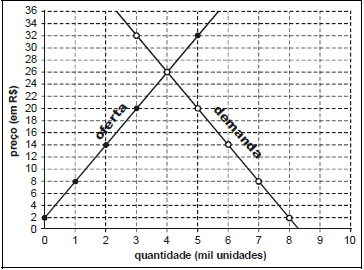
Com base nessas condições hipotéticas, julgue (C ou E) o item seguinte.
Caso o governo imponha apenas uma tarifa específica de importação, equivalente a R$ 6 por unidade importada, serão importadas 4 mil unidades, e o preço do bem em equilíbrio será de R$ 14.
Caso o governo imponha apenas uma tarifa específica de importação, equivalente a R$ 6 por unidade importada, serão importadas 4 mil unidades, e o preço do bem em equilíbrio será de R$ 14.
Provas
Questão presente nas seguintes provas
Considere uma pequena economia com as curvas, abaixo representadas, da oferta e da demanda internas de certo bem internacionalmente comercializado ao preço de R$ 14. Considere, ainda, que o governo cogite aplicar cada uma ou uma combinação das seguintes medidas de política comercial afetas ao bem: livre comércio, apoio ao produtor mediante subsídios à produção ou imposição de quota de importação ou de tarifa de importação.
Com base nessas condições hipotéticas, julgue (C ou E) o item seguinte.
Caso o governo imponha apenas uma quota de importação de 2 mil unidades do referido bem, a parte da demanda atendida pela oferta interna será superior, em mil unidades, à parte provida pela importação.
Caso o governo imponha apenas uma quota de importação de 2 mil unidades do referido bem, a parte da demanda atendida pela oferta interna será superior, em mil unidades, à parte provida pela importação.
Provas
Questão presente nas seguintes provas
Considere uma pequena economia com as curvas, abaixo representadas, da oferta e da demanda internas de certo bem internacionalmente comercializado ao preço de R$ 14. Considere, ainda, que o governo cogite aplicar cada uma ou uma combinação das seguintes medidas de política comercial afetas ao bem: livre comércio, apoio ao produtor mediante subsídios à produção ou imposição de quota de importação ou de tarifa de importação.
Com base nessas condições hipotéticas, julgue (C ou E) o item seguinte.
Em livre-comércio com o resto do mundo, sem qualquer intervenção do governo, o preço do bem em equilíbrio seria de R$ 26, e a demanda do bem, na referida economia, equivaleria a 4 mil unidades.
Em livre-comércio com o resto do mundo, sem qualquer intervenção do governo, o preço do bem em equilíbrio seria de R$ 26, e a demanda do bem, na referida economia, equivaleria a 4 mil unidades.
Provas
Questão presente nas seguintes provas
Text.
It's cold and early and Detlef Fendt repeats a morning ritual, heaving himself onto the side of his 28- year-old BMW motorbike and jumping with all his might on the kick-start. It takes a few goes, but eventually the bike roars into life. After all, this is the sort of solid reliable machine that makes German goods a household name for quality. It's that good name that means Germany is the world's top exporter. China may take the title soon, but for the moment Germany is still a world-beater.
Detlef is part of that success story. For the last years he's made machine tools for Daimler cars at the Berlin plant. He started work when he was 16 and is now the plant's main union representative for IG Metall. But this year, thanks to the world credit crunch, he'll be getting an unwanted seasonal break from his early morning ritual. The plant is closing down for an extra-long Christmas break, from mid-December to mid-January, because of falling orders.
He tells me: "At the moment we are in a distribution crisis — the automobile industry is not selling enough cars and lorries”.
Consumer confidence was dented in Germany long before the credit crunch, and despite his union's recent deal it is not returning.
Germany is now in recession and the figures have been worse than economists were predicting. Equally bad statistics for the whole of the European Union are expected today. While consumers in America feel cowed, while Asia is jittery, the rest of Europe watches fearfully as the biggest economy in Europe continues to shrink.
It's cold and early and Detlef Fendt repeats a morning ritual, heaving himself onto the side of his 28- year-old BMW motorbike and jumping with all his might on the kick-start. It takes a few goes, but eventually the bike roars into life. After all, this is the sort of solid reliable machine that makes German goods a household name for quality. It's that good name that means Germany is the world's top exporter. China may take the title soon, but for the moment Germany is still a world-beater.
Detlef is part of that success story. For the last years he's made machine tools for Daimler cars at the Berlin plant. He started work when he was 16 and is now the plant's main union representative for IG Metall. But this year, thanks to the world credit crunch, he'll be getting an unwanted seasonal break from his early morning ritual. The plant is closing down for an extra-long Christmas break, from mid-December to mid-January, because of falling orders.
He tells me: "At the moment we are in a distribution crisis — the automobile industry is not selling enough cars and lorries”.
Consumer confidence was dented in Germany long before the credit crunch, and despite his union's recent deal it is not returning.
Germany is now in recession and the figures have been worse than economists were predicting. Equally bad statistics for the whole of the European Union are expected today. While consumers in America feel cowed, while Asia is jittery, the rest of Europe watches fearfully as the biggest economy in Europe continues to shrink.
Mark Mardell. Germany loses revs. BBC World News. At: <www.bbc.co.uk> (adapted).
In context, “might” and “kick-start” are respectively
Provas
Questão presente nas seguintes provas
Text.
It's cold and early and Detlef Fendt repeats a morning ritual, heaving himself onto the side of his 28- year-old BMW motorbike and jumping with all his might on the kick-start. It takes a few goes, but eventually the bike roars into life. After all, this is the sort of solid reliable machine that makes German goods a household name for quality. It's that good name that means Germany is the world's top exporter. China may take the title soon, but for the moment Germany is still a world-beater.
Detlef is part of that success story. For the last years he's made machine tools for Daimler cars at the Berlin plant. He started work when he was 16 and is now the plant's main union representative for IG Metall. But this year, thanks to the world credit crunch, he'll be getting an unwanted seasonal break from his early morning ritual. The plant is closing down for an extra-long Christmas break, from mid-December to mid-January, because of falling orders.
He tells me: "At the moment we are in a distribution crisis — the automobile industry is not selling enough cars and lorries”.
Consumer confidence was dented in Germany long before the credit crunch, and despite his union's recent deal it is not returning.
Germany is now in recession and the figures have been worse than economists were predicting. Equally bad statistics for the whole of the European Union are expected today. While consumers in America feel cowed, while Asia is jittery, the rest of Europe watches fearfully as the biggest economy in Europe continues to shrink.
It's cold and early and Detlef Fendt repeats a morning ritual, heaving himself onto the side of his 28- year-old BMW motorbike and jumping with all his might on the kick-start. It takes a few goes, but eventually the bike roars into life. After all, this is the sort of solid reliable machine that makes German goods a household name for quality. It's that good name that means Germany is the world's top exporter. China may take the title soon, but for the moment Germany is still a world-beater.
Detlef is part of that success story. For the last years he's made machine tools for Daimler cars at the Berlin plant. He started work when he was 16 and is now the plant's main union representative for IG Metall. But this year, thanks to the world credit crunch, he'll be getting an unwanted seasonal break from his early morning ritual. The plant is closing down for an extra-long Christmas break, from mid-December to mid-January, because of falling orders.
He tells me: "At the moment we are in a distribution crisis — the automobile industry is not selling enough cars and lorries”.
Consumer confidence was dented in Germany long before the credit crunch, and despite his union's recent deal it is not returning.
Germany is now in recession and the figures have been worse than economists were predicting. Equally bad statistics for the whole of the European Union are expected today. While consumers in America feel cowed, while Asia is jittery, the rest of Europe watches fearfully as the biggest economy in Europe continues to shrink.
Mark Mardell. Germany loses revs. BBC World News. At: <www.bbc.co.uk> (adapted).
In the phrase “consumers in America feel cowed, while Asia is jittery”, the most appropriate synonyms for “cowed” and “jittery” are respectively
Provas
Questão presente nas seguintes provas
Text.
It's cold and early and Detlef Fendt repeats a morning ritual, heaving himself onto the side of his 28- year-old BMW motorbike and jumping with all his might on the kick-start. It takes a few goes, but eventually the bike roars into life. After all, this is the sort of solid reliable machine that makes German goods a household name for quality. It's that good name that means Germany is the world's top exporter. China may take the title soon, but for the moment Germany is still a world-beater.
Detlef is part of that success story. For the last years he's made machine tools for Daimler cars at the Berlin plant. He started work when he was 16 and is now the plant's main union representative for IG Metall. But this year, thanks to the world credit crunch, he'll be getting an unwanted seasonal break from his early morning ritual. The plant is closing down for an extra-long Christmas break, from mid-December to mid-January, because of falling orders.
He tells me: "At the moment we are in a distribution crisis — the automobile industry is not selling enough cars and lorries”.
Consumer confidence was dented in Germany long before the credit crunch, and despite his union's recent deal it is not returning.
Germany is now in recession and the figures have been worse than economists were predicting. Equally bad statistics for the whole of the European Union are expected today. While consumers in America feel cowed, while Asia is jittery, the rest of Europe watches fearfully as the biggest economy in Europe continues to shrink.
It's cold and early and Detlef Fendt repeats a morning ritual, heaving himself onto the side of his 28- year-old BMW motorbike and jumping with all his might on the kick-start. It takes a few goes, but eventually the bike roars into life. After all, this is the sort of solid reliable machine that makes German goods a household name for quality. It's that good name that means Germany is the world's top exporter. China may take the title soon, but for the moment Germany is still a world-beater.
Detlef is part of that success story. For the last years he's made machine tools for Daimler cars at the Berlin plant. He started work when he was 16 and is now the plant's main union representative for IG Metall. But this year, thanks to the world credit crunch, he'll be getting an unwanted seasonal break from his early morning ritual. The plant is closing down for an extra-long Christmas break, from mid-December to mid-January, because of falling orders.
He tells me: "At the moment we are in a distribution crisis — the automobile industry is not selling enough cars and lorries”.
Consumer confidence was dented in Germany long before the credit crunch, and despite his union's recent deal it is not returning.
Germany is now in recession and the figures have been worse than economists were predicting. Equally bad statistics for the whole of the European Union are expected today. While consumers in America feel cowed, while Asia is jittery, the rest of Europe watches fearfully as the biggest economy in Europe continues to shrink.
Mark Mardell. Germany loses revs. BBC World News. At: <www.bbc.co.uk> (adapted).
Judge — right (C) or wrong (E) — the following item with reference to the text.
The word “dented” suggests an acute effect.
The word “dented” suggests an acute effect.
Provas
Questão presente nas seguintes provas
Text.
It's cold and early and Detlef Fendt repeats a morning ritual, heaving himself onto the side of his 28- year-old BMW motorbike and jumping with all his might on the kick-start. It takes a few goes, but eventually the bike roars into life. After all, this is the sort of solid reliable machine that makes German goods a household name for quality. It's that good name that means Germany is the world's top exporter. China may take the title soon, but for the moment Germany is still a world-beater.
Detlef is part of that success story. For the last years he's made machine tools for Daimler cars at the Berlin plant. He started work when he was 16 and is now the plant's main union representative for IG Metall. But this year, thanks to the world credit crunch, he'll be getting an unwanted seasonal break from his early morning ritual. The plant is closing down for an extra-long Christmas break, from mid-December to mid-January, because of falling orders.
He tells me: "At the moment we are in a distribution crisis — the automobile industry is not selling enough cars and lorries”.
Consumer confidence was dented in Germany long before the credit crunch, and despite his union's recent deal it is not returning.
Germany is now in recession and the figures have been worse than economists were predicting. Equally bad statistics for the whole of the European Union are expected today. While consumers in America feel cowed, while Asia is jittery, the rest of Europe watches fearfully as the biggest economy in Europe continues to shrink.
It's cold and early and Detlef Fendt repeats a morning ritual, heaving himself onto the side of his 28- year-old BMW motorbike and jumping with all his might on the kick-start. It takes a few goes, but eventually the bike roars into life. After all, this is the sort of solid reliable machine that makes German goods a household name for quality. It's that good name that means Germany is the world's top exporter. China may take the title soon, but for the moment Germany is still a world-beater.
Detlef is part of that success story. For the last years he's made machine tools for Daimler cars at the Berlin plant. He started work when he was 16 and is now the plant's main union representative for IG Metall. But this year, thanks to the world credit crunch, he'll be getting an unwanted seasonal break from his early morning ritual. The plant is closing down for an extra-long Christmas break, from mid-December to mid-January, because of falling orders.
He tells me: "At the moment we are in a distribution crisis — the automobile industry is not selling enough cars and lorries”.
Consumer confidence was dented in Germany long before the credit crunch, and despite his union's recent deal it is not returning.
Germany is now in recession and the figures have been worse than economists were predicting. Equally bad statistics for the whole of the European Union are expected today. While consumers in America feel cowed, while Asia is jittery, the rest of Europe watches fearfully as the biggest economy in Europe continues to shrink.
Mark Mardell. Germany loses revs. BBC World News. At: <www.bbc.co.uk> (adapted).
Judge — right (C) or wrong (E) — the following item with reference to the text.
The Berlin factory is closing temporarily owing to a slump in demand.
The Berlin factory is closing temporarily owing to a slump in demand.
Provas
Questão presente nas seguintes provas
Text.
It's cold and early and Detlef Fendt repeats a morning ritual, heaving himself onto the side of his 28- year-old BMW motorbike and jumping with all his might on the kick-start. It takes a few goes, but eventually the bike roars into life. After all, this is the sort of solid reliable machine that makes German goods a household name for quality. It's that good name that means Germany is the world's top exporter. China may take the title soon, but for the moment Germany is still a world-beater.
Detlef is part of that success story. For the last years he's made machine tools for Daimler cars at the Berlin plant. He started work when he was 16 and is now the plant's main union representative for IG Metall. But this year, thanks to the world credit crunch, he'll be getting an unwanted seasonal break from his early morning ritual. The plant is closing down for an extra-long Christmas break, from mid-December to mid-January, because of falling orders.
He tells me: "At the moment we are in a distribution crisis — the automobile industry is not selling enough cars and lorries”.
Consumer confidence was dented in Germany long before the credit crunch, and despite his union's recent deal it is not returning.
Germany is now in recession and the figures have been worse than economists were predicting. Equally bad statistics for the whole of the European Union are expected today. While consumers in America feel cowed, while Asia is jittery, the rest of Europe watches fearfully as the biggest economy in Europe continues to shrink.
It's cold and early and Detlef Fendt repeats a morning ritual, heaving himself onto the side of his 28- year-old BMW motorbike and jumping with all his might on the kick-start. It takes a few goes, but eventually the bike roars into life. After all, this is the sort of solid reliable machine that makes German goods a household name for quality. It's that good name that means Germany is the world's top exporter. China may take the title soon, but for the moment Germany is still a world-beater.
Detlef is part of that success story. For the last years he's made machine tools for Daimler cars at the Berlin plant. He started work when he was 16 and is now the plant's main union representative for IG Metall. But this year, thanks to the world credit crunch, he'll be getting an unwanted seasonal break from his early morning ritual. The plant is closing down for an extra-long Christmas break, from mid-December to mid-January, because of falling orders.
He tells me: "At the moment we are in a distribution crisis — the automobile industry is not selling enough cars and lorries”.
Consumer confidence was dented in Germany long before the credit crunch, and despite his union's recent deal it is not returning.
Germany is now in recession and the figures have been worse than economists were predicting. Equally bad statistics for the whole of the European Union are expected today. While consumers in America feel cowed, while Asia is jittery, the rest of Europe watches fearfully as the biggest economy in Europe continues to shrink.
Mark Mardell. Germany loses revs. BBC World News. At: <www.bbc.co.uk> (adapted).
Judge — right (C) or wrong (E) — the following item with reference to the text.
“After all” is equivalent to Eventually.
“After all” is equivalent to Eventually.
Provas
Questão presente nas seguintes provas
Text.
It's cold and early and Detlef Fendt repeats a morning ritual, heaving himself onto the side of his 28- year-old BMW motorbike and jumping with all his might on the kick-start. It takes a few goes, but eventually the bike roars into life. After all, this is the sort of solid reliable machine that makes German goods a household name for quality. It's that good name that means Germany is the world's top exporter. China may take the title soon, but for the moment Germany is still a world-beater.
Detlef is part of that success story. For the last years he's made machine tools for Daimler cars at the Berlin plant. He started work when he was 16 and is now the plant's main union representative for IG Metall. But this year, thanks to the world credit crunch, he'll be getting an unwanted seasonal break from his early morning ritual. The plant is closing down for an extra-long Christmas break, from mid-December to mid-January, because of falling orders.
He tells me: "At the moment we are in a distribution crisis — the automobile industry is not selling enough cars and lorries”.
Consumer confidence was dented in Germany long before the credit crunch, and despite his union's recent deal it is not returning.
Germany is now in recession and the figures have been worse than economists were predicting. Equally bad statistics for the whole of the European Union are expected today. While consumers in America feel cowed, while Asia is jittery, the rest of Europe watches fearfully as the biggest economy in Europe continues to shrink.
It's cold and early and Detlef Fendt repeats a morning ritual, heaving himself onto the side of his 28- year-old BMW motorbike and jumping with all his might on the kick-start. It takes a few goes, but eventually the bike roars into life. After all, this is the sort of solid reliable machine that makes German goods a household name for quality. It's that good name that means Germany is the world's top exporter. China may take the title soon, but for the moment Germany is still a world-beater.
Detlef is part of that success story. For the last years he's made machine tools for Daimler cars at the Berlin plant. He started work when he was 16 and is now the plant's main union representative for IG Metall. But this year, thanks to the world credit crunch, he'll be getting an unwanted seasonal break from his early morning ritual. The plant is closing down for an extra-long Christmas break, from mid-December to mid-January, because of falling orders.
He tells me: "At the moment we are in a distribution crisis — the automobile industry is not selling enough cars and lorries”.
Consumer confidence was dented in Germany long before the credit crunch, and despite his union's recent deal it is not returning.
Germany is now in recession and the figures have been worse than economists were predicting. Equally bad statistics for the whole of the European Union are expected today. While consumers in America feel cowed, while Asia is jittery, the rest of Europe watches fearfully as the biggest economy in Europe continues to shrink.
Mark Mardell. Germany loses revs. BBC World News. At: <www.bbc.co.uk> (adapted).
Judge — right (C) or wrong (E) — the following item with reference to the text.
In context, the phrase “household name” could be appropriately replaced by synonym.
In context, the phrase “household name” could be appropriately replaced by synonym.
Provas
Questão presente nas seguintes provas
Cadernos
Caderno Container