Foram encontradas 100 questões.
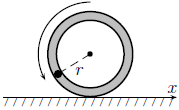
Um tubo fino de massa !$ 1225 \,g !$ e raio !$ r = 10,0\,cm !$ cm encontra-se inicialmente em repouso sobre um plano horizontal sem atrito. A partir do ponto mais alto, um corpo de massa 71,0 g com velocidade inicial zero desliza sem atrito pelo interior do tubo no sentido anti-horário, conforme a figura. Então, quando na posição mais baixa, o corpo terá uma velocidade relativa ao tubo, em !$ cm/s !$, igual a
Provas
Questão presente nas seguintes provas

Dentre os processos químicos abaixo, assinale aquele que ocorre em uma única etapa elementar.
Provas
Questão presente nas seguintes provas
O lugar geométrico das soluções da equação !$ x^2 + bx + 1 = 0 !$, quando !$ \left\vert b \right\vert < 2 !$, !$ b ∈ \mathbb{R} !$, é representado no plano complexo por
Provas
Questão presente nas seguintes provas
Um dado material sólido em equilíbrio térmico emite radiação semelhante a de um corpo negro. Assinale a opção que apresenta a curva que expressa a relação experimental CORRETA entre o comprimento de onda do máximo de emissão !$ (λ_{máx}) !$ e a temperatura desse material.
Provas
Questão presente nas seguintes provas
O texto abaixo é uma das liras que integram Marília de Dirceu, de Tomás Antônio Gonzaga.

Neste poema,
I. há o relato de um episódio vivido por Marília: após ser ferida por uma abelha, ela é socorrida pelo Amor.
II. o Amor é personificado em uma deidade que dirige a Marília uma pequena censura amorosa.
III. a censura que o Amor faz a Marília é um artificio por meio do qual o sujeito lírico, indiretamente, dirige a ela uma queixa amorosa.
IV. o propósito maior do poema surge, no final , no lamento que o sujeito lírico dirige à amada, que parece fazê-lo sofrer.
Estão corretas:
Provas
Questão presente nas seguintes provas
GOODBYE THINGS, HELLO MINIMALISM: CAN LIVING WITH LESS MAKE YOU HAPPIER?
Fumio Sasaki owns a roll-up mattress, three shirts and four pairs of socks. After deciding to scorn
possessions, he began feeling happier. He explains why.
Let me tell you a bit about myself. I’m 35 years old, male, single, never been married. I work as an editor at a publishing company. I recently moved from the Nakameguro neighbourhood in Tokyo, where I lived for a decade, to a neighbourhood called Fudomae in a different part of town. The rent is cheaper, but the move pretty much wiped out my savings.
Some of you may think that I’m a loser: an unmarried adult with not much money. The old me would have been way too embarrassed to admit all this. I was filled with useless pride. But I honestly don’t care about things like that any more. The reason is very simple: I’m perfectly happy just as I am. The reason? I got rid of most of my material possessions.
Minimalism is a lifestyle in which you reduce your possessions to the least possible. Living with only the bare essentials has not only provided superficial benefits such as the pleasure of a tidy room or the simple ease of cleaning, it has also led to a more fundamental shift. It’s given me a chance to think about what it really means to be happy.
We think that the more we have, the happier we will be. We never know what tomorrow might bring, so we collect and save as much as we can. This means we need a lot of money, so we gradually start judging people by how much money they have. You convince yourself that you need to make a lot of money so you don’t miss out on success. And for you to make money, you need everyone else to spend their money. And so it goes.
So I said goodbye to a lot of things, many of which I’d had for years. And yet now I live each day with a happier spirit. I feel more content now than I ever did in the past.
I wasn’t always a minimalist. I used to buy a lot of things, believing that all those possessions would increase my self-worth and lead to a happier life. I loved collecting a lot of useless stuff, and I couldn’t throw anything away. I was a natural hoarder of knick-knacks that I thought made me an interesting person.
At the same time, though, I was always comparing myself with other people who had more or better things, which often made me miserable. I couldn’t focus on anything, and I was always wasting time. Alcohol was my escape, and I didn’t treat women fairly. I didn’t try to change; I thought this was all just part of who I was, and I deserved to be unhappy.
My apartment wasn’t horribly messy; if my girlfriend was coming over for the weekend, I could do enough tidying up to make it look presentable. On a usual day, however, there were books stacked everywhere because there wasn’t enough room on my bookshelves. Most I had thumbed through once or twice, thinking that I would read them when I had the time.
The closet was crammed with what used to be my favourite clothes, most of which I’d only worn a few times. The room was filled with all the things I’d taken up as hobbies and then gotten tired of. A guitar and amplifier, covered with dust. Conversational English workbooks I’d planned to study once I had more free time. Even a fabulous antique camera, which of course I had never once put a roll of film in.
It may sound as if I’m exaggerating when I say I started to become a new person. Someone said to me: “All you did is throw things away,” which is true. But by having fewer things around, I’ve started feeling happier each day. I’m slowly beginning to understand what happiness is.
If you are anything like I used to be – miserable, constantly comparing yourself with others, or just believing your life sucks – I think you should try saying goodbye to some of your things. […] Everyone wants to be happy. But trying to buy happiness only makes us happy for a little while.
Fonte: adaptado de <https://www.theguardian.com/books/2017/apr/12/goodbye-things-hello-minimalism-can-living-with-lessmake- you-happier>. Acesso em: 21 mai. 2017.
As palavras sublinhadas nos excertos da coluna I foram utilizadas tendo os referentes respectivamente indicados na coluna II.
Coluna I
I. ...it has also led to a more fundamental shift.
II. …which often made me miserable.
III. ...I would read them when I had the time.
IV. …which of course I had never once …
Coluna II
living with only the bare essentials
other people who had more or better things
my bookshelves
a fabulous antique camera
Estão corretas
Provas
Questão presente nas seguintes provas
Considere as seguintes proposições a respeito dos valores, em módulo, da energia de orbitais atômicos 2s e 2p:
I. !$ \left\vert E_{2s} \right\vert = \left\vert E_{2p} \right\vert !$ para o átomo de hidrogênio.
II. !$ \left\vert E_{2s} \right\vert = \left\vert E_{2p} \right\vert !$ para o íon de hélio carregado com uma carga positiva.
III. !$ \left\vert E_{2s} \right\vert > \left\vert E_{2p} \right\vert !$ para o átomo de hélio.
Das proposições acima, está(ão) CORRETAS(S)
Provas
Questão presente nas seguintes provas
O poema abaixo retoma, por seu turno, imagens presentes nos dois anteriores.
Passeio no bosque
o canivete na mão não deixa
marcas no tronco da goiabeira
cicatrizes não se transferem
(CACASO. Beijo na boca. Rio de Janeiro: 7 Letras, 2000.)
Algumas pessoas, ao gravarem nomes, datas etc., nos troncos das árvores, buscam externar afetos ou sentimentos. Esse texto, contudo, registra uma experiência particular de alguém que, fazendo isso,
Provas
Questão presente nas seguintes provas
Um recipiente de paredes adiabáticas e de volume constante contém duas amostras de água pura separadas por uma parede também adiabática e de volume desprezível. Umas das amostras consiste em 54 g de água a 25 ºC e, a outra, em 126 g a 75 ºC. Considere que a parede que separa as amostras é retirada e que as amostras de água se misturam até atingir o equilíbrio. Sobre esse processo são feitas as seguintes afirmações:
I. A temperatura da mistura no equilíbrio é de 323 K.
II. A variação de entalpia no processo é nula.
III. A variação de energia interna no processo é nula.
IV. A variação de entropia no processo é nula.
Assinale a opção que apresenta a(s) afirmação(ões) CORRETA(S) sobre a mistura das amostras de água.
Provas
Questão presente nas seguintes provas
Uma progressão aritmética !$ (a_1,a_2, ..., a_n) !$ satisfaz a propriedade: para cada !$ n ∈ \mathbb{N} !$, a soma da progressão é igual a !$ 2n^2+5n !$. Nessas condições, o determinante da matriz !$ \begin{bmatrix} a_1 & a_2 & a_3 \\ a_4 &a_5 & a_6 \\ a_7 + 2 & a_8 & a_9 \end{bmatrix} !$ é
Provas
Questão presente nas seguintes provas
Cadernos
Caderno Container