Foram encontradas 100 questões.
No livro Teoria do Calor (1871), Maxwell, escreveu referindo-se a um recipiente cheio de ar:
“... iniciando com uma temperatura uniforme, vamos supor que um recipiente é dividido em duas partes por uma divisória na qual existe um pequeno orifício, e que um ser que pode ver as moléculas individualmente abre e fecha esse orifício de tal modo que permite somente a passagem de moléculas rápidas de !$ A !$ para !$ B !$ e somente as lentas de !$ B !$ para !$ A !$. Assim, sem realização de trabalho, ele aumentará a temperatura de !$ B !$ e diminuirá a temperatura de !$ A !$ em contradição com ... ”.
Assinale a opção que melhor completa o texto de Maxwell.
Provas
Questão presente nas seguintes provas

Em um triângulo de vértices !$ A, B !$ e !$ C !$ são dados !$ \hat{B}= \pi /2, \hat{C}= \pi /3 !$ eo lado !$ BC=1 !$ cm. Se o lado !$ \overline{AB} !$ é o diâmetro de uma circunferência, então a área da parte do triângulo !$ ABC !$ externa à circunferência, em !$ cm^2 !$, é
Provas
Questão presente nas seguintes provas
WE RECORDED VCs CONVERSATIONS AND ANALYZED HOW DIFFERENTLY
THEY TALK ABOUT FEMALE ENTREPRENEURS
When venture capitalists (VCs) evaluate investment proposals, the language they use to describe the entrepreneurs who write them plays an important but often hidden role in shaping who is awarded funding and why.[…] We were given access to government venture capital decision making meetings in Sweden and were able to observe the types of language that VCs used over a two-year period. One major thing stuck out: The language used to describe male and female entrepreneurs was radically different. And these differences have very real consequences for those seeking funding — and for society in general.
[…] Worldwide, government venture capital is important for bridging significant financial gaps and supporting innovation and growth, as VCs can take risks where banks are not allowed to. When uncertainty is high regarding assessment of product and market potential, for example, the assessment of the entrepreneur’s potential becomes highly central in government VCs’ decision making.
In Sweden, about one-third of businesses are owned and run by women, although they are not granted a corresponding proportion of government funding. In fact, women-owned businesses receive much less — only 13%–18%, the rest going to male-owned companies.
This brings us back to our research. From 2009 to 2010 we were invited to silently observe governmental VC decision-making meetings and, more important, the conversations they had about entrepreneurs applying for funding. […] We observed closed-room, face-to-face discussions leading final funding decisions for 125 venture applications. Of these, 99 (79%) were from male entrepreneurs and 26 (21%) were from female entrepreneurs. The group of government venture capitalists observed included seven individuals: two women and five men. […]
Aside from a few exceptions, the financiers rhetorically produce stereotypical images of women as having qualities opposite to those considered important to being an entrepreneur, with VCs questioning their credibility, trustworthiness, experience, and knowledge.
Conversely, when assessing male entrepreneurs, financiers leaned on stereotypical beliefs about men that reinforced their entrepreneurial potential. Male entrepreneurs were commonly described as being assertive, innovative, competent, experienced, knowledgeable, and having established networks.
We developed male and female entrepreneur personas based on our findings […]. These personas highlight a few key differences in how the entrepreneurs were perceived depending on their gender. Men were characterized as having entrepreneurial potential, while the entrepreneurial potential for women was diminished. Many of the young men and women were described as being young, though youth for men was viewed as promising, while young women were considered inexperienced. Men were praised for being viewed as aggressive or arrogant, while women’s experience and excitement were tempered by discussions of their emotional shortcomings. Similarly, cautiousness was viewed very differently depending on the gender of the entrepreneur.
Unsurprisingly, these stereotypes seem to have played a role in who got funding and who didn’t. Women entrepreneurs were only awarded, on average, 25% of the applied-for amount, whereas men received, on average, 52% of what they asked for. Women were also denied financing to a greater extent than men, with close to 53% of women having their applications dismissed, compared with 38% of men. […]
Such stereotyping will inevitably influence the distribution of financing, but could also have other major consequences. Because the purpose of government venture capital is to use tax money to stimulate growth and value creation for society as a whole, gender bias presents the risk that the money isn’t being invested in businesses that have the highest potential. This isn’t only damaging for women entrepreneurs; it’s potentially damaging for society as a whole.
Fonte: Adaptado de Harvard Business Review <https://hbr.org/2017/05/we-recorded-vcs-conversations-and-analyzedhow- differently-they-talk-about-female-entrepreneurs>. Acesso em: 17 mai. 2017.
A expressão sublinhada na primeira coluna pode ser substituída pela expressão na segunda coluna em todas as opções, EXCETO em
Provas
Questão presente nas seguintes provas
São dadas duas caixas, uma delas contém três bolas brancas e duas pretas e a outra contém duas bolas brancas e uma preta. Retira-se, ao acaso, uma bola de cada caixa. Se !$ P_1 !$ é a probabilidade de que pelo menos uma bola seja preta e !$ P_2 !$ a probabilidade de as duas bolas serem da mesma cor, então !$ P_1+P_2 !$ vale
Provas
Questão presente nas seguintes provas
São feitas as seguintes proposições a respeito de propriedades coligativas:
I. A pressão osmótica depende do tipo de solvente para um dado soluto.
II. A criometria usa o abaixamento do ponto de congelamento do solvente para medir a massa molar do soluto.
III. Na ebuliometria, a variação da temperatura de ebulição depende da concentração molal de soluto não volátil utilizado.
IV. Na tonometria, ocorre abaixamento da pressão de vapor de uma solução que contém um soluto não volátil, em relação ao solvente puro.
Das proposições acima é (são) CORRETAS(S)
Provas
Questão presente nas seguintes provas
A partir de um mesmo ponto a uma certa altura do solo, uma partícula é lançada sequencialmente em três condições diferentes, mas sempre com a mesma velocidade inicial horizontal !$ v_0 !$. O primeiro lançamento é feito no vácuo e o segundo, na atmosfera com ar em repouso. O terceiro é feito na atmosfera com ar em movimento cuja velocidade em relação ao solo é igual em módulo, direção e sentido à velocidade !$ v_0 !$. Para os três lançamentos, designando-se respectivamente de !$ t_1 !$, !$ t_2 !$ e !$ t_3 !$ os tempos de queda da partícula e de !$ v_1 !$, !$ v_2 !$ e !$ v_3 !$ os módulos de suas respectivas velocidades ao atingir o solo, assinale a alternativa correta.
Provas
Questão presente nas seguintes provas
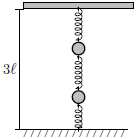
Três molas idênticas, de massas desprezíveis e comprimentos naturais !$ ℓ !$, são dispostas verticalmente entre o solo e o teto a !$ 3ℓ !$ de altura. Conforme a figura, entre tais molas são fixadas duas massas pontuais iguais. Na situação inicial de equilíbrio, retira-se a mola inferior (ligada ao solo) resultando no deslocamento da massa superior de uma distância !$ d_1 !$ para baixo, e da inferior, de uma distância !$ d_2 !$ também para baixo, alcançando-se nova posição de equilíbrio. Assinale a razão !$ d_2/d_1 !$.
Provas
Questão presente nas seguintes provas
Sobre duas retas paralelas !$ r !$ e !$ s !$ são tomados 13 pontos, !$ m !$ pontos em !$ r !$ e !$ n !$ pontos em !$ s !$, sendo !$ m > n !$. Com os pontos são formados todos os triângulos e quadriláteros convexos possíveis. Sabe-se que o quociente entre o número de quadriláteros e o número de triângulos é !$ 15/11 !$. Então, os valores de !$ n !$ e !$ m !$ são, respectivamente,
Provas
Questão presente nas seguintes provas
Em várias passagens de Quincas Borba, de Machado de Assis, as personagens interpretam erroneamente alguns fatos ou fazem ilações equivocadas a partir de algumas falas. Vemos isso, por exemplo, no episódio em que, a partir do relato que ouve de um cocheiro, Rubião se convence de que
Provas
Questão presente nas seguintes provas
GOODBYE THINGS, HELLO MINIMALISM: CAN LIVING WITH LESS MAKE YOU HAPPIER?
Fumio Sasaki owns a roll-up mattress, three shirts and four pairs of socks. After deciding to scorn
possessions, he began feeling happier. He explains why.
Let me tell you a bit about myself. I’m 35 years old, male, single, never been married. I work as an editor at a publishing company. I recently moved from the Nakameguro neighbourhood in Tokyo, where I lived for a decade, to a neighbourhood called Fudomae in a different part of town. The rent is cheaper, but the move pretty much wiped out my savings.
Some of you may think that I’m a loser: an unmarried adult with not much money. The old me would have been way too embarrassed to admit all this. I was filled with useless pride. But I honestly don’t care about things like that any more. The reason is very simple: I’m perfectly happy just as I am. The reason? I got rid of most of my material possessions.
Minimalism is a lifestyle in which you reduce your possessions to the least possible. Living with only the bare essentials has not only provided superficial benefits such as the pleasure of a tidy room or the simple ease of cleaning, it has also led to a more fundamental shift. It’s given me a chance to think about what it really means to be happy.
We think that the more we have, the happier we will be. We never know what tomorrow might bring, so we collect and save as much as we can. This means we need a lot of money, so we gradually start judging people by how much money they have. You convince yourself that you need to make a lot of money so you don’t miss out on success. And for you to make money, you need everyone else to spend their money. And so it goes.
So I said goodbye to a lot of things, many of which I’d had for years. And yet now I live each day with a happier spirit. I feel more content now than I ever did in the past.
I wasn’t always a minimalist. I used to buy a lot of things, believing that all those possessions would increase my self-worth and lead to a happier life. I loved collecting a lot of useless stuff, and I couldn’t throw anything away. I was a natural hoarder of knick-knacks that I thought made me an interesting person.
At the same time, though, I was always comparing myself with other people who had more or better things, which often made me miserable. I couldn’t focus on anything, and I was always wasting time. Alcohol was my escape, and I didn’t treat women fairly. I didn’t try to change; I thought this was all just part of who I was, and I deserved to be unhappy.
My apartment wasn’t horribly messy; if my girlfriend was coming over for the weekend, I could do enough tidying up to make it look presentable. On a usual day, however, there were books stacked everywhere because there wasn’t enough room on my bookshelves. Most I had thumbed through once or twice, thinking that I would read them when I had the time.
The closet was crammed with what used to be my favourite clothes, most of which I’d only worn a few times. The room was filled with all the things I’d taken up as hobbies and then gotten tired of. A guitar and amplifier, covered with dust. Conversational English workbooks I’d planned to study once I had more free time. Even a fabulous antique camera, which of course I had never once put a roll of film in.
It may sound as if I’m exaggerating when I say I started to become a new person. Someone said to me: “All you did is throw things away,” which is true. But by having fewer things around, I’ve started feeling happier each day. I’m slowly beginning to understand what happiness is.
If you are anything like I used to be – miserable, constantly comparing yourself with others, or just believing your life sucks – I think you should try saying goodbye to some of your things. […] Everyone wants to be happy. But trying to buy happiness only makes us happy for a little while.
Fonte: adaptado de <https://www.theguardian.com/books/2017/apr/12/goodbye-things-hello-minimalism-can-living-with-lessmake- you-happier>. Acesso em: 21 mai. 2017.
De acordo com o texto, Fumio
Provas
Questão presente nas seguintes provas
Cadernos
Caderno Container