Foram encontradas 146 questões.
TEXT:
What's the best way to learn receptive skills?
Miranda Hamilton
July 26, 2021
We often think of speaking and writing as the most challenging of the four language skills but what about the receptive skills? With reading, learners have time to think, but listening in another language presents a very different set of challenges for the learner. How often have we heard learners complain ‘it’s too fast, teacher!’? So how can you help?
Some guides are designed to help teachers understand the subskills of listening, with activities, tips and strategies to help you develop your learners’ listening skills as they prepare for their exams.
Here are just a few of the ideas from the guides for you to try with your learners. They will work at all levels.
How many words?
This micro listening is a great activity to try towards the end of your listening lesson, when learners have already heard the recording, so they know the speakers’ voices and the topic.
- Select a short phrase, of around 10 words, from the listening you have just completed. Set up the audio so you are ready to press ‘Play’.
- Tell the learners to listen and count the number of words they hear. You will need to play the audio several times. Pairs discuss. Take a range of answers from the class, but don’t tell them the answer just yet.
- Write the phrase on the board and count the number of words with the class. Who was the closest?
- Now ask them to listen and read the phrase at the same time. This time they have to decide which words they hear most clearly, in other words, you want them to notice the stressed words. Ask why they think they heard these words most clearly. Explain that stressed words carry the key information.
This micro listening activity helps raise learners’ awareness of sounds, helping them notice the stressed words and preparing them to listen for key information.
Support every learner
In mixed-ability classes, put a few simple strategies in place so the whole class can listen to the same recording, and take part in the same activity. This means that no learner feels lost or left behind.
- Make the gap-fill or sentence-completion task more achievable and supply the first letter of the missing word. Alternatively supply the first and the final letter and indicate how many letters the missing word has.
- Provide an additional layer of support for weaker learners by giving them the audio script. They can read the script as they listen and use it to help them find the correct answers.
Prepare to listen, prepare to understand
Don’t be in too much of a hurry to hand out the listening task and press ‘Play’. Time spent in class before listening means learners are better prepared to understand.
- Before you listen, have a class discussion around the topic of the listening. This gives learners the opportunity not only to practice their speaking, but also to practice listening to one another. A good discussion will make them think about the main ideas they might hear when they listen.
- Useful vocabulary always comes out of a class discussion, creating a very natural way to pre-teach vocabulary before they listen. Useful language linked to a discussion is easier to learn because learners have a context, which makes it easier to remember than pre-teaching vocabulary from a wordlist.
- Take your time to discuss the task and check understanding. Encourage the class to reflect on their discussion and predict the answers. Remember to write their predictions on the board. Did they guess correctly? It doesn’t matter if they did or not, what matters is that they are prepared and ready to listen to see if they were right.
Feeling prepared to listen means learners feel confident and ready to understand, both in the classroom and in their exam.
Adapted from: https://www.cambridgeenglish.org/blog/whats-the-best-way-to-
learn-receptive-skills
No trecho “Don’t be in too much of a hurry to hand out the listening task…”, a definição correta para o phrasal verb em destaque é:
Provas

TEXT:
What's the best way to learn receptive skills?
Miranda Hamilton
July 26, 2021
We often think of speaking and writing as the most challenging of the four language skills but what about the receptive skills? With reading, learners have time to think, but listening in another language presents a very different set of challenges for the learner. How often have we heard learners complain ‘it’s too fast, teacher!’? So how can you help?
Some guides are designed to help teachers understand the subskills of listening, with activities, tips and strategies to help you develop your learners’ listening skills as they prepare for their exams.
Here are just a few of the ideas from the guides for you to try with your learners. They will work at all levels.
How many words?
This micro listening is a great activity to try towards the end of your listening lesson, when learners have already heard the recording, so they know the speakers’ voices and the topic.
- Select a short phrase, of around 10 words, from the listening you have just completed. Set up the audio so you are ready to press ‘Play’.
- Tell the learners to listen and count the number of words they hear. You will need to play the audio several times. Pairs discuss. Take a range of answers from the class, but don’t tell them the answer just yet.
- Write the phrase on the board and count the number of words with the class. Who was the closest?
- Now ask them to listen and read the phrase at the same time. This time they have to decide which words they hear most clearly, in other words, you want them to notice the stressed words. Ask why they think they heard these words most clearly. Explain that stressed words carry the key information.
This micro listening activity helps raise learners’ awareness of sounds, helping them notice the stressed words and preparing them to listen for key information.
Support every learner
In mixed-ability classes, put a few simple strategies in place so the whole class can listen to the same recording, and take part in the same activity. This means that no learner feels lost or left behind.
- Make the gap-fill or sentence-completion task more achievable and supply the first letter of the missing word. Alternatively supply the first and the final letter and indicate how many letters the missing word has.
- Provide an additional layer of support for weaker learners by giving them the audio script. They can read the script as they listen and use it to help them find the correct answers.
Prepare to listen, prepare to understand
Don’t be in too much of a hurry to hand out the listening task and press ‘Play’. Time spent in class before listening means learners are better prepared to understand.
- Before you listen, have a class discussion around the topic of the listening. This gives learners the opportunity not only to practice their speaking, but also to practice listening to one another. A good discussion will make them think about the main ideas they might hear when they listen.
- Useful vocabulary always comes out of a class discussion, creating a very natural way to pre-teach vocabulary before they listen. Useful language linked to a discussion is easier to learn because learners have a context, which makes it easier to remember than pre-teaching vocabulary from a wordlist.
- Take your time to discuss the task and check understanding. Encourage the class to reflect on their discussion and predict the answers. Remember to write their predictions on the board. Did they guess correctly? It doesn’t matter if they did or not, what matters is that they are prepared and ready to listen to see if they were right.
Feeling prepared to listen means learners feel confident and ready to understand, both in the classroom and in their exam.
Adapted from: https://www.cambridgeenglish.org/blog/whats-the-best-way-to-
learn-receptive-skills
No trecho “Make the gap-fill or sentence-completion task more achievable and supply the first letter of the missing word.”, o sufixo da palavra em destaque foi utilizado na formação de um:
Provas
TEXT:
What's the best way to learn receptive skills?
Miranda Hamilton
July 26, 2021
We often think of speaking and writing as the most challenging of the four language skills but what about the receptive skills? With reading, learners have time to think, but listening in another language presents a very different set of challenges for the learner. How often have we heard learners complain ‘it’s too fast, teacher!’? So how can you help?
Some guides are designed to help teachers understand the subskills of listening, with activities, tips and strategies to help you develop your learners’ listening skills as they prepare for their exams.
Here are just a few of the ideas from the guides for you to try with your learners. They will work at all levels.
How many words?
This micro listening is a great activity to try towards the end of your listening lesson, when learners have already heard the recording, so they know the speakers’ voices and the topic.
- Select a short phrase, of around 10 words, from the listening you have just completed. Set up the audio so you are ready to press ‘Play’.
- Tell the learners to listen and count the number of words they hear. You will need to play the audio several times. Pairs discuss. Take a range of answers from the class, but don’t tell them the answer just yet.
- Write the phrase on the board and count the number of words with the class. Who was the closest?
- Now ask them to listen and read the phrase at the same time. This time they have to decide which words they hear most clearly, in other words, you want them to notice the stressed words. Ask why they think they heard these words most clearly. Explain that stressed words carry the key information.
This micro listening activity helps raise learners’ awareness of sounds, helping them notice the stressed words and preparing them to listen for key information.
Support every learner
In mixed-ability classes, put a few simple strategies in place so the whole class can listen to the same recording, and take part in the same activity. This means that no learner feels lost or left behind.
- Make the gap-fill or sentence-completion task more achievable and supply the first letter of the missing word. Alternatively supply the first and the final letter and indicate how many letters the missing word has.
- Provide an additional layer of support for weaker learners by giving them the audio script. They can read the script as they listen and use it to help them find the correct answers.
Prepare to listen, prepare to understand
Don’t be in too much of a hurry to hand out the listening task and press ‘Play’. Time spent in class before listening means learners are better prepared to understand.
- Before you listen, have a class discussion around the topic of the listening. This gives learners the opportunity not only to practice their speaking, but also to practice listening to one another. A good discussion will make them think about the main ideas they might hear when they listen.
- Useful vocabulary always comes out of a class discussion, creating a very natural way to pre-teach vocabulary before they listen. Useful language linked to a discussion is easier to learn because learners have a context, which makes it easier to remember than pre-teaching vocabulary from a wordlist.
- Take your time to discuss the task and check understanding. Encourage the class to reflect on their discussion and predict the answers. Remember to write their predictions on the board. Did they guess correctly? It doesn’t matter if they did or not, what matters is that they are prepared and ready to listen to see if they were right.
Feeling prepared to listen means learners feel confident and ready to understand, both in the classroom and in their exam.
Adapted from: https://www.cambridgeenglish.org/blog/whats-the-best-way-to-
learn-receptive-skills
No trecho “This micro listening activity helps raise learners’ awareness of sounds”, a tradução correta para o substantivo “awareness” é:
Provas
TEXT:
What's the best way to learn receptive skills?
Miranda Hamilton
July 26, 2021
We often think of speaking and writing as the most challenging of the four language skills but what about the receptive skills? With reading, learners have time to think, but listening in another language presents a very different set of challenges for the learner. How often have we heard learners complain ‘it’s too fast, teacher!’? So how can you help?
Some guides are designed to help teachers understand the subskills of listening, with activities, tips and strategies to help you develop your learners’ listening skills as they prepare for their exams.
Here are just a few of the ideas from the guides for you to try with your learners. They will work at all levels.
How many words?
This micro listening is a great activity to try towards the end of your listening lesson, when learners have already heard the recording, so they know the speakers’ voices and the topic.
- Select a short phrase, of around 10 words, from the listening you have just completed. Set up the audio so you are ready to press ‘Play’.
- Tell the learners to listen and count the number of words they hear. You will need to play the audio several times. Pairs discuss. Take a range of answers from the class, but don’t tell them the answer just yet.
- Write the phrase on the board and count the number of words with the class. Who was the closest?
- Now ask them to listen and read the phrase at the same time. This time they have to decide which words they hear most clearly, in other words, you want them to notice the stressed words. Ask why they think they heard these words most clearly. Explain that stressed words carry the key information.
This micro listening activity helps raise learners’ awareness of sounds, helping them notice the stressed words and preparing them to listen for key information.
Support every learner
In mixed-ability classes, put a few simple strategies in place so the whole class can listen to the same recording, and take part in the same activity. This means that no learner feels lost or left behind.
- Make the gap-fill or sentence-completion task more achievable and supply the first letter of the missing word. Alternatively supply the first and the final letter and indicate how many letters the missing word has.
- Provide an additional layer of support for weaker learners by giving them the audio script. They can read the script as they listen and use it to help them find the correct answers.
Prepare to listen, prepare to understand
Don’t be in too much of a hurry to hand out the listening task and press ‘Play’. Time spent in class before listening means learners are better prepared to understand.
- Before you listen, have a class discussion around the topic of the listening. This gives learners the opportunity not only to practice their speaking, but also to practice listening to one another. A good discussion will make them think about the main ideas they might hear when they listen.
- Useful vocabulary always comes out of a class discussion, creating a very natural way to pre-teach vocabulary before they listen. Useful language linked to a discussion is easier to learn because learners have a context, which makes it easier to remember than pre-teaching vocabulary from a wordlist.
- Take your time to discuss the task and check understanding. Encourage the class to reflect on their discussion and predict the answers. Remember to write their predictions on the board. Did they guess correctly? It doesn’t matter if they did or not, what matters is that they are prepared and ready to listen to see if they were right.
Feeling prepared to listen means learners feel confident and ready to understand, both in the classroom and in their exam.
Adapted from: https://www.cambridgeenglish.org/blog/whats-the-best-way-to-
learn-receptive-skills
No trecho “Write the phrase on the board and count the number of words with the class.”, os verbos foram empregados no:
Provas
TEXT:
What's the best way to learn receptive skills?
Miranda Hamilton
July 26, 2021
We often think of speaking and writing as the most challenging of the four language skills but what about the receptive skills? With reading, learners have time to think, but listening in another language presents a very different set of challenges for the learner. How often have we heard learners complain ‘it’s too fast, teacher!’? So how can you help?
Some guides are designed to help teachers understand the subskills of listening, with activities, tips and strategies to help you develop your learners’ listening skills as they prepare for their exams.
Here are just a few of the ideas from the guides for you to try with your learners. They will work at all levels.
How many words?
This micro listening is a great activity to try towards the end of your listening lesson, when learners have already heard the recording, so they know the speakers’ voices and the topic.
- Select a short phrase, of around 10 words, from the listening you have just completed. Set up the audio so you are ready to press ‘Play’.
- Tell the learners to listen and count the number of words they hear. You will need to play the audio several times. Pairs discuss. Take a range of answers from the class, but don’t tell them the answer just yet.
- Write the phrase on the board and count the number of words with the class. Who was the closest?
- Now ask them to listen and read the phrase at the same time. This time they have to decide which words they hear most clearly, in other words, you want them to notice the stressed words. Ask why they think they heard these words most clearly. Explain that stressed words carry the key information.
This micro listening activity helps raise learners’ awareness of sounds, helping them notice the stressed words and preparing them to listen for key information.
Support every learner
In mixed-ability classes, put a few simple strategies in place so the whole class can listen to the same recording, and take part in the same activity. This means that no learner feels lost or left behind.
- Make the gap-fill or sentence-completion task more achievable and supply the first letter of the missing word. Alternatively supply the first and the final letter and indicate how many letters the missing word has.
- Provide an additional layer of support for weaker learners by giving them the audio script. They can read the script as they listen and use it to help them find the correct answers.
Prepare to listen, prepare to understand
Don’t be in too much of a hurry to hand out the listening task and press ‘Play’. Time spent in class before listening means learners are better prepared to understand.
- Before you listen, have a class discussion around the topic of the listening. This gives learners the opportunity not only to practice their speaking, but also to practice listening to one another. A good discussion will make them think about the main ideas they might hear when they listen.
- Useful vocabulary always comes out of a class discussion, creating a very natural way to pre-teach vocabulary before they listen. Useful language linked to a discussion is easier to learn because learners have a context, which makes it easier to remember than pre-teaching vocabulary from a wordlist.
- Take your time to discuss the task and check understanding. Encourage the class to reflect on their discussion and predict the answers. Remember to write their predictions on the board. Did they guess correctly? It doesn’t matter if they did or not, what matters is that they are prepared and ready to listen to see if they were right.
Feeling prepared to listen means learners feel confident and ready to understand, both in the classroom and in their exam.
Adapted from: https://www.cambridgeenglish.org/blog/whats-the-best-way-to-
learn-receptive-skills
Diferentemente do senso comum, a autora considera as habilidades linguísticas receptivas as mais desafiadoras. As habilidades consideradas como receptivas são:
Provas
TEXT:
What's the best way to learn receptive skills?
Miranda Hamilton
July 26, 2021
We often think of speaking and writing as the most challenging of the four language skills but what about the receptive skills? With reading, learners have time to think, but listening in another language presents a very different set of challenges for the learner. How often have we heard learners complain ‘it’s too fast, teacher!’? So how can you help?
Some guides are designed to help teachers understand the subskills of listening, with activities, tips and strategies to help you develop your learners’ listening skills as they prepare for their exams.
Here are just a few of the ideas from the guides for you to try with your learners. They will work at all levels.
How many words?
This micro listening is a great activity to try towards the end of your listening lesson, when learners have already heard the recording, so they know the speakers’ voices and the topic.
- Select a short phrase, of around 10 words, from the listening you have just completed. Set up the audio so you are ready to press ‘Play’.
- Tell the learners to listen and count the number of words they hear. You will need to play the audio several times. Pairs discuss. Take a range of answers from the class, but don’t tell them the answer just yet.
- Write the phrase on the board and count the number of words with the class. Who was the closest?
- Now ask them to listen and read the phrase at the same time. This time they have to decide which words they hear most clearly, in other words, you want them to notice the stressed words. Ask why they think they heard these words most clearly. Explain that stressed words carry the key information.
This micro listening activity helps raise learners’ awareness of sounds, helping them notice the stressed words and preparing them to listen for key information.
Support every learner
In mixed-ability classes, put a few simple strategies in place so the whole class can listen to the same recording, and take part in the same activity. This means that no learner feels lost or left behind.
- Make the gap-fill or sentence-completion task more achievable and supply the first letter of the missing word. Alternatively supply the first and the final letter and indicate how many letters the missing word has.
- Provide an additional layer of support for weaker learners by giving them the audio script. They can read the script as they listen and use it to help them find the correct answers.
Prepare to listen, prepare to understand
Don’t be in too much of a hurry to hand out the listening task and press ‘Play’. Time spent in class before listening means learners are better prepared to understand.
- Before you listen, have a class discussion around the topic of the listening. This gives learners the opportunity not only to practice their speaking, but also to practice listening to one another. A good discussion will make them think about the main ideas they might hear when they listen.
- Useful vocabulary always comes out of a class discussion, creating a very natural way to pre-teach vocabulary before they listen. Useful language linked to a discussion is easier to learn because learners have a context, which makes it easier to remember than pre-teaching vocabulary from a wordlist.
- Take your time to discuss the task and check understanding. Encourage the class to reflect on their discussion and predict the answers. Remember to write their predictions on the board. Did they guess correctly? It doesn’t matter if they did or not, what matters is that they are prepared and ready to listen to see if they were right.
Feeling prepared to listen means learners feel confident and ready to understand, both in the classroom and in their exam.
Adapted from: https://www.cambridgeenglish.org/blog/whats-the-best-way-to-
learn-receptive-skills
De acordo com a autora do texto, as habilidades linguísticas que as pessoas consideram como as mais desafiadoras são as habilidades que envolvem:
Provas
O filme “O menino do pijama listrado”, lançado em 2008, aborda a história inusitada de uma amizade entre uma criança de 8 anos, filho de um oficial nazista que dirige um campo de concentração, e um outro menino da mesma idade, que era judeu, então preso e que utilizava a roupa listrada dos prisioneiros.

Os campos de concentração, instalados pela Alemanha Nazista em vários países europeus, foram demonstrações explícitas de uma das maiores barbáries ocorridas no século XX.
Acerca dessa prática adotada pelo Terceiro Reich alemão, sob o comando de Adolf Hitler, pode-se assinalar que:
Provas
“Por mais de 40 anos, as brasileiras foram proibidas de jogar futebol. O veto começou em 1941, na ditadura do Estado Novo (1937-1945), quando o presidente Getúlio Vargas assinou um decreto-lei tirando das mulheres o direito de praticar esportes ‘incompatíveis com as condições de sua natureza’.”
(Adaptado de: Ricardo Westin, www12.senado.leg.br/noticias/especiais/arquivo. Acesso em 10.08.2023.)
Destacavam-se como argumentos à época, para tal proibição: que a violência dentro dos gramados prejudicaria a maior missão delas na sociedade, de serem mães; que uma cotovelada no seio poderia impedi-las de amamentar; que uma bolada na região do útero poderia retirar-lhes a capacidade de gerar filhos; que as jogadas desleais e os xingamentos levariam à degeneração moral do “sexo frágil”.
Neste ano de 2023 realizou-se a nona edição da Copa do Mundo Feminina de Futebol com sedes na Austrália e Nova Zelândia. No Brasil, o governo federal decretou ponto facultativo nos dias de jogos da seleção brasileira que disputou a Copa, num claro avanço do esporte no país. No entanto, nem sempre as mulheres tiveram direito de praticar esse esporte, como nos atesta o texto.
Pode-se afirmar que os motivos que levaram o governo Vargas a proibir esse esporte feminino se relacionam ao:
Provas
- História do BrasilHistória dos Estados e DFHistória do Mato Grosso
- História do BrasilRepública Oligárquica (1889:1930)
“A coluna realizou uma incrível marcha pelo interior do país, percorrendo cerca de 24 mil quilômetros até fevereiro/março de 1927, quando seus remanescentes deram o movimento por terminado e se internaram na Bolívia e Paraguai. Seus componentes nunca passaram de 1.500 pessoas, oscilando muito com a entrada e saída de participantes transitórios.”
(FAUSTO, Boris. História do Brasil. SP: EDUSP, 2006. p. 309.)
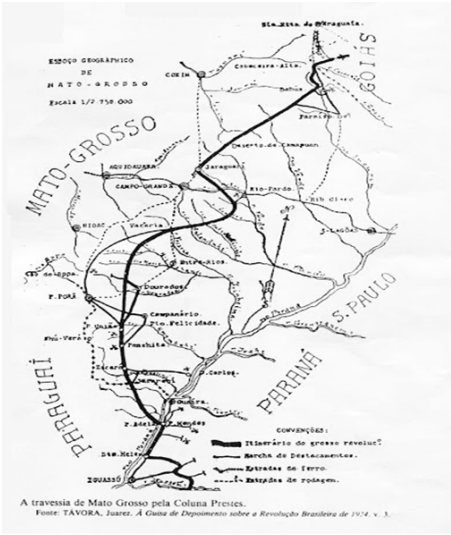
A Coluna Prestes, liderada pelo capitão do exército Luís Carlos Prestes, foi um dos movimentos ocorridos na Primeira República no Brasil (1889 – 1930), por descontentamento com a situação política, econômica e social da época.
Acerca da presença da Coluna Prestes em Mato Grosso, pode-se concluir que:
Provas
O sul do atual Estados Unidos e o Brasil constituíram-se nas duas maiores sociedades escravistas do hemisfério americano. No caso brasileiro, o lucrativo comércio negreiro, impulsionado pelo tráfico transatlântico entre as décadas de 1820 e o decorrer da década de 1840, foi o mais intenso da história do infame comércio para as Américas.

“Mas o tráfico era bem mais do que um simples deslocamento populacional. (...) Além disso, sabe-se que por quase meio século – grosso modo, de 1810 a 1850 – as elites brasileiras puderam resistir às poderosas pressões britânicas pelo seu fim. (...) Os lucros por ele gerados transformaram os mercadores de almas na verdadeira elite brasileira, posição que lhes facultava influenciar decisivamente os destinos do Estado.”
(Fonte: http://www.abphe.org.br/https://arquivos.infra-questoes.grancursosonline.com.br/arquivos/manolo-garcia-florentino.pdf)
A partir da análise do gráfico e do fragmento de texto, pode-se aferir que:
Provas
Caderno Container