Magna Concursos

Foram encontradas 100 questões.

Text CB1A2-I
Oppenheimer’s brief advance into astrophysics began with a 1938 paper about neutron stars, which continued in a 1939 installment that further incorporated the principles of Einstein’s general theory of relativity. He then published a third paper on black holes on September 1st, 1939—but at the time, it was scarcely noticed because this was the very day Germany invaded Poland, launching World War II. Oppenheimer never wrote on the topic again.
Even if it hadn’t been overshadowed by war, Oppenheimer’s work on neutron stars and black holes “was not understood to be terribly significant at the time,” says Cathryn Carson, a historian of science at the University of California, Berkeley.
Each paper was written with a different member of the swarm of graduate students that Oppenheimer carefully cultivated. These protégés facilitated his ability to jump between research topics—and ultimately, helped him develop some of his most important contributions to physics.
Oppenheimer’s climactic third paper, written with his student Hartland Snyder, explores the implications of general relativity on the universe’s most massive stars. Although the physicists needed to include some assumptions to simplify the question, they determined that a large enough star would gravitationally collapse indefinitely—and within a finite amount of time, meaning that the objects we now know as black holes could exist.
Internet: <scientificamerican.com> (adapted)

Based on the vocabulary and linguistic aspects of text CB1A2-I, judge the following item.

The word “installment” (first sentence of the first paragraph) means, in the context of text CB1A2-I, “to make it ready to use”.


Provas

Questão presente nas seguintes provas
Text CB1A2-I
Oppenheimer’s brief advance into astrophysics began with a 1938 paper about neutron stars, which continued in a 1939 installment that further incorporated the principles of Einstein’s general theory of relativity. He then published a third paper on black holes on September 1st, 1939—but at the time, it was scarcely noticed because this was the very day Germany invaded Poland, launching World War II. Oppenheimer never wrote on the topic again.
Even if it hadn’t been overshadowed by war, Oppenheimer’s work on neutron stars and black holes “was not understood to be terribly significant at the time,” says Cathryn Carson, a historian of science at the University of California, Berkeley.
Each paper was written with a different member of the swarm of graduate students that Oppenheimer carefully cultivated. These protégés facilitated his ability to jump between research topics—and ultimately, helped him develop some of his most important contributions to physics.
Oppenheimer’s climactic third paper, written with his student Hartland Snyder, explores the implications of general relativity on the universe’s most massive stars. Although the physicists needed to include some assumptions to simplify the question, they determined that a large enough star would gravitationally collapse indefinitely—and within a finite amount of time, meaning that the objects we now know as black holes could exist.
Internet: <scientificamerican.com> (adapted)

Based on the vocabulary and linguistic aspects of text CB1A2-I, judge the following item.

The word “overshadowed” (first sentence of the second paragraph) means, in the context of text CB1A2-I, “made less noticeable”.


Provas

Questão presente nas seguintes provas
Text CB1A2-I
Oppenheimer’s brief advance into astrophysics began with a 1938 paper about neutron stars, which continued in a 1939 installment that further incorporated the principles of Einstein’s general theory of relativity. He then published a third paper on black holes on September 1st, 1939—but at the time, it was scarcely noticed because this was the very day Germany invaded Poland, launching World War II. Oppenheimer never wrote on the topic again.
Even if it hadn’t been overshadowed by war, Oppenheimer’s work on neutron stars and black holes “was not understood to be terribly significant at the time,” says Cathryn Carson, a historian of science at the University of California, Berkeley.
Each paper was written with a different member of the swarm of graduate students that Oppenheimer carefully cultivated. These protégés facilitated his ability to jump between research topics—and ultimately, helped him develop some of his most important contributions to physics.
Oppenheimer’s climactic third paper, written with his student Hartland Snyder, explores the implications of general relativity on the universe’s most massive stars. Although the physicists needed to include some assumptions to simplify the question, they determined that a large enough star would gravitationally collapse indefinitely—and within a finite amount of time, meaning that the objects we now know as black holes could exist.
Internet: <scientificamerican.com> (adapted)
Based on the vocabulary and linguistic aspects of text CB1A2-I, judge the following item.
The pronoun “they” (last sentence of the last paragraph) refers to the word “assumptions”.
 

Provas

Questão presente nas seguintes provas
Text CB1A2-I
Oppenheimer’s brief advance into astrophysics began with a 1938 paper about neutron stars, which continued in a 1939 installment that further incorporated the principles of Einstein’s general theory of relativity. He then published a third paper on black holes on September 1st, 1939—but at the time, it was scarcely noticed because this was the very day Germany invaded Poland, launching World War II. Oppenheimer never wrote on the topic again.
Even if it hadn’t been overshadowed by war, Oppenheimer’s work on neutron stars and black holes “was not understood to be terribly significant at the time,” says Cathryn Carson, a historian of science at the University of California, Berkeley.
Each paper was written with a different member of the swarm of graduate students that Oppenheimer carefully cultivated. These protégés facilitated his ability to jump between research topics—and ultimately, helped him develop some of his most important contributions to physics.
Oppenheimer’s climactic third paper, written with his student Hartland Snyder, explores the implications of general relativity on the universe’s most massive stars. Although the physicists needed to include some assumptions to simplify the question, they determined that a large enough star would gravitationally collapse indefinitely—and within a finite amount of time, meaning that the objects we now know as black holes could exist.
Internet: <scientificamerican.com> (adapted)

Based on text CB1A2-I, judge the following item.

Hartland Snyder helped Oppenheimer write his least relevant paper in physics.


Provas

Questão presente nas seguintes provas
Text CB1A2-I
Oppenheimer’s brief advance into astrophysics began with a 1938 paper about neutron stars, which continued in a 1939 installment that further incorporated the principles of Einstein’s general theory of relativity. He then published a third paper on black holes on September 1st, 1939—but at the time, it was scarcely noticed because this was the very day Germany invaded Poland, launching World War II. Oppenheimer never wrote on the topic again.
Even if it hadn’t been overshadowed by war, Oppenheimer’s work on neutron stars and black holes “was not understood to be terribly significant at the time,” says Cathryn Carson, a historian of science at the University of California, Berkeley.
Each paper was written with a different member of the swarm of graduate students that Oppenheimer carefully cultivated. These protégés facilitated his ability to jump between research topics—and ultimately, helped him develop some of his most important contributions to physics.
Oppenheimer’s climactic third paper, written with his student Hartland Snyder, explores the implications of general relativity on the universe’s most massive stars. Although the physicists needed to include some assumptions to simplify the question, they determined that a large enough star would gravitationally collapse indefinitely—and within a finite amount of time, meaning that the objects we now know as black holes could exist.
Internet: <scientificamerican.com> (adapted)

Based on text CB1A2-I, judge the following item.

The word “war” (first sentence of the second paragraph) refers to any war.


Provas

Questão presente nas seguintes provas
Text CB1A2-I
Oppenheimer’s brief advance into astrophysics began with a 1938 paper about neutron stars, which continued in a 1939 installment that further incorporated the principles of Einstein’s general theory of relativity. He then published a third paper on black holes on September 1st, 1939—but at the time, it was scarcely noticed because this was the very day Germany invaded Poland, launching World War II. Oppenheimer never wrote on the topic again.
Even if it hadn’t been overshadowed by war, Oppenheimer’s work on neutron stars and black holes “was not understood to be terribly significant at the time,” says Cathryn Carson, a historian of science at the University of California, Berkeley.
Each paper was written with a different member of the swarm of graduate students that Oppenheimer carefully cultivated. These protégés facilitated his ability to jump between research topics—and ultimately, helped him develop some of his most important contributions to physics.
Oppenheimer’s climactic third paper, written with his student Hartland Snyder, explores the implications of general relativity on the universe’s most massive stars. Although the physicists needed to include some assumptions to simplify the question, they determined that a large enough star would gravitationally collapse indefinitely—and within a finite amount of time, meaning that the objects we now know as black holes could exist.
Internet: <scientificamerican.com> (adapted)

Based on text CB1A2-I, judge the following item.

With the help of his students, Oppenheimer could easily shift from one research topic to another.


Provas

Questão presente nas seguintes provas
Text CB1A2-I
Oppenheimer’s brief advance into astrophysics began with a 1938 paper about neutron stars, which continued in a 1939 installment that further incorporated the principles of Einstein’s general theory of relativity. He then published a third paper on black holes on September 1st, 1939—but at the time, it was scarcely noticed because this was the very day Germany invaded Poland, launching World War II. Oppenheimer never wrote on the topic again.
Even if it hadn’t been overshadowed by war, Oppenheimer’s work on neutron stars and black holes “was not understood to be terribly significant at the time,” says Cathryn Carson, a historian of science at the University of California, Berkeley.
Each paper was written with a different member of the swarm of graduate students that Oppenheimer carefully cultivated. These protégés facilitated his ability to jump between research topics—and ultimately, helped him develop some of his most important contributions to physics.
Oppenheimer’s climactic third paper, written with his student Hartland Snyder, explores the implications of general relativity on the universe’s most massive stars. Although the physicists needed to include some assumptions to simplify the question, they determined that a large enough star would gravitationally collapse indefinitely—and within a finite amount of time, meaning that the objects we now know as black holes could exist.
Internet: <scientificamerican.com> (adapted)

Based on text CB1A2-I, judge the following item.

According to Cathryn Carson, Oppenheimer’s work on neutron stars and black holes was meaningless at the time it was developed.


Provas

Questão presente nas seguintes provas
Text CB1A2-I
Oppenheimer’s brief advance into astrophysics began with a 1938 paper about neutron stars, which continued in a 1939 installment that further incorporated the principles of Einstein’s general theory of relativity. He then published a third paper on black holes on September 1st, 1939—but at the time, it was scarcely noticed because this was the very day Germany invaded Poland, launching World War II. Oppenheimer never wrote on the topic again.
Even if it hadn’t been overshadowed by war, Oppenheimer’s work on neutron stars and black holes “was not understood to be terribly significant at the time,” says Cathryn Carson, a historian of science at the University of California, Berkeley.
Each paper was written with a different member of the swarm of graduate students that Oppenheimer carefully cultivated. These protégés facilitated his ability to jump between research topics—and ultimately, helped him develop some of his most important contributions to physics.
Oppenheimer’s climactic third paper, written with his student Hartland Snyder, explores the implications of general relativity on the universe’s most massive stars. Although the physicists needed to include some assumptions to simplify the question, they determined that a large enough star would gravitationally collapse indefinitely—and within a finite amount of time, meaning that the objects we now know as black holes could exist.
Internet: <scientificamerican.com> (adapted)

Based on text CB1A2-I, judge the following item.

Oppenheimer’s paper on black holes received little attention at the time it was published.


Provas
Questão presente nas seguintes provas
2953861 Ano: 2023
Disciplina: Raciocínio Lógico
Banca: CESPE / CEBRASPE
Orgão: TBG
Provas:
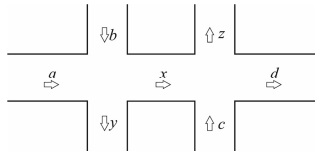
O tráfego de veículos em dois cruzamentos é ilustrado pelo diagrama a seguir, em que as setas indicam o sentido do tráfego e x, y, z, a, b, c e d expressam as quantidades de veículos por hora que passam nos cruzamentos.
Enunciado 3278066-1

A partir dessas informações, e considerando z = y, julgue o item seguinte.

Se a = 600, b = 150, c = 300 e d = 450, então o valor de x + y + z é inferior a 1.200.


Provas

Questão presente nas seguintes provas
2953860 Ano: 2023
Disciplina: Raciocínio Lógico
Banca: CESPE / CEBRASPE
Orgão: TBG
Provas:
O tráfego de veículos em dois cruzamentos é ilustrado pelo diagrama a seguir, em que as setas indicam o sentido do tráfego e x, y, z, a, b, c e d expressam as quantidades de veículos por hora que passam nos cruzamentos.
Enunciado 3278065-1

A partir dessas informações, e considerando z = y, julgue o item seguinte.

Se a = b = d = 100, então o valor de c não pode ser superior a 300.


Provas

Questão presente nas seguintes provas