Foram encontradas 64 questões.
A Figura 1 ilustra um sistema formado por um paralelepípedo homogêneo, de base quadrada, em repouso e apoiado sobre uma barra, disposta na horizontal e sustentada por dois fios, A e B. Inicialmente, os fios e a barra possuem o mesmo comprimento.
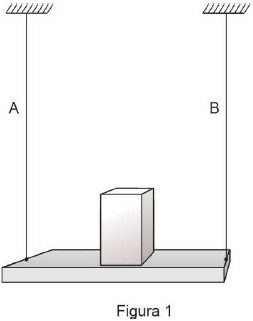
Os fios A e B são feitos de materiais cujos coeficientes de dilatação linear valem, respectivamente, !$ \alpha !$A e !$ \alpha !$B. Ao produzir uma variação de temperatura !$ \Delta \theta !$ em todos os elementos desse sistema, observa-se que todos se dilatam, permanecendo os fios na vertical, a barra se inclina e o paralelepípedo fica na iminência de escorregar e, também, tombar em relação à barra, conforme indica a Figura 2.
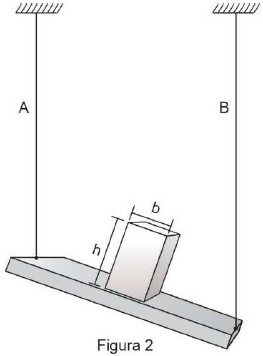
Nessas condições, e considerando que após a dilatação o paralelepípedo tem altura h, e que sua base quadrada tem aresta b, pode-se afirmar que a razão !$ h \over b !$ vale
Provas

Uma criança, sentada à beira da piscina, brinca com seu carrinho, de controle remoto, sobre uma prancha de madeira que flutua nas águas tranquilas dessa piscina.
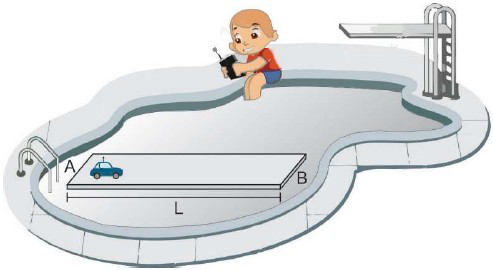
A prancha tem massa M e comprimento L e inicialmente está em repouso em relação à criança.
A partir de certo instante o carrinho, de massa m, que estava em repouso em relação à prancha, passa a realizar um movimento harmônico simples, em relação a um ponto fixo na terra, indo da extremidade A à extremidade B e, em marcha à ré, da extremidade B à extremidade A, num movimento unidimensional (paralelo à borda de comprimento L).
Considere desprezíveis as dimensões do carrinho em relação ao comprimento da prancha, !$ \mu !$ o coeficiente de atrito estático entre as rodinhas do carrinho e a prancha, g o módulo da aceleração da gravidade local e despreze o atrito entre a prancha e a água.
A máxima frequência que o movimento do carrinho poderá ter, sem que o mesmo escorregue, deve ser igual a
Provas
O circuito ilustrado a seguir é alimentado por uma bateria ideal de força eletromotriz !$ \varepsilon !$ igual a 12 V.
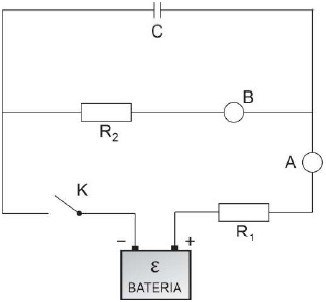
A e B são dois amperímetros ideais, K é uma chave aberta e C um capacitor de capacitância 10 mF, completamente descarregado. O circuito possui ainda dois resistores ôhmicos, R1 e R2, cujas resistências elétricas valem 2 !$ \Omega !$ e 10 !$ \Omega !$, respectivamente.
Ao fechar a chave K, a intensidade da corrente iA, medida pelo amperímetro A, em função da intensidade da corrente iB, medida pelo amperímetro B, está corretamente indicada pelo gráfico
Provas
Uma espira CDE, de resistência elétrica igual a 1 !$ \Omega !$, em forma de um triângulo equilátero de lado !$ \ell !$ igual a 20 cm, desliza, livre de qualquer atrito e resistência do ar, com velocidade constante !$ \vec{\text{v}} !$ de módulo igual a 30 cm/s sobre o plano xy na direção e sentido do eixo x, conforme ilustrado na figura abaixo:
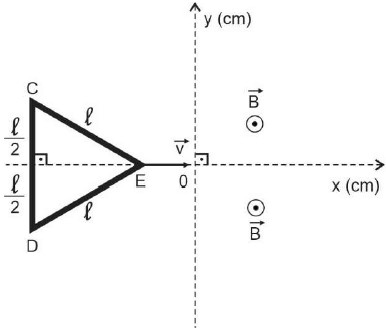
No semiespaço x > 0, atua um campo magnético uniforme e constante !$ \vec{B} !$, perpendicular ao plano xy, cujo módulo vale 2 T. A intensidade da força aplicada por um agente externo, na mesma direção e sentido da velocidade !$ \vec{\text{v}} !$, no instante em que o vértice E da espira estiver passando pelo ponto (15 , 0), a fim de manter a velocidade constante !$ \vec{\text{v}} !$, deverá ser, em mN, igual a
Provas
Um cilindro, contendo certa massa de gás perfeito, tem um pistão que está ligado a uma mola ideal. Ao fornecer certa quantidade de calor Q, para esse sistema termodinâmico, observa-se uma expansão do gás com a consequente deformação da mola !$ \Delta !$x, conforme indica figura a seguir.
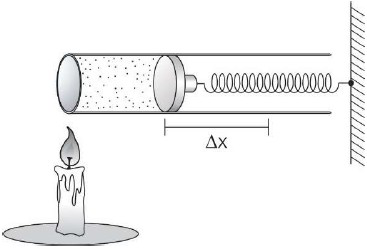
Em outro momento, para as mesmas condições iniciais anteriores, ao se fornecer o dobro da quantidade de calor 2Q, a esse sistema, observa-se que a mola sofre uma deformação duas vezes maior, 2!$ \Delta !$x.
Considerando que nas duas expansões o sistema tenha sofrido a mesma variação de energia interna e que não houve atrito entre o pistão e o cilindro, pode-se afirmar que a constante elástica da mola vale
Provas
Um aquário de paredes finas e área da base igual a S contém água cuja densidade vale μA, até a altura x (Figura A).
Um barquinho de madeira, com uma esfera maciça dentro dele, é posto a flutuar e o nível da água se eleva até a altura y (Figura B).
Ao retirar a esfera e colocá-la diretamente na água, com o barquinho ainda a flutuar, ela afunda e o nível de água altera para o valor z (Figura C).
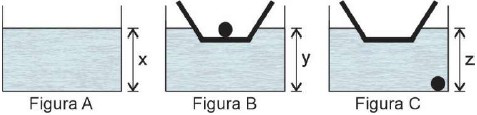
Considerando que as figuras foram feitas em escalas diferentes, e sendo o volume da esfera igual a V e sua densidade μE, pode-se afirmar corretamente que
Provas
Duas partículas, A e B, se movem, em sentidos opostos, em uma mesma trajetória.
No instante t0 = 0, a partícula A inicia do repouso e da origem dos espaços um movimento uniformemente variado, e a partícula B passa pela posição 3,0 m com velocidade constante, permanecendo em movimento uniforme.
No instante t = 2 s, as duas partículas, A e B, se encontram, tendo a partícula B percorrido uma distância igual a duas vezes a distância percorrida pela partícula A, conforme indica figura a seguir:

Nessas condições, a velocidade da partícula A, em m/s, no momento em que as partículas se encontram, é igual a
Provas
Elon Musk, the CEO of SpaceX and Tesla, caused something of a stir at the annual Air Force Association’s Air Warfare Symposium in Orlando, Florida. During an [A] informal ‘fireside chat’ with Lt. Gen. John Thompson of Space Command on Friday, Musk told a room packed with fighter pilots that “the fighter jet era has passed”. Now, Musk is renowned for finding soundbites for the media to hook onto, and also of causing [D] calculated disruption in his target audience, but even by his standards this is a well-baited line. What makes this such a bold and controversial statement?
The contemporary battlefield is far more networked, complex, congested and lethal – it’s those that adapt that will survive. Simply being ‘a good stick’ will rapidly no longer cut it in the hostile skies of the future.
Musk’s main thrust is, however, that the human in the cockpit is the limiting factor in air combat now, not the advantage.
Firstly, humans are awkward for aircraft designers to accommodate. In a modern fighter the pilot sits on an ejection seat for emergency escape, needs an oxygen supply and air-conditioning to function at extremes of temperature and altitude, and requires flight controls and instruments to fly and fight the machine. All of these add a significant amount of weight and cost into the aircraft. Moreover, having a transparent canopy to permit the crew to see out does [C] little to improve signature management1 as radar cross section and the chances of reflected sun glint all increase. The human also adds more weight, especially when encumbered with flight kit such as helmet, NVGs, g-suit and flight planning and survival equipment. Traditionally, pilots sit toward the front of the aircraft to afford them the best view for take-off and landing, as well as air combat. This has implications on aerodynamics, stealth1 design and weight distribution factors. In short, it can make the designers life a lot [B] simpler if the pilot/crew are not in the aircraft.
(Extracted from https://www.forbes.com/. Accessed on March 03, 2022.)
Vocabulary:
1. Signature management and stealth: both terms refer to technology that reduces the likelihood of personnel, aircrafts, missiles, etc. being detected.
Analyzing the grammatical aspects of the text, and considering the standard use of language, it’s correct to say that
Provas
Elon Musk, the CEO of SpaceX and Tesla, caused something of a stir at the annual Air Force Association’s Air Warfare Symposium in Orlando, Florida. During an informal ‘fireside chat’ with Lt. Gen. John Thompson of Space Command on Friday, Musk told a room packed with fighter pilots that “the fighter jet era has passed”. Now, Musk is renowned for finding soundbites for the media to hook onto, and also of causing calculated disruption in his target audience, but even by his standards this is a well-baited line. What makes this such a bold and controversial statement?
The contemporary battlefield is far more networked, complex, congested and lethal – it’s those that adapt that will survive. Simply being ‘a good stick’ will rapidly no longer cut it in the hostile skies of the future.
Musk’s main thrust is, however, that the human in the cockpit is the limiting factor in air combat now, not the advantage.
Firstly, humans are awkward for aircraft designers to accommodate. In a modern fighter the pilot sits on an ejection seat for emergency escape, needs an oxygen supply and air-conditioning to function at extremes of temperature and altitude, and requires flight controls and instruments to fly and fight the machine. All of these add a significant amount of weight and cost into the aircraft. Moreover, having a transparent canopy to permit the crew to see out does little to improve signature management1 as radar cross section and the chances of reflected sun glint all increase. The human also adds more weight, especially when encumbered with flight kit such as helmet, NVGs, g-suit and flight planning and survival equipment. Traditionally, pilots sit toward the front of the aircraft to afford them the best view for take-off and landing, as well as air combat. This has implications on aerodynamics, stealth1 design and weight distribution factors. In short, it can make the designers life a lot simpler if the pilot/crew are not in the aircraft.
(Extracted from https://www.forbes.com/. Accessed on March 03, 2022.)
Vocabulary:
1. Signature management and stealth: both terms refer to technology that reduces the likelihood of personnel, aircrafts, missiles, etc. being detected.
Decide if the sentences are true (T) or false (F) according to the text; then mark the right alternative.
I. Designers are challenged to find solutions that enable fitting flying conditions.
II. The human factor is considered an asset when it comes to air combat.
III. A transparent canopy is both an advantage and a disadvantage.
IV. The flying gear turns out to be heavy and expensive.
Provas
Elon Musk, the CEO of SpaceX and Tesla, caused something of a stir at the annual Air Force Association’s Air Warfare Symposium in Orlando, Florida. During an informal ‘fireside chat’ with Lt. Gen. John Thompson of Space Command on Friday, Musk told a room packed with fighter pilots that “the fighter jet era has passed”. Now, Musk is renowned for finding soundbites for the media to hook onto, and also of causing calculated disruption in his target audience, but even by his standards this is a well-baited line. What makes this such a bold and controversial statement?
The contemporary battlefield is far more networked, complex, congested and lethal – it’s those that adapt that will survive. Simply being ‘a good stick’ will rapidly no longer cut it in the hostile skies of the future.
Musk’s main thrust is, however, that the human in the cockpit is the limiting factor in air combat now, not the advantage.
Firstly, humans are awkward for aircraft designers to accommodate. In a modern fighter the pilot sits on an ejection seat for emergency escape, needs an oxygen supply and air-conditioning to function at extremes of temperature and altitude, and requires flight controls and instruments to fly and fight the machine. All of these add a significant amount of weight and cost into the aircraft. Moreover, having a transparent canopy to permit the crew to see out does little to improve signature management1 as radar cross section and the chances of reflected sun glint all increase. The human also adds more weight, especially when encumbered with flight kit such as helmet, NVGs, g-suit and flight planning and survival equipment. Traditionally, pilots sit toward the front of the aircraft to afford them the best view for take-off and landing, as well as air combat. This has implications on aerodynamics, stealth1 design and weight distribution factors. In short, it can make the designers life a lot simpler if the pilot/crew are not in the aircraft.
(Extracted from https://www.forbes.com/. Accessed on March 03, 2022.)
Vocabulary:
1. Signature management and stealth: both terms refer to technology that reduces the likelihood of personnel, aircrafts, missiles, etc. being detected.
In the future, pilots will
Provas
Caderno Container