Foram encontradas 70 questões.
Considere o croqui a seguir.
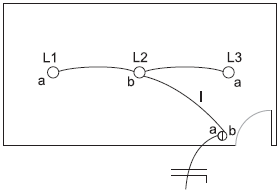
Sabendo-se que L1, L2 e L3 são lâmpadas incandescentes, ao completar o diagrama unifilar dessa instalação, no trecho I, além do neutro, tem-se
Provas

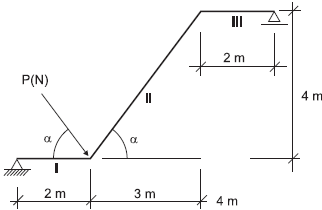
Na estrutura acima, o esforço Normal na barra III, em N, vale
Provas
Observe as condições de apoio do croqui das lajes maciças de concreto armado a seguir. As lajes adjacentes são contínuas com seus extremos simplesmente apoiados.

Considerando-se as charneiras aproximadas por retas inclinadas a partir dos vértices, a área de contribuição da laje para viga V3 é
Provas
Considere o levantamento planimétrico a seguir.
| Linha | Rumo | Distância (m) |
| RS | 29º 30' NE | 9 |
| ST | 60º 30' SE | 12 |
A distância RT, em metros, é de
Provas
Em obras de arruamento, a superfície obtida pela terraplanagem, em conformidade com o greide e as seções transversais projetadas, é denominada
Provas
O uso do prego de duas cabeças (cabeça dupla) é
Provas
Uma obra tem fundação em blocos de concreto ciclópico em forma de paralelepípedo, sendo 10 blocos de 0,80 m x 1,00 m, com altura de 0,70 m, e 5 blocos de 0,60 m x 0,80 m e 0,50 m de altura. Na composição, está previsto o uso de 30% de pedra de mão.
Considerando-se apenas o volume geométrico e sem levar em conta as perdas, qual o volume total, em m3, desse material?
Provas
O concreto de uma certa obra está especificado como C35 S50. No controle de qualidade do concreto recebido de uma central, nos ensaios para a determinação da consistência pelo abatimento do tronco de cone, foram encontrados os seguintes valores em milímetros: 35, 80, 65 e 110.
Por estarem de acordo com as normas da ABNT, foram aceitos APENAS os concretos cujos resultados dos ensaios foram
Provas
By Rachel Ehrenberg Science News, Web edition: Monday, February 21st, 2011
WASHINGTON — Getting blood or other perishable supplies to an area that’s been struck by an earthquake or hurricane isn’t as simple as asking what brown can do for you. But a new model quickly determines the best routes and means for delivering humanitarian aid, even in situations where bridges are out or airport tarmacs are clogged with planes.
The research, presented February 18 at the annual meeting of the American Association for the Advancement of Science, could help get supplies to areas which have experienced natural disasters or help prepare for efficient distribution of vaccines when the flu hits.
Efficient supply chains have long been a goal of manufacturers, but transport in fragile networks — where supply, demand and delivery routes may be in extremely rapid flux — requires a different approach, said Anna Nagurney of the University of Massachusetts Amherst, who presented the new work. Rather than considering the shortest path from one place to another to maximize profit, her system aims for the cleanest path at minimum cost, while capturing factors such as the perishability of the product and the uncertainty of supply routes. ‘You don’t know where demand is, so it’s tricky,’ said Nagurney. ‘It’s a multicriteria decision-making problem.’
By calculating the total cost associated with each link in a network, accounting for congestion and incorporating penalties for time and products that are lost, the computer model calculates the best supply chain in situations where standard routes may be disrupted.
‘Mathematical tools are essential to develop formal means to predict, and to respond to, such critical perturbations,’ said Iain Couzin of Princeton University, who uses similar computational tools to study collective animal behavior. ‘This is particularly important where response must be rapid and effective, such as during disaster scenarios … or during epidemics or breaches of national security.
’ The work can be applied to immediate, pressing situations, such as getting blood, food or medication to a disaster site, or to longer-term problems such as determining the best locations for manufacturing flu vaccines. . Retrieved April 7th, 2011.
Provas
By Rachel Ehrenberg Science News, Web edition: Monday, February 21st, 2011
WASHINGTON — Getting blood or other perishable supplies to an area that’s been struck by an earthquake or hurricane isn’t as simple as asking what brown can do for you. But a new model quickly determines the best routes and means for delivering humanitarian aid, even in situations where bridges are out or airport tarmacs are clogged with planes.
The research, presented February 18 at the annual meeting of the American Association for the Advancement of Science, could help get supplies to areas which have experienced natural disasters or help prepare for efficient distribution of vaccines when the flu hits.
Efficient supply chains have long been a goal of manufacturers, but transport in fragile networks — where supply, demand and delivery routes may be in extremely rapid flux — requires a different approach, said Anna Nagurney of the University of Massachusetts Amherst, who presented the new work. Rather than considering the shortest path from one place to another to maximize profit, her system aims for the cleanest path at minimum cost, while capturing factors such as the perishability of the product and the uncertainty of supply routes. ‘You don’t know where demand is, so it’s tricky,’ said Nagurney. ‘It’s a multicriteria decision-making problem.’
By calculating the total cost associated with each link in a network, accounting for congestion and incorporating penalties for time and products that are lost, the computer model calculates the best supply chain in situations where standard routes may be disrupted.
‘Mathematical tools are essential to develop formal means to predict, and to respond to, such critical perturbations,’ said Iain Couzin of Princeton University, who uses similar computational tools to study collective animal behavior. ‘This is particularly important where response must be rapid and effective, such as during disaster scenarios … or during epidemics or breaches of national security.
’ The work can be applied to immediate, pressing situations, such as getting blood, food or medication to a disaster site, or to longer-term problems such as determining the best locations for manufacturing flu vaccines. . Retrieved April 7th, 2011.
Provas
Caderno Container