Foram encontradas 45 questões.
Read the dialogue to answer 15.
Peter: Jackson is always late, he is also quite feckless. We should’ve already begun our rehearsal.
Kat: Oh, he just phoned me and said he’s on his way.
Peter: Better late than never.
Kat:________________________________
Choose the item to complete the dialogue.
Provas

Read the text to answer 11, 12, 13 and 14.
2016’s Manifest Misogyny
(By Margaret Talbot.)
At the end of the second Presidential debate, on October 9th, when an audience member asked if each candidate could say something positive about the other, Donald Trump declared Hillary Clinton a fighter: “She doesn’t quit. She doesn’t give up.” It was a surprising admission — Trump had spent the previous several weeks castigating Clinton for her weakness, her lack of “stamina” — and one of the few unassailably true things he said all evening.
Plenty of the attacks against Clinton over the years have been policy-oriented and substantive, stemming from her mishandling of health-care reform during her husband’s first Administration, or from her initial support for the war in Iraq, or from her use of a private e-mail server while she was Secretary of State — criticisms that could have been lobbed in the same terms at a male politician of similar ambition. But much of what Clinton has had to battle, for decades, is sexism. She has not, as Trump noted, given up.
When Patricia Schroeder, the former Democratic U.S. representative from Colorado, was campaigning in the nineteen-eighties, she was asked whether she was “running as a woman.” She replied, “Do I have a choice?”. Clinton has certainly never had a choice; she has been scrutinized and judged as a woman in every possible way from the moment she appeared on the national stage. She’s been criticized for using her maiden name, for her decision to continue working as a lawyer after her husband became governor of Arkansas, and for her lack of interest in cookie baking — not to mention for her hair, her ankles, her clothes, her smile, her laugh, and her voice. The conspiracy theories about the Clintons often partook of old fears and suspicions regarding women: that Hillary was a lesbian; that she was a Lady Macbeth, responsible for the murder of the deputy White House counsel Vince Foster. (Trump has revived that rumor, calling Foster’s death, a suicide, “very fishy.”).
During Clinton’s lifetime, institutionalized discrimination against women has retreated markedly. So has the routine sexism that assumes that a woman can’t, by definition, do a given job as well as a man, or that she shouldn’t be working outside the home at all. But what lingers is misogyny — the kind of hate- and fear-filled objectification of women that flourishes in corners of the Internet, and in the rhetoric of Trump and some of his supporters. It turns out that what some of them seemed to have meant when they said they were tired of being politically correct was that they were tired of addressing others with a modicum of respect.
Trump has been defending the boasts he made on the leaked “Access Hollywood” tape — that, as a “star,” he could “do anything” to women — by saying they were just words. That does not seem to have been the case: in the past week, a number of women have come forward with allegations that Trump groped or kissed them without their consent. But, in any event, words do matter, and Trump’s words about women, immigrants, and Muslims incite bigotry and fear.
There’s something both grotesque and bracing about the confrontation between Clinton, with her disciplined professionalism, and Trump, with his increasingly frenzied assertions of male prerogative. Like the female protagonist of a quest narrative — or, perhaps, of a dystopian fantasy — Clinton has made it through all her challenges to face the bull-headed Minotaur of sexism at the end of the maze.
(October 24, 2016. Available: http://www.newyorker.com. Adapted.)
According to the text, Trump has been a:
Provas
Read the text to answer 11, 12, 13 and 14.
2016’s Manifest Misogyny
(By Margaret Talbot.)
At the end of the second Presidential debate, on October 9th, when an audience member asked if each candidate could say something positive about the other, Donald Trump declared Hillary Clinton a fighter: “She doesn’t quit. She doesn’t give up.” It was a surprising admission — Trump had spent the previous several weeks castigating Clinton for her weakness, her lack of “stamina” — and one of the few unassailably true things he said all evening.
Plenty of the attacks against Clinton over the years have been policy-oriented and substantive, stemming from her mishandling of health-care reform during her husband’s first Administration, or from her initial support for the war in Iraq, or from her use of a private e-mail server while she was Secretary of State — criticisms that could have been lobbed in the same terms at a male politician of similar ambition. But much of what Clinton has had to battle, for decades, is sexism. She has not, as Trump noted, given up.
When Patricia Schroeder, the former Democratic U.S. representative from Colorado, was campaigning in the nineteen-eighties, she was asked whether she was “running as a woman.” She replied, “Do I have a choice?”. Clinton has certainly never had a choice; she has been scrutinized and judged as a woman in every possible way from the moment she appeared on the national stage. She’s been criticized for using her maiden name, for her decision to continue working as a lawyer after her husband became governor of Arkansas, and for her lack of interest in cookie baking — not to mention for her hair, her ankles, her clothes, her smile, her laugh, and her voice. The conspiracy theories about the Clintons often partook of old fears and suspicions regarding women: that Hillary was a lesbian; that she was a Lady Macbeth, responsible for the murder of the deputy White House counsel Vince Foster. (Trump has revived that rumor, calling Foster’s death, a suicide, “very fishy.”).
During Clinton’s lifetime, institutionalized discrimination against women has retreated markedly. So has the routine sexism that assumes that a woman can’t, by definition, do a given job as well as a man, or that she shouldn’t be working outside the home at all. But what lingers is misogyny — the kind of hate- and fear-filled objectification of women that flourishes in corners of the Internet, and in the rhetoric of Trump and some of his supporters. It turns out that what some of them seemed to have meant when they said they were tired of being politically correct was that they were tired of addressing others with a modicum of respect.
Trump has been defending the boasts he made on the leaked “Access Hollywood” tape — that, as a “star,” he could “do anything” to women — by saying they were just words. That does not seem to have been the case: in the past week, a number of women have come forward with allegations that Trump groped or kissed them without their consent. But, in any event, words do matter, and Trump’s words about women, immigrants, and Muslims incite bigotry and fear.
There’s something both grotesque and bracing about the confrontation between Clinton, with her disciplined professionalism, and Trump, with his increasingly frenzied assertions of male prerogative. Like the female protagonist of a quest narrative — or, perhaps, of a dystopian fantasy — Clinton has made it through all her challenges to face the bull-headed Minotaur of sexism at the end of the maze.
(October 24, 2016. Available: http://www.newyorker.com. Adapted.)
Clinton has been criticized for
Provas
Read the text to answer 11, 12, 13 and 14.
2016’s Manifest Misogyny
(By Margaret Talbot.)
At the end of the second Presidential debate, on October 9th, when an audience member asked if each candidate could say something positive about the other, Donald Trump declared Hillary Clinton a fighter: “She doesn’t quit. She doesn’t give up.” It was a surprising admission — Trump had spent the previous several weeks castigating Clinton for her weakness, her lack of “stamina” — and one of the few unassailably true things he said all evening.
Plenty of the attacks against Clinton over the years have been policy-oriented and substantive, stemming from her mishandling of health-care reform during her husband’s first Administration, or from her initial support for the war in Iraq, or from her use of a private e-mail server while she was Secretary of State — criticisms that could have been lobbed in the same terms at a male politician of similar ambition. But much of what Clinton has had to battle, for decades, is sexism. She has not, as Trump noted, given up.
When Patricia Schroeder, the former Democratic U.S. representative from Colorado, was campaigning in the nineteen-eighties, she was asked whether she was “running as a woman.” She replied, “Do I have a choice?”. Clinton has certainly never had a choice; she has been scrutinized and judged as a woman in every possible way from the moment she appeared on the national stage. She’s been criticized for using her maiden name, for her decision to continue working as a lawyer after her husband became governor of Arkansas, and for her lack of interest in cookie baking — not to mention for her hair, her ankles, her clothes, her smile, her laugh, and her voice. The conspiracy theories about the Clintons often partook of old fears and suspicions regarding women: that Hillary was a lesbian; that she was a Lady Macbeth, responsible for the murder of the deputy White House counsel Vince Foster. (Trump has revived that rumor, calling Foster’s death, a suicide, “very fishy.”).
During Clinton’s lifetime, institutionalized discrimination against women has retreated markedly. So has the routine sexism that assumes that a woman can’t, by definition, do a given job as well as a man, or that she shouldn’t be working outside the home at all. But what lingers is misogyny — the kind of hate- and fear-filled objectification of women that flourishes in corners of the Internet, and in the rhetoric of Trump and some of his supporters. It turns out that what some of them seemed to have meant when they said they were tired of being politically correct was that they were tired of addressing others with a modicum of respect.
Trump has been defending the boasts he made on the leaked “Access Hollywood” tape — that, as a “star,” he could “do anything” to women — by saying they were just words. That does not seem to have been the case: in the past week, a number of women have come forward with allegations that Trump groped or kissed them without their consent. But, in any event, words do matter, and Trump’s words about women, immigrants, and Muslims incite bigotry and fear.
There’s something both grotesque and bracing about the confrontation between Clinton, with her disciplined professionalism, and Trump, with his increasingly frenzied assertions of male prerogative. Like the female protagonist of a quest narrative — or, perhaps, of a dystopian fantasy — Clinton has made it through all her challenges to face the bull-headed Minotaur of sexism at the end of the maze.
(October 24, 2016. Available: http://www.newyorker.com. Adapted.)
Patricia Schroeder’s “running as a woman” (L 11) means that:
Provas
Read the text to answer 11, 12, 13 and 14.
2016’s Manifest Misogyny
(By Margaret Talbot.)
At the end of the second Presidential debate, on October 9th, when an audience member asked if each candidate could say something positive about the other, Donald Trump declared Hillary Clinton a fighter: “She doesn’t quit. She doesn’t give up.” It was a surprising admission — Trump had spent the previous several weeks castigating Clinton for her weakness, her lack of “stamina” — and one of the few unassailably true things he said all evening.
Plenty of the attacks against Clinton over the years have been policy-oriented and substantive, stemming from her mishandling of health-care reform during her husband’s first Administration, or from her initial support for the war in Iraq, or from her use of a private e-mail server while she was Secretary of State — criticisms that could have been lobbed in the same terms at a male politician of similar ambition. But much of what Clinton has had to battle, for decades, is sexism. She has not, as Trump noted, given up.
When Patricia Schroeder, the former Democratic U.S. representative from Colorado, was campaigning in the nineteen-eighties, she was asked whether she was “running as a woman.” She replied, “Do I have a choice?”. Clinton has certainly never had a choice; she has been scrutinized and judged as a woman in every possible way from the moment she appeared on the national stage. She’s been criticized for using her maiden name, for her decision to continue working as a lawyer after her husband became governor of Arkansas, and for her lack of interest in cookie baking — not to mention for her hair, her ankles, her clothes, her smile, her laugh, and her voice. The conspiracy theories about the Clintons often partook of old fears and suspicions regarding women: that Hillary was a lesbian; that she was a Lady Macbeth, responsible for the murder of the deputy White House counsel Vince Foster. (Trump has revived that rumor, calling Foster’s death, a suicide, “very fishy.”).
During Clinton’s lifetime, institutionalized discrimination against women has retreated markedly. So has the routine sexism that assumes that a woman can’t, by definition, do a given job as well as a man, or that she shouldn’t be working outside the home at all. But what lingers is misogyny — the kind of hate- and fear-filled objectification of women that flourishes in corners of the Internet, and in the rhetoric of Trump and some of his supporters. It turns out that what some of them seemed to have meant when they said they were tired of being politically correct was that they were tired of addressing others with a modicum of respect.
Trump has been defending the boasts he made on the leaked “Access Hollywood” tape — that, as a “star,” he could “do anything” to women — by saying they were just words. That does not seem to have been the case: in the past week, a number of women have come forward with allegations that Trump groped or kissed them without their consent. But, in any event, words do matter, and Trump’s words about women, immigrants, and Muslims incite bigotry and fear.
There’s something both grotesque and bracing about the confrontation between Clinton, with her disciplined professionalism, and Trump, with his increasingly frenzied assertions of male prerogative. Like the female protagonist of a quest narrative — or, perhaps, of a dystopian fantasy — Clinton has made it through all her challenges to face the bull-headed Minotaur of sexism at the end of the maze.
(October 24, 2016. Available: http://www.newyorker.com. Adapted.)
Trump recognizes that Clinton is NOT
Provas
Texto III para responder às questões 09 e 10.
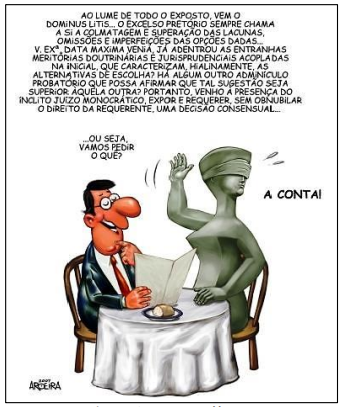
(Disponível em: http://gilnei-os.blogspot.com.br/2010/07/abaixo-ao-juridiques.html.)
Considerando os textos II e III pode-se afirmar que:
Provas
Texto II para responder às questões de 06 a 10.
“Juridiquês” é alvo de discussão em todo o País
Entre as maneiras de se escrever uma ação ou uma decisão judicial não só a poesia é vista de forma diferente. A forma rebuscada também. A recente reforma do Código de Processo Civil trouxe além da busca por agilidade nos processos jurídicos um debate acerca do vocabulário jurídico.
“Consorte supérstite”, por exemplo, significa viúvo. Pior, “ergástulo público” é sinônimo de cadeia. Esse excesso de preciosismo é considerado pelo advogado especialista em redação jurídica, Carlos André Nunes, dispensável em determinadas situações, como na busca do Latim. “Existe ainda quem utilize uma linguagem rebuscada, como em séculos passados, e em muitas vezes desnecessárias. Há ainda a redundância dispensável, como em termos em Latim. Aquele que recebe a prestação de serviços jurisdicionais não consegue entender o que está acontecendo”, salientou. “Nesse processo de reforma a grande discussão é de como o direito vai se expor diante do público em termos de texto”, complementou.
Há, inclusive, uma recomendação do Conselho Nacional de Justiça (CNJ) para a simplificação das decisões judiciais. “Eu já pratico isso há muito tempo. Não sou adepto de uma linguagem tão rebuscada. Sou a favor das decisões de forma clara e mais objetiva”, afirmou o desembargador Walter Carlos Lemes, presidente do TRE-GO.
Há, porém, uma questão a ser considerada, segundo Carlos André Nunes, em relação aos termos técnicos no Direito, outra questão também criticada. Para ele, alguns têm que ser mantidos.
“Nós temos que fazer uma diferenciação daquilo que chamamos de ‘juridiquês’ e a necessidade de se usar os termos técnicos. Precisamos saber o momento ideal de utilizar. Existem termos específicos em toda profissão, como engenheiros e médicos. Toda ciência utiliza-se disso. É o caso do direito também. São termos necessários para o bom processo de comunicação na petição inicial”, defendeu. “Mesmo que haja uma simplificação. Eu não vejo com bons olhos retirar os termos técnicos”, pontuou.
(Disponível em: http://www.opopular.com.br/editorias/cidade/juridiqu%C3%AAs-%C3%A9-alvo-de-discuss%C3%A3o-em-todo-o-pa%C3%ADs1.896833 12/07/2015. Adaptado.)
De acordo com as ideias trazidas ao texto, é correto afirmar que:
Provas
Texto II para responder às questões de 06 a 10.
“Juridiquês” é alvo de discussão em todo o País
Entre as maneiras de se escrever uma ação ou uma decisão judicial não só a poesia é vista de forma diferente. A forma rebuscada também. A recente reforma do Código de Processo Civil trouxe além da busca por agilidade nos processos jurídicos um debate acerca do vocabulário jurídico.
“Consorte supérstite”, por exemplo, significa viúvo. Pior, “ergástulo público” é sinônimo de cadeia. Esse excesso de preciosismo é considerado pelo advogado especialista em redação jurídica, Carlos André Nunes, dispensável em determinadas situações, como na busca do Latim. “Existe ainda quem utilize uma linguagem rebuscada, como em séculos passados, e em muitas vezes desnecessárias. Há ainda a redundância dispensável, como em termos em Latim. Aquele que recebe a prestação de serviços jurisdicionais não consegue entender o que está acontecendo”, salientou. “Nesse processo de reforma a grande discussão é de como o direito vai se expor diante do público em termos de texto”, complementou.
Há, inclusive, uma recomendação do Conselho Nacional de Justiça (CNJ) para a simplificação das decisões judiciais. “Eu já pratico isso há muito tempo. Não sou adepto de uma linguagem tão rebuscada. Sou a favor das decisões de forma clara e mais objetiva”, afirmou o desembargador Walter Carlos Lemes, presidente do TRE-GO.
Há, porém, uma questão a ser considerada, segundo Carlos André Nunes, em relação aos termos técnicos no Direito, outra questão também criticada. Para ele, alguns têm que ser mantidos.
“Nós temos que fazer uma diferenciação daquilo que chamamos de ‘juridiquês’ e a necessidade de se usar os termos técnicos. Precisamos saber o momento ideal de utilizar. Existem termos específicos em toda profissão, como engenheiros e médicos. Toda ciência utiliza-se disso. É o caso do direito também. São termos necessários para o bom processo de comunicação na petição inicial”, defendeu. “Mesmo que haja uma simplificação. Eu não vejo com bons olhos retirar os termos técnicos”, pontuou.
(Disponível em: http://www.opopular.com.br/editorias/cidade/juridiqu%C3%AAs-%C3%A9-alvo-de-discuss%C3%A3o-em-todo-o-pa%C3%ADs1.896833 12/07/2015. Adaptado.)
Em relação às estruturas linguísticas, analise o que se afirma a seguir e assinale a alternativa verdadeira.
Provas
Texto II para responder às questões de 06 a 10.
“Juridiquês” é alvo de discussão em todo o País
Entre as maneiras de se escrever uma ação ou uma decisão judicial não só a poesia é vista de forma diferente. A forma rebuscada também. A recente reforma do Código de Processo Civil trouxe além da busca por agilidade nos processos jurídicos um debate acerca do vocabulário jurídico.
“Consorte supérstite”, por exemplo, significa viúvo. Pior, “ergástulo público” é sinônimo de cadeia. Esse excesso de preciosismo é considerado pelo advogado especialista em redação jurídica, Carlos André Nunes, dispensável em determinadas situações, como na busca do Latim. “Existe ainda quem utilize uma linguagem rebuscada, como em séculos passados, e em muitas vezes desnecessárias. Há ainda a redundância dispensável, como em termos em Latim. Aquele que recebe a prestação de serviços jurisdicionais não consegue entender o que está acontecendo”, salientou. “Nesse processo de reforma a grande discussão é de como o direito vai se expor diante do público em termos de texto”, complementou.
Há, inclusive, uma recomendação do Conselho Nacional de Justiça (CNJ) para a simplificação das decisões judiciais. “Eu já pratico isso há muito tempo. Não sou adepto de uma linguagem tão rebuscada. Sou a favor das decisões de forma clara e mais objetiva”, afirmou o desembargador Walter Carlos Lemes, presidente do TRE-GO.
Há, porém, uma questão a ser considerada, segundo Carlos André Nunes, em relação aos termos técnicos no Direito, outra questão também criticada. Para ele, alguns têm que ser mantidos.
“Nós temos que fazer uma diferenciação daquilo que chamamos de ‘juridiquês’ e a necessidade de se usar os termos técnicos. Precisamos saber o momento ideal de utilizar. Existem termos específicos em toda profissão, como engenheiros e médicos. Toda ciência utiliza-se disso. É o caso do direito também. São termos necessários para o bom processo de comunicação na petição inicial”, defendeu. “Mesmo que haja uma simplificação. Eu não vejo com bons olhos retirar os termos técnicos”, pontuou.
(Disponível em: http://www.opopular.com.br/editorias/cidade/juridiqu%C3%AAs-%C3%A9-alvo-de-discuss%C3%A3o-em-todo-o-pa%C3%ADs1.896833 12/07/2015. Adaptado.)
Considerando as funções sintaticamente estabelecidas pelos termos empregados na construção das orações, pode-se afirmar que entre os destacados a seguir, DIFERE-SE quanto à classificação dos demais apenas:
Provas
Texto I para responder às questões de 01 a 05.
Um pé de milho
Os americanos, através do radar, entraram em contato com a Lua, o que não deixa de ser emocionante. Mas o fato mais importante da semana aconteceu com o meu pé de milho.
Aconteceu que, no meu quintal, em um monte de terra trazida pelo jardineiro, nasceu alguma coisa que podia ser um pé de capim – mas descobri que era um pé de milho. Transplantei-o para o exíguo canteiro da casa. Secaram as pequenas folhas; pensei que fosse morrer. Mas ele reagiu. Quando estava do tamanho de um palmo, veio um amigo e declarou desdenhosamente que aquilo era capim. Quando estava com dois palmos, veio um outro amigo e afirmou que era cana.
Sou um ignorante, um pobre homem da cidade. Mas eu tinha razão. Ele cresceu, está com dois metros, lança suas folhas além do muro e é um esplêndido pé de milho. Já viu o leitor um pé de milho? Eu nunca tinha visto. Tinha visto centenas de milharais – mas é diferente.
Um pé de milho sozinho, em um canteiro espremido, junto do portão, numa esquina de rua – não é um número numa lavoura, é um ser vivo e independente.
Suas raízes roxas se agarram no chão e suas folhas longas e verdes nunca estão imóveis. Detesto comparações surrealistas – mas na glória de seu crescimento, tal como vi numa noite de luar, o pé de milho parecia um cavalo empinado, de crinas ao vento e em outra madrugada, parecia um galo cantando.
Anteontem aconteceu o que era inevitável, mas que nos encantou como se fosse inesperado: meu pé de milho pendoou. Há muitas flores lindas no mundo, e a flor de milho não será a mais linda. Mas aquele pendão firme, vertical, beijado pelo vento do mar, veio enriquecer nosso canteirinho vulgar com uma força e uma alegria que me fazem bem. É alguma coisa que se afirma com ímpeto e certeza. Meu pé de milho é um belo gesto da terra. Eu não sou mais um medíocre homem que vive atrás de uma chata máquina de escrever: sou um rico lavrador da Rua Júlio de Castilhos.
(BRAGA, Rubem. Um pé de milho. In: ________. 200 (Duzentas) crônicas escolhidas. 22 ed. Rio de Janeiro: Record, 2004, p. 77.)
Em “Detesto comparações surrealistas – mas na glória de seu crescimento, tal como vi numa noite de luar, o pé de milho parecia um cavalo empinado, de crinas ao vento e em outra madrugada, parecia um galo cantando.” (5º§) é possível inferir que
Provas
Caderno Container