Foram encontradas 90 questões.
Mitocôndrias e cloroplastos são organelas celulares relacionadas à produção de energia. Nas mitocôndrias ocorre a produção de ATP a partir da quebra de moléculas combustíveis com a utilização de oxigênio. Já os cloroplastos são responsáveis pela captação da energia solar que será transformada em energia química armazenada em carboidratos, aminoácidos e ácidos graxos.
Considerando a presença ou a ausência dessas organelas em células animais e células vegetais, é CORRETO afirmar que:
Provas

"As membranas biológicas permitem a passagem de algumas substâncias, mas impedem o trânsito de outras. Essa característica das membranas é referida como permeabilidade seletiva. A permeabilidade seletiva permite que a membrana determine quais substâncias poderão penetrar ou sair de uma célula ou organela."
Fonte: Sadava et al. Vida: A Ciência da Biologia. Volume I.
Em relação à seletividade da membrana plasmática, abordada no texto, é CORRETO afirmar que:
Provas
Pelo espírito atribulado do sertanejo passou a ideia de abandonar o filho naquele descampado. Pensou nos urubus, nas ossadas, coçou a barba ruiva e suja, irresoluto, examinou os arredores. Sinhá Vitória estirou o beiço indicando vagamente uma direção e afirmou com alguns sons guturais que estavam perto. Fabiano meteu a faca na bainha, guardou-a no cinturão, acocorou-se, pegou no pulso do menino, que se encolhia, os joelhos encostados no estômago, frio como um defunto. Aí a cólera desapareceu e Fabiano teve pena. Impossível abandonar o anjinho aos bichos do mato. Entregou a espingarda a Sinhá Vitória, pôs o filho no cangote, levantou-se, agarrou os bracinhos que lhe caíam sobre o peito, moles, finos como cambitos. Sinhá Vitória aprovou esse arranjo, lançou de novo a interjeição gutural, designou os juazeiros invisíveis.
E a viagem prosseguiu, mais lenta, mais arrastada, num silêncio grande.
Ausente do companheiro, a cachorra Baleia tomou a frente do grupo. Arqueada, as costelas à mostra, corria ofegando, a língua fora da boca. E de quando em quando se detinha, esperando as pessoas, que se retardavam.
Vidas Secas, Graciliano Ramos
Sobre Vidas Secas, de Graciliano Ramos, marque a opção CORRETA:
Provas
Queimadas no Pantanal em 2020 superaram recorde histórico
Número de focos de queimadas registrados em 2020 superaram o total de três anos anteriores, segundo o Inpe. (Dândara Genelhú em 08h52 - 02/01/2021)
Marcado com cenário de fogo e fumaça, causados pelas queimadas, o Pantanal foi o bioma mais afetado em 2020. O índice de queimadas registrado pelo Inpe (Instituto Nacional de Pesquisas Espaciais) foi o maior da história.
Assim, desde 1998, quando começaram a monitorar a situação, não havia sido registrada tamanha destruição por queimadas. Apenas em 2020, foram 22.116 focos de incêndio contabilizados pelo Inpe. O bioma faz parte do território de Mato Grosso do Sul e Mato Grosso.
Além de ser o maior registro histórico de queimadas, esta foi a primeira vez em que o Pantanal registrou mais de 12,5 mil focos de incêndio. Antes, o recorde de queimadas era de 12.536 focos, em 2005. Então, se comparado o mesmo período dos anos com maiores índices de queimadas, o aumento do último ano foi de 76.41%.
Indo mais além, 2020 teve mais focos de incêndio no Pantanal do que os três anos anteriores juntos. Em 2019 foram 10.025 focos, em 2018 foram 1.691 e 2017 registrou 5.773. Com isso, somam 17.489 focos de queimadas.
Pantanal sul-mato-grossense
No MS foram registrados 12.080 focos de queimadas em 2020. De acordo com a CNN, o último número expressivo no Estado aconteceu em 2005, quando houveram 12.904 focos de incêndio.
Então, segundo levantamento do INPE, a semana com mais focos registrados foi de 28 de setembro até 04 de outubro de 2020. Neste período foram contabilizados 1.276 focos de queimadas.
Assim, mais de 40 mil km2 do Pantanal inteiro foram devastados até novembro. Ou seja, cerca de 30% do bioma já foi devastado. O apontamento foi realizado pelo LASA (Laboratório de Aplicações de Satélites Ambientais), da UFRJ (Universidade Federal do Rio de Janeiro), e divulgado pela CNN. [...]
Texto reproduzido fielmente conforme publicado em https://www.midiamax.com.br/cotidiano/2021/queimadas-no-pantanal-em-2020-superaram-recorde-historico (acesso em 02/01/2021)
Ao lermos os versos do poeta e compositor Neuber Uchôa em “Mujica com paçoca”, observamos elementos da cultura roraimense: “Nossa Senhora da Consolata abençoa a nossa festa,/Mujica pro Carnaval como índio pra floresta/ Senhora da Consolata abençoa a nossa festa, /Mujica pro Carnaval como índio pra floresta/ Paçoca, a volta por cima da carne seca/ Nossa música que toca/ Soca soca/ Mujica pro carnaval/ Nossa Senhora paçoca”. Destacando a palavra paçoca e pensando nas variações de compreensão dessa palavra em outras regiões do Brasil, chamamos esse tipo de variação linguística de:
Provas
The World’s Largest Tropical Wetland Has Become an Inferno
By Catrin Einhorn, Maria Magdalena Arréllaga, Blacki Migliozzi and Scott Reinhard
This year, roughly a quarter of the vast Pantanal wetland in Brazil, one of the most biodiverse places on Earth, has burned in wildfires worsened by climate change. What happens to a rich and unique biome when so much is destroyed?
The unprecedented fires in the wetland have attracted less attention than blazes in Australia, the Western United States and the Amazon, its celebrity sibling to the north. But while the Pantanal is not a global household name, tourists in the know flock there because it is home to exceptionally high concentrations of breathtaking wildlife: Jaguars, tapirs, endangered giant otters and bright blue hyacinth macaws. Like a vast tub, the wetland swells with water during the rainy season and empties out during the dry months. Fittingly, this rhythm has a name that evokes a beating heart: the flood pulse.
The wetland, which is larger than Greece and stretches over parts of Brazil, Paraguay and Bolivia, also offers unseen gifts to a vast swath of South America by regulating the water cycle upon which life depends. Its countless swamps, lagoons and tributaries purify water and help prevent floods and droughts. They also store untold amounts of carbon, helping to stabilize the climate.
(…)
Naturally occurring fire plays a role in the Pantanal, in addition to the burning by ranchers. The flames are usually contained by the landscape’s mosaic of water. But this year’s drought sucked these natural barriers dry. The fires are far worse than any since satellite records began.
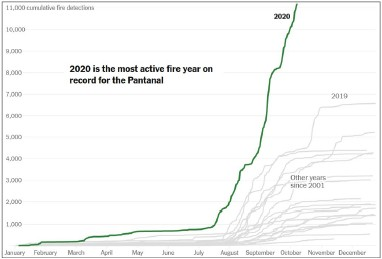
Note: Cumulative sum of fire detections across the Pantanal Biome. Data as of Oct. 12. Instruments on Terra and Aqua satellites have experienced periodic failures. Source: NASA Terra and Aqua satellite data, based on detections with greater than 95 percent confidence levels.
The fires are also worse than any in the memory of the Guató people, an Indigenous group whose ancestors have lived in the Pantanal for thousands of years.
Guató leaders in an Indigenous territory called Baía dos Guató said the fires spread from the ranches that surround their land, and satellite images confirm that the flames swept in from the outside. When fire started closing in on the home of Sandra Guató Silva, a community leader and healer, she fought to save it with the help of her son, grandson and a boat captain with a hose.
(...)
Now Ms. Guató Silva mourns the loss of nature itself. “It makes me sick,” she said. “The birds don’t sing anymore. I no longer hear the song of the Chaco chachalaca bird. Even the jaguar that once scared me is suffering. That hurts me. I suffer from depression because of this. Now there is a hollow silence. I feel as though our freedom has left us, has been taken from us with the nature that we have always protected.”
Disponível em: https://www.nytimes.com/interactive/2020/10/13/climate/pantanal-brazil-fires.html Acesso em: 12 nov. 2020.
The excerpt “Guató leaders in an Indigenous territory called Baía dos Guató said the fires spread from the ranches that surround their land” would be correctly written in the direct style as shown in the following sentence:
Provas
The World’s Largest Tropical Wetland Has Become an Inferno
By Catrin Einhorn, Maria Magdalena Arréllaga, Blacki Migliozzi and Scott Reinhard
This year, roughly a quarter of the vast Pantanal wetland in Brazil, one of the most biodiverse places on Earth, has burned in wildfires worsened by climate change. What happens to a rich and unique biome when so much is destroyed?
The unprecedented fires in the wetland have attracted less attention than blazes in Australia, the Western United States and the Amazon, its celebrity sibling to the north. But while the Pantanal is not a global household name, tourists in the know flock there because it is home to exceptionally high concentrations of breathtaking wildlife: Jaguars, tapirs, endangered giant otters and bright blue hyacinth macaws. Like a vast tub, the wetland swells with water during the rainy season and empties out during the dry months. Fittingly, this rhythm has a name that evokes a beating heart: the flood pulse.
The wetland, which is larger than Greece and stretches over parts of Brazil, Paraguay and Bolivia, also offers unseen gifts to a vast swath of South America by regulating the water cycle upon which life depends. Its countless swamps, lagoons and tributaries purify water and help prevent floods and droughts. They also store untold amounts of carbon, helping to stabilize the climate.
(…)
Naturally occurring fire plays a role in the Pantanal, in addition to the burning by ranchers. The flames are usually contained by the landscape’s mosaic of water. But this year’s drought sucked these natural barriers dry. The fires are far worse than any since satellite records began.
Note: Cumulative sum of fire detections across the Pantanal Biome. Data as of Oct. 12. Instruments on Terra and Aqua satellites have experienced periodic failures. Source: NASA Terra and Aqua satellite data, based on detections with greater than 95 percent confidence levels.
The fires are also worse than any in the memory of the Guató people, an Indigenous group whose ancestors have lived in the Pantanal for thousands of years.
Guató leaders in an Indigenous territory called Baía dos Guató said the fires spread from the ranches that surround their land, and satellite images confirm that the flames swept in from the outside. When fire started closing in on the home of Sandra Guató Silva, a community leader and healer, she fought to save it with the help of her son, grandson and a boat captain with a hose.
(...)
Now Ms. Guató Silva mourns the loss of nature itself. “It makes me sick,” she said. “The birds don’t sing anymore. I no longer hear the song of the Chaco chachalaca bird. Even the jaguar that once scared me is suffering. That hurts me. I suffer from depression because of this. Now there is a hollow silence. I feel as though our freedom has left us, has been taken from us with the nature that we have always protected.”
Disponível em: https://www.nytimes.com/interactive/2020/10/13/climate/pantanal-brazil-fires.html Acesso em: 12 nov. 2020.
By analyzing the data presented by The New York Times agency graph, it is correct to affirm that the fires started being detected across the Pantanal Biome in:
Provas
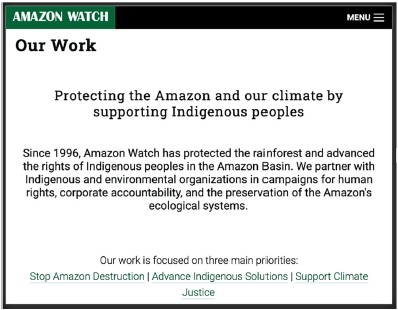
Disponível em: https://amazonwatch.org/work. Acesso em 01 dez. 2020.
The organization Amazon Watch presented on the website works to protect the Amazon rainforest as well as to promote the rights of indigenous peoples in the region. The sentence that indicates their work started in the past and continues in the present is:
Provas
Disponível em: https://amazonwatch.org/work. Acesso em 01 dez. 2020.
O texto apresenta a página principal de uma organização sem fins lucrativos sediada no Canadá denominada Amazon Watch. Ao clicar nos links disponibilizados ao fim do texto, o leitor poderá saber mais sobre:
Provas
Brazil's Amazon rainforest suffers worst fires in a decade
Fires in Brazil’s Amazon increased 13% in the first nine months of the year compared with a year ago, as the rainforest region experiences its worst rash of blazes in a decade, data from space research agency Inpe has shown. Satellites in September recorded 32,017 hotspots in the world’s largest rainforest, a 61% rise from the same month in 2019. In August last year, surging fires in the Amazon captured global headlines and prompted criticism from world leaders such as France’s Emmanuel Macron that Brazil was not doing enough to protect the rainforest.
On Tuesday, the US Democratic presidential candidate, Joe Biden, called for a world effort to offer $20bn to end Amazon deforestation and threatened Brazil with unspecified “economic consequences” if it did not “stop tearing down the forest”. President Jair Bolsonaro lambasted Biden’s comment as a “cowardly threat” to Brazil’s sovereignty and a “clear sign of contempt”.
Data from Inpe released on Thursday showed that in 2019, fires spiked in August and declined considerably the month after, but this year’s peak has been more sustained. Both August and September of 2020 have matched or surpassed last year’s single-month high. “We have had two months with a lot of fire. It’s already worse than last year,” said Ane Alencar, science director for Brazil’s Amazon Environmental Research Institute (Ipam). “It could get worse if the drought continues. We are at the mercy of the rain.” The Amazon is experiencing a more severe dry season than last year, which scientists attribute in part to warming in the tropical North Atlantic Ocean pulling moisture away from South America.
(...)
The warming of the North Atlantic is also helping drive drought in the Brazilian Pantanal, the world’s largest wetland, which has suffered more fires this year than ever previously recorded, according to Inpe data.
A Federal University of Rio de Janeiro analysis found that 23% of the wetlands, which are home to the densest population of jaguars in the world, has burned. “Brazil is on fire,” said Cristiane Mazzetti, a forest campaigner for advocacy group Greenpeace Brasil, in a statement.
Available at: https://www.theguardian.com/environment/2020/oct/01/brazil-amazon-rainforest-worst-fires-in-decade. Last access on November 16, 2020
Considere as afirmativas a seguir e marque a alternativa CORRETA, de acordo com as informações possíveis de se obter a partir do texto:
I. O Brasil possui a maior região pantaneira e a maior floresta tropical do mundo.
II. O Brasil experimentou o maior incêndio na região de floresta tropical em uma década.
III. À altura da elaboração da matéria, a situação do fogo já havia chegado ao limite.
IV. O estrago causado pelo fogo na região amazônica foi pior do que o da região pantaneira.
V. Apesar da intensidade do incêndio em 2020, a seca em 2019 foi mais agressiva na Amazônia.
De acordo com o texto:
Provas

Disponível em: https://www.ncronline.org/news/earthbeat/francis-chronicles/francis-comic-strip-1 Acesso em 12 nov. 2020
O uso do modo imperativo deve ser feito cuidadosamente por se tratar de uma forma direta. Assim sendo, a alternativa que substitui a frase "Close the window, Leo!", de maneira que ela soe menos direta e mais polida, sem a perda do seu sentido original, é:
Provas
Caderno Container