Foram encontradas 416 questões.
On May 13th, 1822, a group of 186 women sent Maria Leopoldina the Letter from the Bahian Women to Her Royal Highness Dona Leopoldina, congratulating her on her role in the patriotic rulings of her husband, Prince Regent Dom Pedro. The document acknowledged the contribution made by the then princess and empress-to-be to ensuring her husband’s permanence in Brazil, which they believed was a key factor in gaining independence from Portugal. “Far more than just a letter, it is a political manifesto,” notes historian Maria de Lourdes Viana Lyra. “At that time, in Brazil, women were given a subordinate role restricted to private household and family affairs. Outside the domestic sphere, women were made invisible, but that did not stop them from mobilizing politically to fight for independence in a variety of ways,” she states.
In addition to isolated actions led by famous figures, there were other many significant actions that are still largely unknown to the general public, more specifically, those related to instances of collective mobilization of women active in the public arena during the fight for Brazilian independence. Historian Andréa Slemian expands on the matter. “Throughout this process, many women expressed themselves through letters, manifestos, and other texts. Thus, the nascent press in Brazil played an important role, not only by publishing these women’s ideas regarding independence on editorial pages, for example, but also by serving as a mouthpiece for views supporting women’s rights,” notes Slemian.
Ana Paula Orlandi. Unafraid to fight. Internet:<www.revistapesquisa.fapesp.br> (adapted).
Considering the ideas and linguistic aspects of the text above, judge the following item.
The passage “which they believed was a key factor” could be correctly rewritten in the passive voice as which was believed to be a key factor, without this changing the meaning and coherence of the text.
Provas

On May 13th, 1822, a group of 186 women sent Maria Leopoldina the Letter from the Bahian Women to Her Royal Highness Dona Leopoldina, congratulating her on her role in the patriotic rulings of her husband, Prince Regent Dom Pedro. The document acknowledged the contribution made by the then princess and empress-to-be to ensuring her husband’s permanence in Brazil, which they believed was a key factor in gaining independence from Portugal. “Far more than just a letter, it is a political manifesto,” notes historian Maria de Lourdes Viana Lyra. “At that time, in Brazil, women were given a subordinate role restricted to private household and family affairs. Outside the domestic sphere, women were made invisible, but that did not stop them from mobilizing politically to fight for independence in a variety of ways,” she states.
In addition to isolated actions led by famous figures, there were other many significant actions that are still largely unknown to the general public, more specifically, those related to instances of collective mobilization of women active in the public arena during the fight for Brazilian independence. Historian Andréa Slemian expands on the matter. “Throughout this process, many women expressed themselves through letters, manifestos, and other texts. Thus, the nascent press in Brazil played an important role, not only by publishing these women’s ideas regarding independence on editorial pages, for example, but also by serving as a mouthpiece for views supporting women’s rights,” notes Slemian.
Ana Paula Orlandi. Unafraid to fight. Internet:<www.revistapesquisa.fapesp.br> (adapted).
Considering the ideas and linguistic aspects of the text above, judge the following item.
Even though the press supported women who were in favor of Brazilian independence, it did not help them in their struggle for their rights.
Provas
On May 13th, 1822, a group of 186 women sent Maria Leopoldina the Letter from the Bahian Women to Her Royal Highness Dona Leopoldina, congratulating her on her role in the patriotic rulings of her husband, Prince Regent Dom Pedro. The document acknowledged the contribution made by the then princess and empress-to-be to ensuring her husband’s permanence in Brazil, which they believed was a key factor in gaining independence from Portugal. “Far more than just a letter, it is a political manifesto,” notes historian Maria de Lourdes Viana Lyra. “At that time, in Brazil, women were given a subordinate role restricted to private household and family affairs. Outside the domestic sphere, women were made invisible, but that did not stop them from mobilizing politically to fight for independence in a variety of ways,” she states.
In addition to isolated actions led by famous figures, there were other many significant actions that are still largely unknown to the general public, more specifically, those related to instances of collective mobilization of women active in the public arena during the fight for Brazilian independence. Historian Andréa Slemian expands on the matter. “Throughout this process, many women expressed themselves through letters, manifestos, and other texts. Thus, the nascent press in Brazil played an important role, not only by publishing these women’s ideas regarding independence on editorial pages, for example, but also by serving as a mouthpiece for views supporting women’s rights,” notes Slemian.
Ana Paula Orlandi. Unafraid to fight. Internet:<www.revistapesquisa.fapesp.br> (adapted).
Considering the ideas and linguistic aspects of the text above, judge the following item.
In the title of the letter alluded to in the first paragraph, the word “her” is used four times with the same meaning and could correctly be replaced by his in all four cases, had the letter been written to the Prince.
Provas
On May 13th, 1822, a group of 186 women sent Maria Leopoldina the Letter from the Bahian Women to Her Royal Highness Dona Leopoldina, congratulating her on her role in the patriotic rulings of her husband, Prince Regent Dom Pedro. The document acknowledged the contribution made by the then princess and empress-to-be to ensuring her husband’s permanence in Brazil, which they believed was a key factor in gaining independence from Portugal. “Far more than just a letter, it is a political manifesto,” notes historian Maria de Lourdes Viana Lyra. “At that time, in Brazil, women were given a subordinate role restricted to private household and family affairs. Outside the domestic sphere, women were made invisible, but that did not stop them from mobilizing politically to fight for independence in a variety of ways,” she states.
In addition to isolated actions led by famous figures, there were other many significant actions that are still largely unknown to the general public, more specifically, those related to instances of collective mobilization of women active in the public arena during the fight for Brazilian independence. Historian Andréa Slemian expands on the matter. “Throughout this process, many women expressed themselves through letters, manifestos, and other texts. Thus, the nascent press in Brazil played an important role, not only by publishing these women’s ideas regarding independence on editorial pages, for example, but also by serving as a mouthpiece for views supporting women’s rights,” notes Slemian.
Ana Paula Orlandi. Unafraid to fight. Internet:<www.revistapesquisa.fapesp.br> (adapted).
Considering the ideas and linguistic aspects of the text above, judge the following item.
It can be correctly inferred from the text that the general public is unaware of many different facts which led to Brazilian independence.
Provas
On May 13th, 1822, a group of 186 women sent Maria Leopoldina the Letter from the Bahian Women to Her Royal Highness Dona Leopoldina, congratulating her on her role in the patriotic rulings of her husband, Prince Regent Dom Pedro. The document acknowledged the contribution made by the then princess and empress-to-be to ensuring her husband’s permanence in Brazil, which they believed was a key factor in gaining independence from Portugal. “Far more than just a letter, it is a political manifesto,” notes historian Maria de Lourdes Viana Lyra. “At that time, in Brazil, women were given a subordinate role restricted to private household and family affairs. Outside the domestic sphere, women were made invisible, but that did not stop them from mobilizing politically to fight for independence in a variety of ways,” she states.
In addition to isolated actions led by famous figures, there were other many significant actions that are still largely unknown to the general public, more specifically, those related to instances of collective mobilization of women active in the public arena during the fight for Brazilian independence. Historian Andréa Slemian expands on the matter. “Throughout this process, many women expressed themselves through letters, manifestos, and other texts. Thus, the nascent press in Brazil played an important role, not only by publishing these women’s ideas regarding independence on editorial pages, for example, but also by serving as a mouthpiece for views supporting women’s rights,” notes Slemian.
Ana Paula Orlandi. Unafraid to fight. Internet:<www.revistapesquisa.fapesp.br> (adapted).
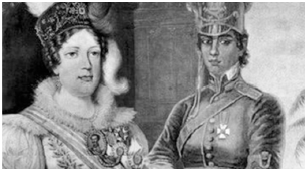
Based on the picture above, which shows paintings depicting Empress Maria Leopoldina and Maria Quitéria de Jesus, and the information given in the previous text, it is correct to state that both these women
Provas
Internet : <www.one.be>.
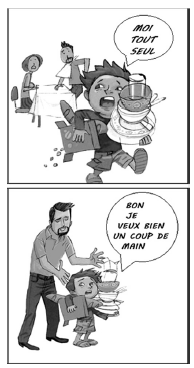
À partir des vignettes ci-dessus, jugez l’item 29 et choisissez l’option correcte concernant l’item 30, cet item-ci étant du tipo C.
La phrase de la deuxième vignette met en évidence que l’enfant
Provas
Internet : <www.one.be>.
À partir des vignettes ci-dessus, jugez l’item 29 et choisissez l’option correcte concernant l’item 30, cet item-ci étant du tipo C.
On peut dire que, par son comportement, l’enfant exprime une tentative d’indépendance.
Provas
Internet: <bu.uco.fr>.
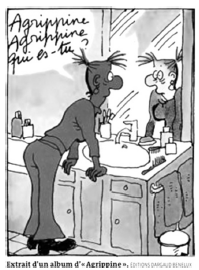
D’après la vignette ci-dessus, jugez le item.
Agrippine souffre d’un trouble de distorsion de l’image corporelle.
Provas
Internet: <bu.uco.fr>.
D’après la vignette ci-dessus, jugez le item.
Agrippine cherche à reconnaître sa valeur.
Provas

Le Brésil indépendant et le Portugal (1822-1922) — normalisation politique, liens culturels et migrations
Marie-Jo Ferreira (Auteur).
Fruits d’un processus atypique dans le contexte sud-américain — le propre fils du roi du Portugal devenant premier empereur du Brésil indépendant — les relations entre le Portugal et le Brésil sont, après 1822, traversées par des périodes tour à tour conflictuelles et cordiales. Ce livre retrace la trajectoire politique des relations entre les deux pays depuis l’Indépendance jusqu’en 1922, année où fut célébrée l’existence d’une union fraternelle entre les deux pays.
Internet : <www.cultura.com>.
D’après le texte ci-dessus, jugez le item.
En considérant le contexte, l’expression « tour à tour » (dans « les relations entre le Portugal et le Brésil sont, après 1822, traversées par des périodes tour à tour conflictuelles etcordiales ») a le même sens que successivement.
Provas
Caderno Container