Foram encontradas 357 questões.
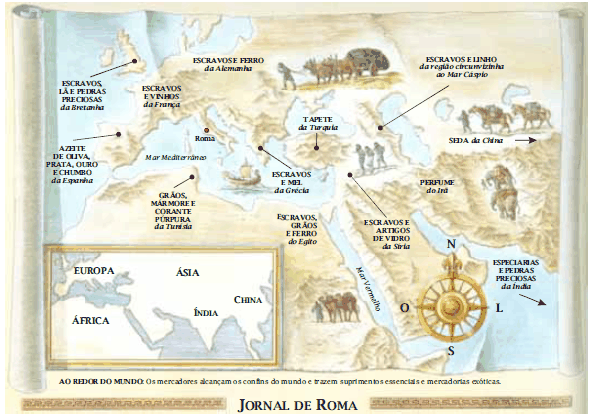
Peter Morter. In: Andrew Langley e Philip de Souza. Jornal de Roma 800 a.C-400 d.C. Belo
Hor izonte: Ed. Dimensão Ltda. e Walker Brooks, s/d, p. 12.
No mapa acima, estão representadas as longas distâncias percorridas pelos homens na Antiguidade, quando viajar era uma atividade
extremamente perigosa, tal como se depreende do texto a seguir.
Viajando por terra ou mar, arriscando suas vidas, os mercadores ficavam lo 1 nge de suas famílias durante meses ou até mesmo anos. Piratas emboscados e naufrágios eram apenas alguns dos perigos que esses bravos tinham de enfrentar em nome de todos. Por que os mercadores continuavam a participar daquelas jornadas arriscadas? Bom, não era apenas pelo dinheiro. O alimento vendido por eles ajudava as pessoas a matarem a fome. Eram tantos vivendo nas cidades, que não era possível cultivar a quantidade suficiente de alimento para todos. Sem a colheita dos grãos do Egito ou sem os carregamentos de vinho da região que hoje corresponde à França e o azeite de oliva da região correspondente à Espanha, o que essas sociedades fariam?
Idem, ibidem (com adaptações).
Tendo como referência o mapa e o texto acima bem como os múltiplos aspectos por eles suscitados, julgue o item a seguir.
A informação expressa na sentença iniciada pelo termo “O alimento” é ratificada no mapa, dado serem desse tipo os produtos predominantes no comércio ali representado.
Provas

Peter Morter. In: Andrew Langley e Philip de Souza. Jornal de Roma 800 a.C-400 d.C. Belo
Hor izonte: Ed. Dimensão Ltda. e Walker Brooks, s/d, p. 12.
No mapa acima, estão representadas as longas distâncias percorridas pelos homens na Antiguidade, quando viajar era uma atividade
extremamente perigosa, tal como se depreende do texto a seguir.
Viajando por terra ou mar, arriscando suas vidas, os mercadores ficavam lo 1 nge de suas famílias durante meses ou até mesmo anos. Piratas emboscados e naufrágios eram apenas alguns dos perigos que esses bravos tinham de enfrentar em nome de todos. Por que os mercadores continuavam a participar daquelas jornadas arriscadas? Bom, não era apenas pelo dinheiro. O alimento vendido por eles ajudava as pessoas a matarem a fome. Eram tantos vivendo nas cidades, que não era possível cultivar a quantidade suficiente de alimento para todos. Sem a colheita dos grãos do Egito ou sem os carregamentos de vinho da região que hoje corresponde à França e o azeite de oliva da região correspondente à Espanha, o que essas sociedades fariam?
Idem, ibidem (com adaptações).
Tendo como referência o mapa e o texto acima bem como os múltiplos aspectos por eles suscitados, julgue o item a seguir.
Na Antiguidade, Roma era denominada a cidade eterna e, para manter o seu status de cabeça (capital) do império, era fundamental que demonstrasse autossuficiência quanto a abastecimento e eliminasse qualquer laço de dependência com outras cidades.
Provas
Peter Morter. In: Andrew Langley e Philip de Souza. Jornal de Roma 800 a.C-400 d.C. Belo
Hor izonte: Ed. Dimensão Ltda. e Walker Brooks, s/d, p. 12.
No mapa acima, estão representadas as longas distâncias percorridas pelos homens na Antiguidade, quando viajar era uma atividade
extremamente perigosa, tal como se depreende do texto a seguir.
Viajando por terra ou mar, arriscando suas vidas, os mercadores ficavam lo 1 nge de suas famílias durante meses ou até mesmo anos. Piratas emboscados e naufrágios eram apenas alguns dos perigos que esses bravos tinham de enfrentar em nome de todos. Por que os mercadores continuavam a participar daquelas jornadas arriscadas? Bom, não era apenas pelo dinheiro. O alimento vendido por eles ajudava as pessoas a matarem a fome. Eram tantos vivendo nas cidades, que não era possível cultivar a quantidade suficiente de alimento para todos. Sem a colheita dos grãos do Egito ou sem os carregamentos de vinho da região que hoje corresponde à França e o azeite de oliva da região correspondente à Espanha, o que essas sociedades fariam?
Idem, ibidem (com adaptações).
Tendo como referência o mapa e o texto acima bem como os múltiplos aspectos por eles suscitados, julgue o item a seguir.
A localização da Somália, na região conhecida como Chifre da África, e as guerras civis ali vivenciadas criaram condições para o surgimento, nessa região, de ações de pirataria, que se desenvolveram com o emprego de tecnologia avançada.
Provas
Peter Morter. In: Andrew Langley e Philip de Souza. Jornal de Roma 800 a.C-400 d.C. Belo
Hor izonte: Ed. Dimensão Ltda. e Walker Brooks, s/d, p. 12.
No mapa acima, estão representadas as longas distâncias percorridas pelos homens na Antiguidade, quando viajar era uma atividade
extremamente perigosa, tal como se depreende do texto a seguir.
Viajando por terra ou mar, arriscando suas vidas, os mercadores ficavam lo 1 nge de suas famílias durante meses ou até mesmo anos. Piratas emboscados e naufrágios eram apenas alguns dos perigos que esses bravos tinham de enfrentar em nome de todos. Por que os mercadores continuavam a participar daquelas jornadas arriscadas? Bom, não era apenas pelo dinheiro. O alimento vendido por eles ajudava as pessoas a matarem a fome. Eram tantos vivendo nas cidades, que não era possível cultivar a quantidade suficiente de alimento para todos. Sem a colheita dos grãos do Egito ou sem os carregamentos de vinho da região que hoje corresponde à França e o azeite de oliva da região correspondente à Espanha, o que essas sociedades fariam?
Idem, ibidem (com adaptações).
Tendo como referência o mapa e o texto acima bem como os múltiplos aspectos por eles suscitados, julgue o item a seguir.
Na Antiguidade, as rotas comerciais de longa distância uniam o Oriente ao Ocidente, como a famosa rota da seda, caminho monopolizado pelos tecelões chineses.
Provas
Bus systems provide a versatile form of public transportation with the flexibility to serve a variety of access needs and unlimited range of locations throughout a metropolitan area. Buses also travel on urban roadways, so infrastructure investments can be substantially lower than the capital costs required for rail systems. As a result, bus service can be implemented cost-effectively on many routes. Yet, despite the inherent advantages of a bus service, conventional urban buses inching their way through congested streets don’t win much political support. The essence of a Bus Rapid Transit is to improve bus operating speed and reliability on arterial streets by reducing or eliminating the various types of delay.
The bus system of Curitiba, Brazil, exemplifies a model Bus Rapid Transit (BRT) system, and plays a large part in making this a livable city. The buses run frequently — some as often as every 90 seconds — and reliably, and the stations are convenient, well-designed, comfortable, and attractive. Consequently, Curitiba has one of the most frequently used, yet low-cost, transit systems in the world. It offers many of the features of a subway system — vehicle movements unimpeded by traffic lights and congestion, fare collection prior to boarding, quick passenger loading and unloading — but it is above ground and visible. Around 70 percent of Curitiba’s commuters use BRT to travel to work, resulting in congestion-free streets and pollution free air for the 2.2 million inhabitants of greater Curitiba.
Internet: <www.urbanhabitat.org> (adapted).
According to what is stated in the text, it can be deduced that
nowhere in the world can it be found such a transit system as good as that of Curitiba.
Provas
Bus systems provide a versatile form of public transportation with the flexibility to serve a variety of access needs and unlimited range of locations throughout a metropolitan area. Buses also travel on urban roadways, so infrastructure investments can be substantially lower than the capital costs required for rail systems. As a result, bus service can be implemented cost-effectively on many routes. Yet, despite the inherent advantages of a bus service, conventional urban buses inching their way through congested streets don’t win much political support. The essence of a Bus Rapid Transit is to improve bus operating speed and reliability on arterial streets by reducing or eliminating the various types of delay.
The bus system of Curitiba, Brazil, exemplifies a model Bus Rapid Transit (BRT) system, and plays a large part in making this a livable city. The buses run frequently — some as often as every 90 seconds — and reliably, and the stations are convenient, well-designed, comfortable, and attractive. Consequently, Curitiba has one of the most frequently used, yet low-cost, transit systems in the world. It offers many of the features of a subway system — vehicle movements unimpeded by traffic lights and congestion, fare collection prior to boarding, quick passenger loading and unloading — but it is above ground and visible. Around 70 percent of Curitiba’s commuters use BRT to travel to work, resulting in congestion-free streets and pollution free air for the 2.2 million inhabitants of greater Curitiba.
Internet: <www.urbanhabitat.org> (adapted).
According to what is stated in the text, it can be deduced that
the buses in Curitiba pick up passengers every 90 seconds.
Provas
Bus systems provide a versatile form of public transportation with the flexibility to serve a variety of access needs and unlimited range of locations throughout a metropolitan area. Buses also travel on urban roadways, so infrastructure investments can be substantially lower than the capital costs required for rail systems. As a result, bus service can be implemented cost-effectively on many routes. Yet, despite the inherent advantages of a bus service, conventional urban buses inching their way through congested streets don’t win much political support. The essence of a Bus Rapid Transit is to improve bus operating speed and reliability on arterial streets by reducing or eliminating the various types of delay.
The bus system of Curitiba, Brazil, exemplifies a model Bus Rapid Transit (BRT) system, and plays a large part in making this a livable city. The buses run frequently — some as often as every 90 seconds — and reliably, and the stations are convenient, well-designed, comfortable, and attractive. Consequently, Curitiba has one of the most frequently used, yet low-cost, transit systems in the world. It offers many of the features of a subway system — vehicle movements unimpeded by traffic lights and congestion, fare collection prior to boarding, quick passenger loading and unloading — but it is above ground and visible. Around 70 percent of Curitiba’s commuters use BRT to travel to work, resulting in congestion-free streets and pollution free air for the 2.2 million inhabitants of greater Curitiba.
Internet: <www.urbanhabitat.org> (adapted).
According to what is stated in the text, it can be deduced that
thanks to Curitiba’s BRT, the city became a worth living place.
Provas
Bus systems provide a versatile form of public transportation with the flexibility to serve a variety of access needs and unlimited range of locations throughout a metropolitan area. Buses also travel on urban roadways, so infrastructure investments can be substantially lower than the capital costs required for rail systems. As a result, bus service can be implemented cost-effectively on many routes. Yet, despite the inherent advantages of a bus service, conventional urban buses inching their way through congested streets don’t win much political support. The essence of a Bus Rapid Transit is to improve bus operating speed and reliability on arterial streets by reducing or eliminating the various types of delay.
The bus system of Curitiba, Brazil, exemplifies a model Bus Rapid Transit (BRT) system, and plays a large part in making this a livable city. The buses run frequently — some as often as every 90 seconds — and reliably, and the stations are convenient, well-designed, comfortable, and attractive. Consequently, Curitiba has one of the most frequently used, yet low-cost, transit systems in the world. It offers many of the features of a subway system — vehicle movements unimpeded by traffic lights and congestion, fare collection prior to boarding, quick passenger loading and unloading — but it is above ground and visible. Around 70 percent of Curitiba’s commuters use BRT to travel to work, resulting in congestion-free streets and pollution free air for the 2.2 million inhabitants of greater Curitiba.
Internet: <www.urbanhabitat.org> (adapted).
According to what is stated in the text, it can be deduced that
BRT in Curitiba can be taken as an instance of a workable solution to the cities’ traffic problems.
Provas
Bus systems provide a versatile form of public transportation with the flexibility to serve a variety of access needs and unlimited range of locations throughout a metropolitan area. Buses also travel on urban roadways, so infrastructure investments can be substantially lower than the capital costs required for rail systems. As a result, bus service can be implemented cost-effectively on many routes. Yet, despite the inherent advantages of a bus service, conventional urban buses inching their way through congested streets don’t win much political support. The essence of a Bus Rapid Transit is to improve bus operating speed and reliability on arterial streets by reducing or eliminating the various types of delay.
The bus system of Curitiba, Brazil, exemplifies a model Bus Rapid Transit (BRT) system, and plays a large part in making this a livable city. The buses run frequently — some as often as every 90 seconds — and reliably, and the stations are convenient, well-designed, comfortable, and attractive. Consequently, Curitiba has one of the most frequently used, yet low-cost, transit systems in the world. It offers many of the features of a subway system — vehicle movements unimpeded by traffic lights and congestion, fare collection prior to boarding, quick passenger loading and unloading — but it is above ground and visible. Around 70 percent of Curitiba’s commuters use BRT to travel to work, resulting in congestion-free streets and pollution free air for the 2.2 million inhabitants of greater Curitiba.
Internet: <www.urbanhabitat.org> (adapted).
According to what is stated in the text, it can be deduced that
Bus Rapid Transit succeeded in improving bus speed and reliability by taking away the several causes of delay, once and for all.
Provas
Bus systems provide a versatile form of public transportation with the flexibility to serve a variety of access needs and unlimited range of locations throughout a metropolitan area. Buses also travel on urban roadways, so infrastructure investments can be substantially lower than the capital costs required for rail systems. As a result, bus service can be implemented cost-effectively on many routes. Yet, despite the inherent advantages of a bus service, conventional urban buses inching their way through congested streets don’t win much political support. The essence of a Bus Rapid Transit is to improve bus operating speed and reliability on arterial streets by reducing or eliminating the various types of delay.
The bus system of Curitiba, Brazil, exemplifies a model Bus Rapid Transit (BRT) system, and plays a large part in making this a livable city. The buses run frequently — some as often as every 90 seconds — and reliably, and the stations are convenient, well-designed, comfortable, and attractive. Consequently, Curitiba has one of the most frequently used, yet low-cost, transit systems in the world. It offers many of the features of a subway system — vehicle movements unimpeded by traffic lights and congestion, fare collection prior to boarding, quick passenger loading and unloading — but it is above ground and visible. Around 70 percent of Curitiba’s commuters use BRT to travel to work, resulting in congestion-free streets and pollution free air for the 2.2 million inhabitants of greater Curitiba.
Internet: <www.urbanhabitat.org> (adapted).
According to what is stated in the text, it can be deduced that
buses tend to move very slowly or in a lot of short stages, which favours congested streets.
Provas
Caderno Container