Foram encontradas 90 questões.
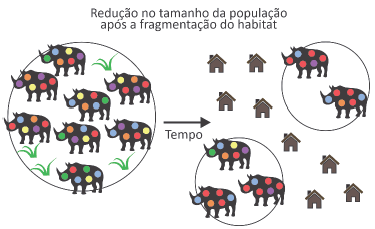
A imagem a seguir ilustra o aparecimento de uma barreira que promoveu separação de uma população de rinocerontes e consequente redução no tamanho das populações resultantes.
Disponível em https://kids.frontiersin.org/articles/10.3389/ (Adaptado).
É correto afirmar que, nas populações fragmentadas, ocorre
Provas

TEXTO PARA A QUESTÃO.
Climate change is messing with time
“The melting of polar ice due to global warming is affecting Earth’s rotation and could impact on precision timekeeping, according to a recent study.
The planet is not about to jerk to a halt, nor speed up so rapidly that everyone gets flung into space. But timekeeping is an exact science in a highly technological society, which is why global authorities more than half a century ago felt compelled by the slight changes in Earth’s rotation to invent the concept of the ‘leap second’.
Climate change makes these calculations even more complicated: Soon it may be necessary to insert a ‘negative leap second’ into the calendar to get the planet’s rotation in sync with Coordinated Universal Time.
Timekeeping is based on an astronomical basis. Earth is a type of a clock. In simpler times, the planet would spin one full revolution on its axis, and everyone would call it a day.
But Earth doesn’t spin at a perfectly constant speed. Our planet is in a complicated gravitational dance with the moon, the sun, the oceanic tides, Earth’s own atmosphere and the motion of the planet’s solid inner core.
The planet’s fluctuating spin rate is carefully tracked by the International Earth Rotation and Reference Systems Service. In the early 1970s, Earth was clearly slowing down in its rotation, and a gap was forming between atomic time and astronomical time. Thus, was born the ‘leap second’ to adjust for the fact that the ‘day’ was getting a bit longer.
The melting of the ice caps in Antarctica and Greenland shifts mass — meltwater — toward the equator. That process increases the equatorial bulge of the planet. Meanwhile, at the poles, the land that had been pressed down by ice rises, and Earth becomes more spherical.
According to the study, although the core is causing the planet to spin faster, the planetary shape changes caused by a warming climate are slowing that process. Absent this effect, the overall acceleration of the planet’s rotation might require timekeepers to insert a ‘negative leap second’ at the end of 2026. Because of climate change, that might not be necessary until 2029.”
Disponível em https://www.washingtonpost.com/science/2024/03/27/ (Adaptado).
Considerando os seres vivos atuais, as informações trazidas pelo texto e os princípios da Teoria Sintética da Evolução, é correto afirmar que
Provas
TEXTO PARA A QUESTÃO.
Climate change is messing with time
“The melting of polar ice due to global warming is affecting Earth’s rotation and could impact on precision timekeeping, according to a recent study.
The planet is not about to jerk to a halt, nor speed up so rapidly that everyone gets flung into space. But timekeeping is an exact science in a highly technological society, which is why global authorities more than half a century ago felt compelled by the slight changes in Earth’s rotation to invent the concept of the ‘leap second’.
Climate change makes these calculations even more complicated: Soon it may be necessary to insert a ‘negative leap second’ into the calendar to get the planet’s rotation in sync with Coordinated Universal Time.
Timekeeping is based on an astronomical basis. Earth is a type of a clock. In simpler times, the planet would spin one full revolution on its axis, and everyone would call it a day.
But Earth doesn’t spin at a perfectly constant speed. Our planet is in a complicated gravitational dance with the moon, the sun, the oceanic tides, Earth’s own atmosphere and the motion of the planet’s solid inner core.
The planet’s fluctuating spin rate is carefully tracked by the International Earth Rotation and Reference Systems Service. In the early 1970s, Earth was clearly slowing down in its rotation, and a gap was forming between atomic time and astronomical time. Thus, was born the ‘leap second’ to adjust for the fact that the ‘day’ was getting a bit longer.
The melting of the ice caps in Antarctica and Greenland shifts mass — meltwater — toward the equator. That process increases the equatorial bulge of the planet. Meanwhile, at the poles, the land that had been pressed down by ice rises, and Earth becomes more spherical.
According to the study, although the core is causing the planet to spin faster, the planetary shape changes caused by a warming climate are slowing that process. Absent this effect, the overall acceleration of the planet’s rotation might require timekeepers to insert a ‘negative leap second’ at the end of 2026. Because of climate change, that might not be necessary until 2029.”
Disponível em https://www.washingtonpost.com/science/2024/03/27/ (Adaptado).
Conforme o texto, os fenômenos naturais que desempenham papel significativo na complexa interação gravitacional que afeta a rotação da Terra são
Provas
TEXTO PARA A QUESTÃO.
Climate change is messing with time
“The melting of polar ice due to global warming is affecting Earth’s rotation and could impact on precision timekeeping, according to a recent study.
The planet is not about to jerk to a halt, nor speed up so rapidly that everyone gets flung into space. But timekeeping is an exact science in a highly technological society, which is why global authorities more than half a century ago felt compelled by the slight changes in Earth’s rotation to invent the concept of the ‘leap second’.
Climate change makes these calculations even more complicated: Soon it may be necessary to insert a ‘negative leap second’ into the calendar to get the planet’s rotation in sync with Coordinated Universal Time.
Timekeeping is based on an astronomical basis. Earth is a type of a clock. In simpler times, the planet would spin one full revolution on its axis, and everyone would call it a day.
But Earth doesn’t spin at a perfectly constant speed. Our planet is in a complicated gravitational dance with the moon, the sun, the oceanic tides, Earth’s own atmosphere and the motion of the planet’s solid inner core.
The planet’s fluctuating spin rate is carefully tracked by the International Earth Rotation and Reference Systems Service. In the early 1970s, Earth was clearly slowing down in its rotation, and a gap was forming between atomic time and astronomical time. Thus, was born the ‘leap second’ to adjust for the fact that the ‘day’ was getting a bit longer.
The melting of the ice caps in Antarctica and Greenland shifts mass — meltwater — toward the equator. That process increases the equatorial bulge of the planet. Meanwhile, at the poles, the land that had been pressed down by ice rises, and Earth becomes more spherical.
According to the study, although the core is causing the planet to spin faster, the planetary shape changes caused by a warming climate are slowing that process. Absent this effect, the overall acceleration of the planet’s rotation might require timekeepers to insert a ‘negative leap second’ at the end of 2026. Because of climate change, that might not be necessary until 2029.”
Disponível em https://www.washingtonpost.com/science/2024/03/27/ (Adaptado).
Segundo o texto, o processo de derretimento das calotas polares
Provas
Atualmente 80% do comércio mundial transita pelos mares, principalmente em rotas que passam pelos Canais do Panamá e de Suez. Com a redução das calotas polares, novas rotas estão surgindo no Ártico. Mesmo com sua fragilidade ambiental, a região passou a ser uma nova fronteira para o comércio mundial.
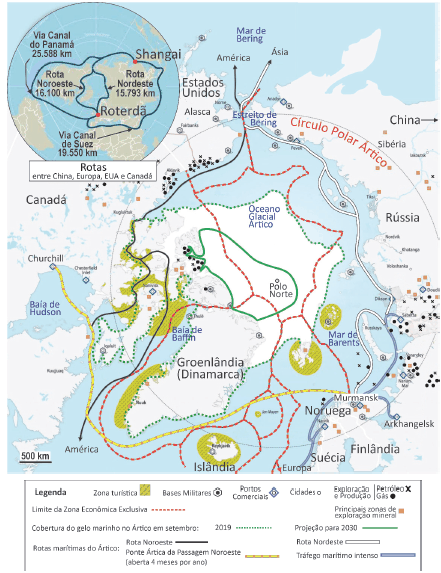
Carto Le monde en cartes, n.59, maio-junho 2020 (Adaptado).
Com base no texto, na leitura do mapa e em seus conhecimentos sobre as rotas marítimas, assinale a alternativa correta.
Provas
“Historiadores encontraram um mapa antigo onde não era possível identificar a escala do mapa. Com algum esforço e apoio de Geógrafos, foi possível avaliar a distância no mapa entre duas localidades como sendo de 20 centímetros. Buscando elementos na paisagem, foi possível quantificar a distância entre elas como equivalente a 40 quilômetros.
” FITZ, Paulo Roberto. Cartografia Básica. São Paulo: Oficina de Textos, 2008 (Adaptado).
Com base nessas medidas, a escala numérica do mapa corresponde a
Provas
Na zona sul da cidade de São Paulo, há uma esquina formada pelas ruas Cloreto de Sódio e Relíquia do Oceano.
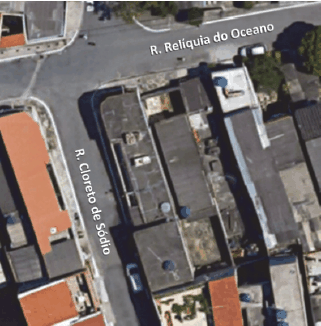
A coincidência do encontro dessas ruas chama a atenção, pois o cloreto de sódio
Provas
Considere o texto a seguir.
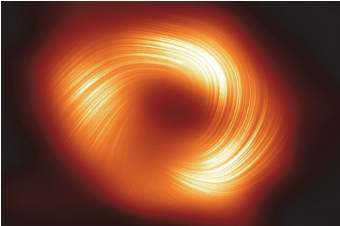
The Event Horizon Telescope Collaboration.
“Com observações feitas pela primeira vez em luz polarizada, a nova imagem do buraco negro que se esconde no coração da Via Láctea revelou um campo magnético com uma estrutura muito semelhante à de outro buraco negro situado no centro da galáxia M87, sugerindo que campos magnéticos intensos podem ser comuns a todos os buracos negros.
A luz é uma onda eletromagnética que nos permite ver objetos. Por vezes, os campos elétrico e magnético associados à onda oscilam em direções preferenciais, definindo o que chamamos de luz polarizada. Apesar de estarmos rodeados por luz polarizada, aos olhos humanos essa luz é indistinguível da luz dita ‘normal’. No plasma que rodeia estes buracos negros, as partículas que giram em torno das linhas de campo magnético conferem-lhe um padrão de polarização com orientação na direção perpendicular ao campo magnético do buraco negro, o que permite aos astrônomos ver com muitos detalhes o que se passa nas regiões dos buracos negros e mapear as suas linhas de campo magnético.”
“Astrônomos descobrem campos magnéticos em espiral nas bordas de buraco negro da Via Láctea”, Jornal da USP 29/03/2024. Disponível em https://jornal.usp.br/ciencias/ (Adaptado).
Com base no texto e em seus conhecimentos, é correto afirmar:
Provas
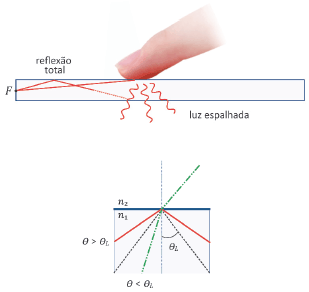
Uma das possíveis tecnologias para a produção de telas sensíveis ao toque aproveita a reflexão interna total da luz. Esse tipo de reflexão ocorre quando um raio luminoso viaja do interior de um meio 1, com índice de refração n1, em direção a um meio 2, com índice de refração n2, formando com a direção perpendicular à interface entre os meios um ângulo \( θ \) maior do que um certo valor limite \( θ_L \) , tal que \( \sin θ_L=n_2/n_1 \). Quando um objeto (como um dedo) se aproxima da interface entre os meios, a reflexão total não ocorre, o que é captado por sensores, revelando a posição do objeto. Suponha que se deseje projetar uma tela sensível ao toque que, conforme mostra a figura, funcione com uma fonte luminosa F fixa na borda. A tabela a seguir indica os índices de refração de alguns materiais candidatos à utilização no meio 1.
|
Material |
Índice de refração \( n_1 \) |
| A |
1,0002 |
| B |
1,0003 |
| C |
1,1503 |
| D |
1,3204 |
| E |
1,4889 |
Tratando o meio 2 sempre como tendo índice de refração \( n_2 \) 1,0003, o material que permite o maior intervalo de ângulos de incidência que produzem reflexão total é:
Provas
Baterias íon-lítio (íon-Li) armazenam energia por meio de um processo de intercalação iônica, no qual íons Li+ penetram e se acomodam entre camadas de grafite no ânodo da bateria. A quantidade de energia armazenada é diretamente proporcional ao número de íons Li+ intercalados no ânodo, que, entre outros aspectos, é limitado pelo espaço disponível para a sua alocação. Uma recente inovação tecnológica em baterias é a substituição de Li por Na, formando baterias íon-sódio (íon-Na). O mecanismo de funcionamento se baseia no processo de intercalação, com a vantagem de que o Na é mais abundante do que o Li no planeta.
Considerando que a única diferença entre baterias de mesma massa e volume seja o íon utilizado (Na+ ou Li+) e que a densidade de energia é a quantidade de energia armazenada na bateria por unidade de massa e volume, é correto afirmar que a densidade de energia de uma bateria íon-Na é
Provas
Caderno Container