Foram encontradas 45.123 questões.
Based on text CB1A2-I, judge the following item.
With the help of his students, Oppenheimer could easily shift from one research topic to another.
Provas

Based on text CB1A2-I, judge the following item.
According to Cathryn Carson, Oppenheimer’s work on neutron stars and black holes was meaningless at the time it was developed.
Provas
Based on text CB1A2-I, judge the following item.
Oppenheimer’s paper on black holes received little attention at the time it was published.
Provas
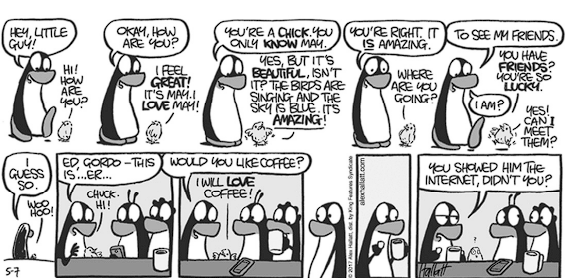
Internet: <alexhallat.com> (adapted).
Judge the following item, according to the preceding comic strip.
The penguin doesn’t seem surprised by the chick’s affirmation that he is lucky to have friends.
Provas
Internet: <alexhallat.com> (adapted).
Judge the following item, according to the preceding comic strip.
In the comic strip, it is possible to find examples of sentences in the present, past and future tenses.
Provas
Internet: <alexhallat.com> (adapted).
Judge the following item, according to the preceding comic strip.
The words “beautiful” (third box) and “lucky” (fifth box) belong to the same word class.
Provas
Internet: <alexhallat.com> (adapted).
Judge the following item, according to the preceding comic strip.
It can be inferred from the strip that the penguin thinks the Internet is responsible for draining Chuck’s excitement.
Provas
In the quest for technological advancements that can revolutionize our world, the scientific community has always been captivated by the elusive phenomenon of superconductivity. For decades, researchers have strived to unlock its full potential, seeking to discover materials that can exhibit superconducting properties at room temperature. And now, the wait might finally be over! Enter LK-99, a groundbreaking potential room-temperature superconductor that has sent shockwaves through the scientific world, spearheaded by a team of brilliant minds from Korea University, led by esteemed researchers Sukbae Lee and Ji-Hoon Kim.
Superconductors are materials that can conduct electricity with zero resistance, leading to unprecedented energy efficiency and technological advancements. In summary, LK-99 represents an exciting prospect as a potential room-temperature superconductor, but its superconducting properties have yet to be confirmed and independently verified.
Room temperature superconductors could revolutionize the energy sector by enabling lossless power transmission over long distances. With reduced energy dissipation during transmission, electricity could be distributed more efficiently, lowering carbon footprints and electricity costs.
Internet: <dataconomy.com/> (adapted).
According to the preceding text, judge the following item.
It is correct to affirm that the word “elusive” (first sentence of the first paragraph) has a similar meaning to its cognate word in Portuguese.
Provas
In the quest for technological advancements that can revolutionize our world, the scientific community has always been captivated by the elusive phenomenon of superconductivity. For decades, researchers have strived to unlock its full potential, seeking to discover materials that can exhibit superconducting properties at room temperature. And now, the wait might finally be over! Enter LK-99, a groundbreaking potential room-temperature superconductor that has sent shockwaves through the scientific world, spearheaded by a team of brilliant minds from Korea University, led by esteemed researchers Sukbae Lee and Ji-Hoon Kim.
Superconductors are materials that can conduct electricity with zero resistance, leading to unprecedented energy efficiency and technological advancements. In summary, LK-99 represents an exciting prospect as a potential room-temperature superconductor, but its superconducting properties have yet to be confirmed and independently verified.
Room temperature superconductors could revolutionize the energy sector by enabling lossless power transmission over long distances. With reduced energy dissipation during transmission, electricity could be distributed more efficiently, lowering carbon footprints and electricity costs.
Internet: <dataconomy.com/> (adapted).
According to the preceding text, judge the following item.
LK-99 generates positive expectations for the future in terms of electricity use and its distribution.
Provas
In the quest for technological advancements that can revolutionize our world, the scientific community has always been captivated by the elusive phenomenon of superconductivity. For decades, researchers have strived to unlock its full potential, seeking to discover materials that can exhibit superconducting properties at room temperature. And now, the wait might finally be over! Enter LK-99, a groundbreaking potential room-temperature superconductor that has sent shockwaves through the scientific world, spearheaded by a team of brilliant minds from Korea University, led by esteemed researchers Sukbae Lee and Ji-Hoon Kim.
Superconductors are materials that can conduct electricity with zero resistance, leading to unprecedented energy efficiency and technological advancements. In summary, LK-99 represents an exciting prospect as a potential room-temperature superconductor, but its superconducting properties have yet to be confirmed and independently verified.
Room temperature superconductors could revolutionize the energy sector by enabling lossless power transmission over long distances. With reduced energy dissipation during transmission, electricity could be distributed more efficiently, lowering carbon footprints and electricity costs.
Internet: <dataconomy.com/> (adapted).
According to the preceding text, judge the following item.
The search for room temperature superconductors is likely to be over.
Provas
Caderno Container