Foram encontradas 297 questões.
Com relação à curva de custo sabe-se que:
Item 3 - o custo marginal iguala-se ao custo médio no ponto onde o custo médio é mínimo.
Provas

Uma economia realizou durante um determinado ano as seguintes transações com o exterior:
a) Exportações de matérias primas (recebendo à vista em moeda forte) no valor FOB de $15 bilhões.
b) Importação de esquipamentos (com financiamento de longo prazo dado pelo fornecedor estrangeiro) no valor FOB de $ 7 bilhões.
c) Pagamento de fretes (em moeda forte) no valor de $ 3 bilhões.
d) Prestação de serviços de engenharia por firmas residentes no Brasil atuando no exterior (recebendo à vista em moeda forte) no valor de $ 2 bilhões.
e) Dos $ 5 bilhões de juros vincendos de sua dívida externa, o país desembolsa em moeda forte apenas $ 2 bilhões e consegue refinanciar os $ 3 bilhões restantes junto aos credores.
(f) Recebe doação humanitária de vacinas, remédios e equipamentos cirúrgicos no valor de $ 1 bilhão, entregues em espécie pelo país doador.
(g) Dos $13 bilhões de amortizações vincendas, o país desembolsa em moeda forte apenas $ 3 bilhões e consegue refinanciar os $ 10 bilhões restantes junto aos credores.
Assinale como Verdadeira ou Falsa a afirmativa abaixo:
Item 0 - O saldo do Balanço Comercial é 8 (oito).
Provas
A figura 1 apresenta a linha de orçamento (AB) de um consumidor que possui uma renda de $300.
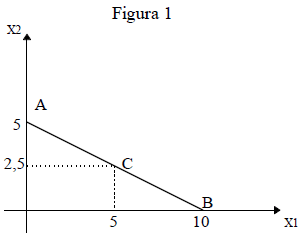
Item 3 - A função de utilidade !$ U(x_1,x_2) = x_1.x_2 !$ . é compatível com a escolha da cesta igual a (5; 2,5).
Provas
Indique a afirmação abaixo verdadeira ou falsa:
Item 1 - !$ \underset { \times \rightarrow 2} {\lim} { \Large { x^2 - 5x + 6 \over x-2}} = -1 !$
Provas
The breakdown of the Phillips curve and the prescience of Friedman and Phelps made macroeconomics ready for Robert Lucas’ (1976) more comprehensive attack on the consensus view. Lucas contended that many of the empirical relations that make up the large-scale macroeconometric models were no better founded on microeconomic principles than was the Phillips curve. In particular, the decisions that determine most macroeconomic variables, such as consumption and investment, depend crucially on expectations of the future course of the economy. Macroeconometric models treated expectations in a cavalier way, most often resorting to plausible but arbitrary proxies. Lucas pointed out that most policy interventions change the way individuals form expectations about the future. Yet the proxies for expectations used in the macroeconometric models failed to take account of this change in expectation formation. Lucas concluded therefore, that these models should not be used to evaluate the impact of alternative policies.
According to the paragraph above:
Item 4 - The Phillips curve was not founded on microeconomic principles.
Provas
Em uma economia a taxa de inflação “!$ \pi !$” é constante e a taxa de expansão monetária !$ { \Large {dM/dt \over M}} !$ é igual à de inflação:
!$ { \Large {dM/dt \over M}}. \pi !$ (1)
A demanda por moeda é uma função crescente do nível de produto y (que é constante) e decrescente da taxa de inflação, sendo tal função expressa por:
!$ { \Large { M \over P}} Ky\,exp (-a \pi) !$ (2)
onde “P” é o nível de preços, “k” e “a” são constantes positivas e “exp” é a função exponencial.
Isto posto, o imposto inflacionário I a cada momento é igual ao poder da compra da moeda que entra em circulação:
!$ I = { \Large {dM \over dt}}. { \Large {1 \over P}} = { \Large { M \over P}}. { \Large {dM \over Mdt}} = Ky\,\,exp(-a \pi) \pi !$ (3)
Verifica-se de (3) que o imposto inflacionário é uma função de uma única variável, !$ \pi !$, pois k e y são constantes:
!$ I ( \pi)= \pi\,exp (-a \pi)\,Ky !$
O governo deste país escolhe a taxa de expansão monetária (que é igual à taxa de inflação) !$ \pi !$ de modo a arrecadar o máximo de imposto inflacionário possível. Seja !$ \pi^* !$ a taxa escolhida e I * a arrecadação do imposto inflacionário quando a taxa de inflação for !$ \pi^* !$.
Isto posto, responda Verdadeiro ou Falso:
Item 1 - !$ \pi^* =a^{-1} !$.
Provas
Considere um monopolista maximizador de lucros:
Item 1 - a curva de demanda coincide com a curva de receita marginal, fazendo, assim, com que a elasticidade-preço esteja associada à receita marginal.
Provas
The breakdown of the Phillips curve and the prescience of Friedman and Phelps made macroeconomics ready for Robert Lucas’ (1976) more comprehensive attack on the consensus view. Lucas contended that many of the empirical relations that make up the large-scale macroeconometric models were no better founded on microeconomic principles than was the Phillips curve. In particular, the decisions that determine most macroeconomic variables, such as consumption and investment, depend crucially on expectations of the future course of the economy. Macroeconometric models treated expectations in a cavalier way, most often resorting to plausible but arbitrary proxies. Lucas pointed out that most policy interventions change the way individuals form expectations about the future. Yet the proxies for expectations used in the macroeconometric models failed to take account of this change in expectation formation. Lucas concluded therefore, that these models should not be used to evaluate the impact of alternative policies.
According to the paragraph above:
Item 3 - Macroeconomists were aware of and attributed great importance to expectations; they just could not measure them properly.
Provas
Tome como referência uma empresa maximizadora de lucros, produzindo 48 unidades de um bem através de uma função de produção com 2 fatores (K e L) caracterizada por retornos constantes à escala. Supondo que o preço do produto é igual a $1, os preços dos fatores K e L iguais a $4 e $2 respectivamente, e o uso de K igual a 3, então:
Item 0 - a quantidade demandada do fator L é igual a 18.
Provas
PART I
Rudiger Dornbusch, Policies to Move from Stabilization to Growth. Proceedings of the World Bank Annual Conference on Development Economics 1990, pages 19-48.
The typical stabilization program for an economy emerging from high inflation involves freezing wages and prices and making little fiscal adjustment. For the first month of two this program is successful, partly because expectations of a freeze will have led to prior price hikes. Soon the freeze wears off, however, and the deferred rise in public sector prices, the lifting of export taxes, and real appreciation combine to erode the budget position. Then, in phase two, policy-makers implement tight money. This gives an unsustainable program another few months of life, but of course it also increases public indebtedness sharply. Next, in phase three, the problems with the program become widely perceived, and debtors plead distress due to high real interest rates. When tight money goes, the house of cards collapses; the exchange rate collapses, inflation surges, and real interest rates turn very negative. Soon, another stabilization is under construction, ready for spring, tottering in the summer, and blown away by fall.
The important lesson to draw is this: tight money is not a substitute for a balanced budget. Real interest rates ultimately should be low, and the only way such a situation is sustainable is by basically sound fiscal and real exchange rate policies. Here we note that tight monetary policy is a signal of serious misalignment in the budget, the real exchange rate, or both. Realized real interest rates of 30 or 40 percent, in the presence of domestic debt, soon give rise to fiscal problems (p.26).
According to the same text:
Item 0 - Although it may do well for a while, high real interest rate policy works against its own ends.
Provas
Caderno Container