Foram encontradas 390 questões.
Sejam !$ f: R^2 → R\ !$ e !$ F: R^2 \times R^+ → R\ !$ funções diferenciáveis tais que f (1,2) = 1 e !$ F (x,y,z)= z^2 f(x/z, y/z) !$. Julgue o item abaixo:
Item 3: Se !$ f (x,y)= x^{1/2} y^{1/3} !$, então !$ f !$ é convexa.
Provas
Questão presente nas seguintes provas

Seja !$ a_n !$ uma seqüência de números reais tais que a série !$ \sum ^ ∞ _ {n=0} !$ !$ a_n x^n !$ converge ao tomarmos x = 2. Suponha ainda que o limite.
!$ L= lim \begin{vmatrix} \large {a _{n+1} \over a_n } \end{vmatrix} < ∞ !$
existe. Para cada !$ x \ ∈ \ R\ !$, defina !$ b_n (x)= a_n x^n !$ e avalie se cada afirmação abaixo é certo ou errado:
Item 1: !$ 2L >1. !$
Provas
Questão presente nas seguintes provas
With capital so mobile and America's monetary policy so loose, emerging economies have no easy fix for inflation. Interest rates clearly need to be raised by a lot, but a tidal wave of capital could either boost domestic liquidity or cause currencies to become overvalued. Brazil has allowed its currency to rise by more than 100% against the dollar over the past five years. This has helped to bring inflation down (though it is now rising again), but the real is now widely thought to be overvalued, pushing the current account back into deficit.
One solution is to tighten fiscal policy, which would reduce excess demand. Rapid growth in public spending is partly to blame for the excessive growth in Brazil's domestic demand. But fiscal tightening would be hard to justify in China, which already has a budget surplus. A larger surplus would boost domestic saving and hence the country's already large current-account surplus.
Either way, emerging economies need to accept that because their productivity growth is faster than the rich world's, their real exchange rates will have to rise over time. That must mean either a rise in the nominal exchange rate or higher inflation; they cannot escape both.
According to the text, emerging economies:
Item 4: already have a faster productivity growth than developed economies.
Provas
Questão presente nas seguintes provas
Depois de várias tentativas fracassadas, implementou-se, no governo Itamar Franco, um plano de estabilização bem sucedido. No que se refere ao Plano Real, pode-se afirmar que:
Item 1: enfrentou a dimensão inercial da inflação por intermédio da criação da URV – que se constituiu numa espécie de superindexador;
Provas
Questão presente nas seguintes provas
Denote por Μn o espaço das matrizes !$ n \times n !$ com entradas !$ a_{ij} !$ ∈ R. Seja !$ D :Μ_2 ×Μ_2 → Μ_4 !$ a aplicação dada por
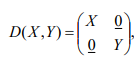
em que 2 0∈Μ é identicamente nula. Seja A a matriz da aplicação linear !$ L : R^2 → R^2 !$ , dada por !$ L(x, y) = ( y − x, y) !$. Se !$ B = D(A, A ) !$ julgue a afirmativa:
Item 1: = !$ A ^{−1} !$ e !$ det A = det B =1. !$
Provas
Questão presente nas seguintes provas
Some countries look more prone to rising inflation than others. From an analysis of wages, inflation expectations, demand and capacity pressures, and monetary growth, Mr Cates infers that Argentina, Brazil, India, Russia and the Middle East oil exporters face the biggest risks in the months ahead. Pressures seem less great in China, Mexico, South Korea and Turkey.
Clearly, monetary policy needs to be tightened. Instead, it has in effect been loosened: real interest rates are generally lower than they were a year ago. Short-term interest rates are also unusually low relative to nominal GDP growth a crude gauge of where rates should be, which implies that monetary policy is very loose (...). The broad money supply has grown by an average of 20% over the past year in emerging economies, almost three times the pace in the developed world (…). Russia's money supply has swelled by fully 42%.
Add all this up, and emerging economies bear strong similarities to rich countries in the 1970s, when the Great Inflation took off. A synchronised boom in the world economy has caused commodity prices to surge. Governments have responded with subsidies and wage and price controls. Official statistics understate price pressures. Economies are running at full pelt. Money-supply growth is soaring. Inflation expectations are not anchored and labour markets are fairly rigid, increasing the risk of a spiral in wages and prices.
According to conventional wisdom, the monetary-policy mistakes that caused the Great Inflation are much less likely today because central banks are independent of politicians. But unlike the Federal Reserve and the European Central Bank ECB, many central banks in emerging economies notably China, India and Russia are not fully independent. In another echo of the 1970s, they often face intense political pressure to hold rates low to boost growth and jobs.
The text remarks on:
Item 3: the existence of strong similarities between emerging economies now and rich countries in the 1970s;
Provas
Questão presente nas seguintes provas
Neste ano, comemora-se 50 anos da publicação de Formação Econômica do Brasil, livro de Celso Furtado que marcou os estudos sobre a economia brasileira. Nesta obra, defendeu-se, entre outros argumentos, que:
Item 1: o processo de industrialização do Brasil teve forte expansão nas primeiras décadas do século XX, principalmente nos períodos de valorização do mil-réis, que estimulava o aumento das inversões para ampliar a capacidade produtiva das indústrias locais;
Provas
Questão presente nas seguintes provas
No que se refere ao II PND, implementado durante o governo Geisel, Antônio Barros de Castro afirma o seguinte:
Item 4: para completar a matriz industrial do país, priorizou o desenvolvimento dos segmentos industriais produtores de bens de consumo duráveis.
Provas
Questão presente nas seguintes provas
Podem ser associados ao período conhecido como “milagre econômico brasileiro” (1968-1973):
Item 3: o incentivo governamental à concorrência no sistema bancário, como forma de diminuir a taxa de juros;
Provas
Questão presente nas seguintes provas
With capital so mobile and America's monetary policy so loose, emerging economies have no easy fix for inflation. Interest rates clearly need to be raised by a lot, but a tidal wave of capital could either boost domestic liquidity or cause currencies to become overvalued. Brazil has allowed its currency to rise by more than 100% against the dollar over the past five years. This has helped to bring inflation down (though it is now rising again), but the real is now widely thought to be overvalued, pushing the current account back into deficit.
One solution is to tighten fiscal policy, which would reduce excess demand. Rapid growth in public spending is partly to blame for the excessive growth in Brazil's domestic demand. But fiscal tightening would be hard to justify in China, which already has a budget surplus. A larger surplus would boost domestic saving and hence the country's already large current-account surplus.
Either way, emerging economies need to accept that because their productivity growth is faster than the rich world's, their real exchange rates will have to rise over time. That must mean either a rise in the nominal exchange rate or higher inflation; they cannot escape both.
According to the text, emerging economies:
Item 1: must lower their real exchange rates over time;
Provas
Questão presente nas seguintes provas
Cadernos
Caderno Container