Foram encontradas 390 questões.
Indeed, official figures understate inflationary pressures in many emerging economies. Widespread government subsidies and price controls are one reason, and price indices are often skewed by a lack of data or government cheating. China's true inflation rate may be higher because the consumer-price index does not properly cover private services. Delays in data collection in India can mean big revisions to inflation: the final number for early March was almost two percentage points higher than the original. The latest wholesale-price inflation rate might therefore be pushed up to 9-10%. If measured correctly, five of the ten biggest emerging economies could have inflation rates of 10% or more by mid-summer. Two-thirds of the world's population may then be struggling with double-digit inflation.
The recent jump has been caused mainly by surging oil and food prices. For example, in China food prices have risen by 22% in the past year, whereas non-food prices have gone up by only 1.8%. Governments have responded with more price controls and export bans. India's government has suspended futures trading in several commodities, which it blames (wrongly) for high prices. In the short run such measures may help to cap inflation and avoid social unrest, but in the long run they do more harm than good. Preventing prices from rising reduces the incentive for farmers to increase supply and for consumers to curb demand, prolonging the very imbalance that has stoked prices.
According to the text:
Item 2: farmers favour preventing prices from rising;
Provas
Questão presente nas seguintes provas

Considere o modelo abaixo:
!$ y_t = \alpha x_t + u_{1t} !$ (Equação 1)
!$ x_t = λ x_{t-1} + u_{2t} !$ (Equação 2)
em que !$ \alpha !$ e !$ λ !$ são parâmetros, !$ y_0 = x_0 = 0 !$ e !$ u_t !$ é um vetor aleatório independente e distribuido da seguinte forma:
!$ u_t = \begin{pmatrix} u_{1t} \\ u_{2t} \end{pmatrix} ~Normal \begin{bmatrix} \begin{pmatrix} 0 \\ 0 \end{pmatrix} , \begin{pmatrix} σ^2_1 & σ_{12} \\ σ_{12} & σ_2^2 \end{pmatrix} \end{bmatrix} !$, para todo t.
Indique se a afirmação abaixo é verdadeira ou falsa:
Item 0: Se !$ λ = 1 !$, !$ x_t !$ será I(1) , ou seja , xt será integrada de primeira ordem. Se !$ \alpha \ne 0 !$, então !$ y_t !$ e !$ x_t !$ serão co-integradas.
Provas
Questão presente nas seguintes provas
Sejam X1, X2, ..., Xn variáveis aleatórias independentes e normalmente distribuidas com média !$ μ !$ e variância 1. Defina as variáveis aleatórias !$ \overline X = n^{-1} \sum^n _{i=1} X_i !$, e !$ Z = \sum^n _{i=1} X_i^2 !$. É correto afirmar que:
Item 2: Se !$ W = exp (X) !$, !$ E(W) = μ + σ^2 /2 !$.
Provas
Questão presente nas seguintes provas
Com relação ao endividamento externo do Brasil, no período correspondente ao “milagre econômico” e ao II PND, pode-se afirmar o seguinte:
Item 3: parte significativa do aumento do endividamento externo durante o período do “milagre econômico” esteve associado ao aumento das reservas internacionais;
Provas
Questão presente nas seguintes provas
Considere o modelo de crescimento endógeno, com função de produção Y = AK, em que Y é o produto, K é o capital e A é um índice de produtividade. A taxa de poupança é de 30%. O capital deprecia à taxa de 10% ao ano. O parâmetro A é igual a 0,5. Não há crescimento populacional. Suponha que o estoque de capital inicial seja positivo. Julgue as seguintes afirmativas:
Item 2: Um aumento na taxa de poupança (tudo o mais constante) pode reduzir permanentemente a taxa de crescimento do consumo por trabalhador.
Provas
Questão presente nas seguintes provas
Denote por Μn o espaço das matrizes !$ n \times n !$ com entradas !$ a_{ij} !$ ∈ R. Seja !$ D :Μ_2 ×Μ_2 → Μ_4 !$ a aplicação dada por
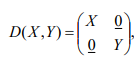
em que 2 0∈Μ é identicamente nula. Seja A a matriz da aplicação linear !$ L : R^2 → R^2 !$ , dada por !$ L(x, y) = ( y − x, y) !$. Se !$ B = D(A, A ) !$ julgue a afirmativa:
Item 3: = O polinômio característico de !$ B !$ é dado por !$ q(t)= t^4 + 2t^2+1 !$.
Provas
Questão presente nas seguintes provas
Considere as funções f: R → R e g: R → R, em que
!$ f (x)= \begin{cases} ax^2 + 1, \ se \ x < 0, \ \ e \ g(x)= xe^x \\ 1, \ se \ x \ge 0 \end{cases} !$
Julgue a afirmativa:
Item 04: g’’(x) > g’(x), para todo x∈ R.
Provas
Questão presente nas seguintes provas
Um indivíduo vive por dois períodos, t = 1 e t = 2. O indivíduo possui renda real Y1 no primeiro período e Y2 no segundo período. Além disso, ele pode emprestar/tomar emprestado livremente à taxa de juros real r. As preferências do indivíduo são dadas por U = lnC1 + βlnC2, em que C1 e C2 representam o consumo real em t = 1 e t = 2, respectivamente, e β > 0. A poupança entre os dois períodos é definida pela diferença entre renda e consumo em t = 1, ou seja, S = Y1 – C1. De acordo com estas informações, julgue as seguintes afirmativas:
Item 1: Se β(1+r) > 1, o consumo será decrescente ao longo do tempo, isto é, C2 < C1.
Provas
Questão presente nas seguintes provas
Seja !$ Q= K^a L^{1-a} !$ uma função de produção Cobb-Douglas. Julgue a afirmativa a seguir:
Item 0: A demanda condicional pelo fator trabalho é L* = Q.
Provas
Questão presente nas seguintes provas
Some countries look more prone to rising inflation than others. From an analysis of wages, inflation expectations, demand and capacity pressures, and monetary growth, Mr Cates infers that Argentina, Brazil, India, Russia and the Middle East oil exporters face the biggest risks in the months ahead. Pressures seem less great in China, Mexico, South Korea and Turkey.
Clearly, monetary policy needs to be tightened. Instead, it has in effect been loosened: real interest rates are generally lower than they were a year ago. Short-term interest rates are also unusually low relative to nominal GDP growth a crude gauge of where rates should be, which implies that monetary policy is very loose (...). The broad money supply has grown by an average of 20% over the past year in emerging economies, almost three times the pace in the developed world (…). Russia's money supply has swelled by fully 42%.
Add all this up, and emerging economies bear strong similarities to rich countries in the 1970s, when the Great Inflation took off. A synchronised boom in the world economy has caused commodity prices to surge. Governments have responded with subsidies and wage and price controls. Official statistics understate price pressures. Economies are running at full pelt. Money-supply growth is soaring. Inflation expectations are not anchored and labour markets are fairly rigid, increasing the risk of a spiral in wages and prices.
According to conventional wisdom, the monetary-policy mistakes that caused the Great Inflation are much less likely today because central banks are independent of politicians. But unlike the Federal Reserve and the European Central Bank ECB, many central banks in emerging economies notably China, India and Russia are not fully independent. In another echo of the 1970s, they often face intense political pressure to hold rates low to boost growth and jobs.
The text advocates:
Item 3: an increase of 42% in Russia's money supply;
Provas
Questão presente nas seguintes provas
Cadernos
Caderno Container