Foram encontradas 1.145 questões.
Considere o contexto abaixo para responder à questão.

No mecanismo de quatro barras da figura, a barra O2A é acionada por um motor acoplado ao mancal O2 a uma velocidade angular constante !$ \omega !$2. Considere a fase indicada na figura e que os comprimentos das barras paralelas sejam tais que O4B = 2 O2A.
Nessas condições, as acelerações angulares !$ \alpha !$3 e !$ \alpha !$4 das barras 3 e 4 são tais queProvas
Questão presente nas seguintes provas

Um solenoide produz, no interior de sua cavidade cilíndrica vazia, um campo magnético de intensidade 8,00 x 10⁻⁴ T, quando percorrido por corrente de 5,0 A. Qual a intensidade do campo magnético, se a cavidade interna desse solenoide fosse preenchida por um núcleo de ferro e se a corrente elétrica percorrida fosse de 15 A? Considere a permeabilidade relativa do ferro como 5500.
Provas
Questão presente nas seguintes provas
Considere o croqui e os dados a seguir para responder à questão.
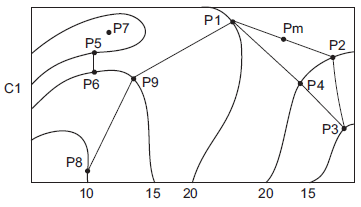
Dados:
- Croqui com linhas proporcionais
- Escala não indicada
- Cotas em metros
- Pm é ponto médio entre !$ \overline {P1P2} !$, com cota P3>Pm>P2
- A cota de P5 é diferente de P6
Entre as cotas apresentadas, a única que o ponto P7 pode assumir, em metros, é
Provas
Questão presente nas seguintes provas
263939
Ano: 2010
Disciplina: Inglês (Língua Inglesa)
Banca: CESGRANRIO
Orgão: BR Distribuidora
Disciplina: Inglês (Língua Inglesa)
Banca: CESGRANRIO
Orgão: BR Distribuidora
Provas:
Happy 150th, Oil! So Long, and Thanks for Modern Civilization
By Alexis Madrigal
WIRED SCIENCE, August 27, 2009
WIRED SCIENCE, August 27, 2009
One hundred and fifty years ago on Aug. 27, Colonel Edwin L. Drake sunk the very first commercial well that produced flowing petroleum. The discovery that large amounts of oil could be found underground marked the beginning of a time during which this convenient fossil fuel became America’s dominant energy source.
But what began 150 years ago won’t last another 150 years — or even another 50. The era of cheap oil is ending, and with another energy transition upon us, we’ve got to extract all the lessons we can from its remarkable history.
“I would see this as less of an anniversary to note for celebration and more of an anniversary to note how far we’ve come and the serious moment that we’re at right now,” said Brian Black, an energy historian at Pennsylvania State University. “Energy transitions happen and I argue that we’re in one right now. Thus, we need to aggressively look to the future to what’s going to happen after petroleum.”
When Drake and others sunk their wells, there were no cars, no plastics, no chemical industry. Water power was the dominant industrial energy source. Steam engines burning coal were on the rise, but the nation’s energy system — unlike Great Britain’s — still used fossil fuels sparingly. The original role for oil was as an illuminant, not a motor fuel, which would come decades later.
Oil, people later found, was uniquely convenient. To equal the amount of energy in a tank of gasoline, you need 200 pounds of wood. Pair that energy density with stability under most conditions and that, as a liquid, it was easy to transport, and you have the killer application for the infrastructure age.
In a world that only had a tiny fraction of the amount of heat, light, and power available that we do now, people came up with all kinds of ideas for what to do with oil’s energy: cars, tractors, airplanes, chemicals, fertilizer, and plastic.
The scale of the oil industry is astounding, but it’s becoming clear the world’s oil supply will peak soon, or perhaps has peaked already. People discuss about the details, but no one argues that oil will play a much different role in our energy system in 50 years than it did in 1959.
The search for alternatives is on. If that search goes poorly — as some Peak Oil analysts predict — human civilization will fall off an energy cliff. The amount of energy we get back from drilling oil wells in the middle of the Gulf of Mexico continues to drop, and alternative sources don’t provide usable energy for humans on the generous terms that oil long has.
Yet humans with an economic incentive to be optimistic become optimists, and the harder we look, the more possible alternatives we find. The big question now is whether the cure for our oil addiction will come with a heavy carbon side effect.
Over the next 20 years, synthetic fuels made from coal or shale oil could conceivably become the fuels of the future. On the other hand, so could advanced biofuels from cellulosic ethanol or algae. Or the era of fuel could end and electric vehicles could be deployed in mass, at least in rich countries.
With the massive injection of stimulus and venture capital money into alternative energy that’s occurred over the past few years, the solutions for replacing oil could already be circulating among the labs and office parks of the country. To paraphrase technology expert Clay Shirky talking about the media, nothing will work to replace oil, but everything might.
If history tells us anything, it’s that energy sources can change, never tomorrow, but always some day.
“What is required is to operate without fear and to take energy transitions on as a developmental opportunity,” Black said.
slightly adapted from: http://www.wired.com/wiredscience/
2009/08/oilat150/#ixzz0gW1mC0Zm, access on Feb. 10, 2010.
Alexis Madrigal comments that oil was
Provas
Questão presente nas seguintes provas
Observe a seguinte planilha eletrônica que acompanha o total executado de um certo serviço:
| A | B | C | |
| 1 | Data | Quantidade Executada | Quantidade Executada Acumulada |
| 2 | |||
| 3 | |||
| 4 | |||
| 5 | |||
| 6 |
Utilizando-se o Excel, a fórmula que pode constar em C3, de forma que possa ser copiada em C4, C5 e, assim, sucessivamente, é
Provas
Questão presente nas seguintes provas
Observe as afirmativas abaixo, sobre as resinas compostas de micropartículas.
I – Apresentam propriedades físicas e mecânicas geralmente inferiores às das resinas compostas tradicionais.
II – Apresentam grande potencial para fratura quando aplicadas em restaurações de Classes II e IV.
III – Graças à sua superfície lisa, são indicadas para restaurações estéticas de dentes anteriores.
Está correto o que se afirma em
Provas
Questão presente nas seguintes provas
263293
Ano: 2010
Disciplina: Segurança e Saúde no Trabalho (SST)
Banca: CESGRANRIO
Orgão: BR Distribuidora
Disciplina: Segurança e Saúde no Trabalho (SST)
Banca: CESGRANRIO
Orgão: BR Distribuidora
Provas:
Quando for constatada divergência entre os registros constantes na Carteira Profissional ou na Carteira de Trabalho e Previdência Social e no Perfil Profissiográfico Previdenciário, exceto se a empresa for legalmente extinta, a mesma deverá ser esclarecida, segundo a Instrução Normativa INSS/DC nº 84, de 17/12/2002, por
Provas
Questão presente nas seguintes provas
Um fluido newtoniano escoa em uma tubulação de aço comercial sendo o número de Reynolds igual a 1.600. Se, devido a problemas operacionais, a velocidade do fluido diminui de 25 %, o fator/coeficiente de atrito associado
Provas
Questão presente nas seguintes provas
Para os diferentes tipos de motores são concebidos diferentes métodos de controle de velocidade, de forma que o uso do(a)
Provas
Questão presente nas seguintes provas
262391
Ano: 2010
Disciplina: Segurança e Saúde no Trabalho (SST)
Banca: CESGRANRIO
Orgão: BR Distribuidora
Disciplina: Segurança e Saúde no Trabalho (SST)
Banca: CESGRANRIO
Orgão: BR Distribuidora
Provas:
Um vaso de pressão contendo fluido combustível a temperatura de 200 ºC, instalado em um polo de trabalho de uma empresa, foi submetido a uma inspeção periódica. Considerando-se que o vaso de pressão é da categoria II, não contém enchimento interno ou catalisador, e a inspeção foi executada pelo Serviço Próprio de Inspeção de Equipamentos desta empresa, composto de acordo com o Anexo II da NR 13, o prazo máximo para o Exame externo, Exame interno e Teste hidrostático, de acordo com a mesma NR, será, respectivamente, em anos, de
Provas
Questão presente nas seguintes provas
Cadernos
Caderno Container