Foram encontradas 50 questões.
Curiosidade é uma coceira nas ideias
Eu estava com a cabeça quente. Queria descansar, parar de pensar. Para parar de pensar nada melhor que trabalhar com as mãos!$ ^{B)} !$. Peguei minha caixa de ferramentas, a serra circular e a furadeira e fui para o terceiro andar!$ ^{C)} !$, onde guardo os meus livros.
Iria fazer umas estantes. As tábuas já estavam lá. Nem bem comecei a trabalhar de carpinteiro e fui interrompido com a chegada da faxineira!$ ^{D)} !$. Com ela, sua filhinha de 7 anos, Dionéia. Carinha redonda, sorriso mostrando os dentes brancos, trancinhas estilo afro.
O que se era de esperar numa menina da idade dela era que ela ficasse com a mãe. Não ficou. Preferiu ficar comigo, vendo o que eu fazia!$ ^{A)} !$. Por que ela fez isso? Curiosidade. Curiosidade é uma coceira que dá nas ideias...Aquelas ferramentas e o que eu estava fazendo a fascinavam. Ela queria aprender. (...)
Assim se iniciou uma das mais alegres experiências de ensino e aprendizagem que tive na minha vida. A Dionéia queria saber de tudo. Não precisei fazer uso de nenhum artifício de “motivação” para que ela estivesse motivada. O que a motivava era o fascínio daquilo que eu estava fazendo e das ferramentas que eu estava usando. Seus olhos e pensamentos estavam coçando de curiosidade. Ela queria aprender para se curar da coceira...(...)
Fiquei a imaginar o que vai acontecer com a Dionéia quando, na escola, os seus olhinhos curiosos vão ser subtraídos do fascínio das coisas do mundo que a cerca, e vão ser obrigados a seguir aquilo a que os programas obrigam. Será possível aprender sem que os olhos estejam fascinados pelo objeto misterioso que os desafia?
ALVES, Rubens. O desejo de ensinar e a arte de aprender. Campinas: Fundação Educar, 2004, p. 8-9.
A relação lógico-semântica está corretamente indicada em
Provas
Questão presente nas seguintes provas

A centopeia e o gafanhoto
Conta-se que, um dia, um gafanhoto encontrou-se!$ ^{I)} !$ com uma centopeia que descansava no meio da folhagem.
– Dona Centopeia, eu tenho pela senhora a maior admiração. Deus Todo-Poderoso me deu apenas seis pernas. Para a senhora ele deu cem. Assombra-me a elegância tranquila do seu andar. Todas se movem na ordem certa. Jamais vi uma centopeia tropeçar. Mas, por isso mesmo!$ ^{IV)} !$, tenho uma curiosidade: quando a senhora vai começar a andar, qual é a perna que!$ ^{IV)} !$ a senhora mexe primeiro?
– Obrigada pelos elogios, senhor Gafanhoto - respondeu a Centopeia. - Sua pergunta é muito interessante porque!$ ^{II)} !$ eu mesma, até hoje, nunca pensei no assunto!$ ^{IV)} !$. Sempre andei sem pensar. Perdoe minha ignorância. Jamais fui à escola do andar certo. Não fui conscientizada. Andei sempre um andar ignorante. Mas agora vou prestar atenção...
Conta-se que, desde esse dia, a Centopeia ficou paralítica!$ ^{III)} !$.
ALVES, Rubens. Do universo à jabuticaba. São Paulo: Editora Planeta do Brasil, 2010, p. 242.
Julgue com base nos fatos de língua as afirmações abaixo:
I. O verbo “encontrou-se” está na voz passiva sintética.
II. O vocábulo “porque” introduz uma pergunta indireta.
III. Não haveria mudança de sentido caso as vírgulas fossem suprimidas no trecho “Conta-se que, desde esse dia, a Centopeia ficou paralítica”.
IV. Poderíamos fazer, no texto, sem qualquer prejuízo para o sentido e para a correção gramatical, as seguintes substituições: “por isso mesmo” por “por essa mesma razão”; “qual é a perna que” por “que perna”; “no assunto” por “nisso”.
- Está correto o que se afirma em
Provas
Questão presente nas seguintes provas
De acordo com a Lei 12.815/2013, o órgão de gestão de mão de obra terá obrigatoriamente um (01) conselho de supervisão, que será composto por __________ membro(s) titulare(s) e seu(s) suplente(s), indicado(s) na forma do regulamento.
- A quantidade que preenche corretamente a afirmativa acima é
Provas
Questão presente nas seguintes provas
Para estudiosos da área, o profissional de secretariado executivo é um gestor, já que se envolve com os resultados esperados pela organização em que atua e participa de processos conhecidos como __________ para atingir os __________, mediando __________ para a obtenção desses resultados.
Para que isso ocorra, são importantes as atividades __________, sendo imprescindível desenvolver e manter um __________ de rotinas.
- As expressões que completam correta e respectivamente as lacunas acima são:
Provas
Questão presente nas seguintes provas
De acordo com a Lei 12.815/2013, as infrações cometidas pelos destinatários de suas regras, dentre outras penalidades, sujeitam os infratores à pena de proibição de ingresso na área do porto por período de __________ a __________ dias.
- A quantidade de dias que preenche correta e respectivamente a afirmativa acima é
Provas
Questão presente nas seguintes provas
Is Breakfast Overrated?
By Gretchen Reynolds
August 21, 2014
For years, we’ve heard that breakfast is the most important meal of the day. But scientific support for that idea has been surprisingly meager, and a spate of new research at several different universities — published in multiple articles in the August issue of The American Journal of Clinical Nutrition — could change the way we think about early-hours eating.
The largest and most provocative of the studies focused on whether breakfast plays a role in weight loss. Researchers at the University of Alabama at Birmingham and other institutions recruited nearly 300 volunteers who were trying to lose weight. They randomly assigned subjects to either skip breakfast, always eat the meal or continue with their current dietary habits. (Each group contained people who habitually ate or skipped breakfast at the start, so some changed habits, and others did not.)
Sixteen weeks later, the volunteers returned to the lab to be weighed. No one had lost much, only a pound or so per person, with weight in all groups unaffected by whether someone ate breakfast or skipped it.
In another new study — this one of lean volunteers — researchers at the University of Bath determined the resting metabolic rates, cholesterol levels and blood-sugar profiles of 33 participants and randomly assigned them to eat or skip breakfast. Volunteers were then provided with activity monitors.
After six weeks, their body weights, resting metabolic rates, cholesterol and most measures of blood sugar were about the same as they had been at the start, whether people ate breakfast or not. The one difference was that the breakfast eaters seemed to move around more during the morning; their activity monitors showed that volunteers in this group burned almost 500 calories more in light-intensity movement. But by eating breakfast, they also consumed an additional 500 calories each day. Contrary to popular belief, skipping breakfast had not driven volunteers to wolf down enormous lunches and dinners — but it had made them somewhat more sluggish first thing in the morning.
Together, the new research suggests that in terms of weight loss, “breakfast may be just another meal,” said Emily Dhurandhar, the assistant professor at the University of Alabama at Birmingham who led the study there. Skipping breakfast in these studies, she said, did not fatten people.
Each study was fairly short-term, however, and involved a limited range of volunteers. More randomized experiments are needed before we can fully understand the impact of breakfast, said James Betts, the professor who led the study of lean people. It’s not yet clear, for instance, whether heavy people’s bodies respond differently to morning meals than lean people’s, or if the timing and makeup of breakfast matters.
For now, the slightly unsatisfying takeaway from the new science would seem to be that if you like breakfast, fine; but if not, don’t sweat it. “I almost never have breakfast,” Dr. Betts said. “That was part of my motivation for conducting this research, as everybody was always telling me off and saying I should know better.” Based on the results of these studies, he said his habits won’t change.
Neither will those of Dr. Dhurandhar, who enjoys a morning meal. But, she said, “I guess I won’t nag my husband to eat breakfast anymore.”
(http://well.blogs.nytimes.com/2014/08/21/is-breakfast-overrated/??src=dayp&action=click&pgtype=Homepage&module=ccolumn- above-moth-fixed-region®ion=c-column-above-moth-fixed-region&WT.nav=c-column-above-moth-fixed-region)
The results of Dr. Betts’s studies made him
Provas
Questão presente nas seguintes provas
Sobre licenças e tipos de distribuição de software, considere os itens abaixo:
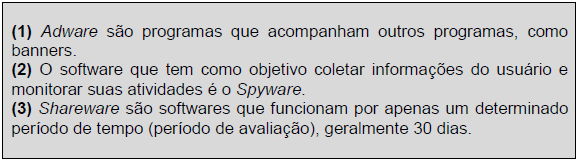
- Assinale a alternativa que corresponde a uma correta avaliação dos itens acima.
Provas
Questão presente nas seguintes provas
Conforme previsão da Lei 12.815/2013, na falta de pagamento de multa no prazo de __________ dias, contado da ciência pelo infrator da decisão final que impuser a penalidade, será realizado processo de execução.
- A quantidade de dias que preenche correta e respectivamente a afirmativa acima é
Provas
Questão presente nas seguintes provas
Dois tipos de ideias
Há dois tipos de ideias: ideias inertes e ideias com poder gravitacional. As ideias inertes, como o nome está dizendo, são destituídas de poder. Estão onde estão e isso é tudo. Como pedras. A maior parte das ideias que se ensinam nas escolas pertence a essa categoria. Um bom exemplo se encontra naquele parágrafo do livro de biologia que minha neta tinha de aprender. Via de regra, essas ideias são logo esquecidas. A memória as deleta e joga na lixeira. Algumas permanecem na memória consciente como lixo. Por exemplo, aprendi no curso de admissão que a ilha de Tupinambarana é a segunda maior ilha fluvial do mundo. Essa informação não faz nada com a minha cabeça. Note-se que as ideias inertes, frequentemente, possuem os critérios cartesianos de clareza e distinção. As ideias com poder gravitacional são aquelas que têm o poder de chamar outras. Elas nunca estão sozinhas. São sóis do sistema solar que é a nossa mente. Elas produzem big bang na cabeça do qual nascem universos. É assim que acontecem a poesia, a literatura, a música: uma única ideia explode e eis a obra!
ALVES, Rubens. Ostra feliz não faz pérola. São Paulo: Editora Planeta do Brasil, 2008, p. 118-119.
O enunciado em que não se expressa uma característica daquilo que o autor chama “ideias inertes” é:
Provas
Questão presente nas seguintes provas
Is Breakfast Overrated?
By Gretchen Reynolds
August 21, 2014
For years, we’ve heard that breakfast is the most important meal of the day. But scientific support for that idea has been surprisingly meager, and a spate of new research at several different universities — published in multiple articles in the August issue of The American Journal of Clinical Nutrition — could change the way we think about early-hours eating.
The largest and most provocative of the studies focused on whether breakfast plays a role in weight loss. Researchers at the University of Alabama at Birmingham and other institutions recruited nearly 300 volunteers who were trying to lose weight. They randomly assigned subjects to either skip breakfast, always eat the meal or continue with their current dietary habits. (Each group contained people who habitually ate or skipped breakfast at the start, so some changed habits, and others did not.)
Sixteen weeks later, the volunteers returned to the lab to be weighed. No one had lost much, only a pound or so per person, with weight in all groups unaffected by whether someone ate breakfast or skipped it.
In another new study — this one of lean volunteers — researchers at the University of Bath determined the resting metabolic rates, cholesterol levels and blood-sugar profiles of 33 participants and randomly assigned them to eat or skip breakfast. Volunteers were then provided with activity monitors.
After six weeks, their body weights, resting metabolic rates, cholesterol and most measures of blood sugar were about the same as they had been at the start, whether people ate breakfast or not. The one difference was that the breakfast eaters seemed to move around more during the morning; their activity monitors showed that volunteers in this group burned almost 500 calories more in light-intensity movement. But by eating breakfast, they also consumed an additional 500 calories each day. Contrary to popular belief, skipping breakfast had not driven volunteers to wolf down enormous lunches and dinners — but it had made them somewhat more sluggish first thing in the morning.
Together, the new research suggests that in terms of weight loss, “breakfast may be just another meal,” said Emily Dhurandhar, the assistant professor at the University of Alabama at Birmingham who led the study there. Skipping breakfast in these studies, she said, did not fatten people.
Each study was fairly short-term, however, and involved a limited range of volunteers. More randomized experiments are needed before we can fully understand the impact of breakfast, said James Betts, the professor who led the study of lean people. It’s not yet clear, for instance, whether heavy people’s bodies respond differently to morning meals than lean people’s, or if the timing and makeup of breakfast matters.
For now, the slightly unsatisfying takeaway from the new science would seem to be that if you like breakfast, fine; but if not, don’t sweat it. “I almost never have breakfast,” Dr. Betts said. “That was part of my motivation for conducting this research, as everybody was always telling me off and saying I should know better.” Based on the results of these studies, he said his habits won’t change.
Neither will those of Dr. Dhurandhar, who enjoys a morning meal. But, she said, “I guess I won’t nag my husband to eat breakfast anymore.”
(http://well.blogs.nytimes.com/2014/08/21/is-breakfast-overrated/??src=dayp&action=click&pgtype=Homepage&module=ccolumn- above-moth-fixed-region®ion=c-column-above-moth-fixed-region&WT.nav=c-column-above-moth-fixed-region)
The underlined word in “Each group contained people who habitually ate or skipped breakfast at the start, so some changed habits, and others did not.” (!$ 2^{nd} !$ paragraph) introduces
Provas
Questão presente nas seguintes provas
Cadernos
Caderno Container