Foram encontradas 940 questões.
READ THE FOLLOWING TEXT AND CHOOSE THE OPTION WHICH BEST COMPLETES EACH QUESTION ACCORDING TO IT:
Technology has created more jobs than it has destroyed
The battle between men and machines goes back centuries. Are they taking our jobs? Or are they easing our workload? A study by economists at the consultancy Deloitte seeks to shed new light on the relationship between jobs and the rise of technology by searching through census data for England and Wales going back to 1871.
Their conclusion is that, rather than destroying jobs, technology has been a “great job-creating machine”. Findings by Deloitte such as rise in bar staff since the 1950s or a surge in the number of hairdressers this century suggest to the authors that technology has increased spending power, therefore creating new demand and new jobs. Their study argues that the debate has been twisted towards the job-destroying effects of technological change, which are more easily observed than its creative aspects.
Going back over past figures paints a more balanced picture, say authors Ian Stewart and Alex Cole. “The dominant trend is of contracting employment in agriculture and manufacturing being more than balanced by rapid growth in the caring, creative, technology and business services sectors,” they write. “Machines will take on more repetitive and laborious tasks, but they seem no closer to eliminating the need for human labor than at any time in the last 150 years.”
According to the study, hard, dangerous and dull jobs have declined. In some sectors, technology has quite clearly cost jobs, but they question whether they are really jobs we would want to hold on to. Technology directly substitutes human muscle power and, in so doing, raises productivity and shrinks employment. “In the UK the first sector to feel this effect on any scale was agriculture,” says the study.
The study also found out that ‘caring’ jobs have increased. The report cites a “profound shift”, with labor switching from its historic role, as a source of raw power, to the care, education and provision of services to others.
Technological progress has cut the prices of essentials, such as food, and the price of bigger household items such as TVs and kitchen appliances, notes Stewart. That leaves more money to spend on leisure, and creates new demand and new jobs, which may explain the big rise in bar staff, he adds. “Despite the decline in the traditional pub, census data shows that the number of people employed in bars rose fourfold between 1951 and 2011,” the report says.
The Deloitte economists believe that rising incomes have allowed consumers to spend more on personal services, such as grooming. That in turn has driven employment of hairdressers. So, while in 1871 there was one hairdresser or barber for every 1,793 citizens of England and Wales; today there is one for every 287 people.
(Adapted from: https://goo.gl/7V5vuw. Access: 02/02/2018.)
When it comes to job losses, what is the authors’ conclusion?
Provas
Questão presente nas seguintes provas


A ponte de Wheatstone da figura está equilibrada, com VA = VB. Qual o valor de R4, considerando que R1 = R2 = R3 = 1Ω?
Provas
Questão presente nas seguintes provas
O sistema de ancoragem, conforme preconizado pela Norma Regulamentadora 35 – NR 35, Trabalho em Altura, são componentes definitivos ou temporários, dimensionados para suportar impactos de queda, aos quais o trabalhador possa conectar seu Equipamento de Proteção Individual, diretamente ou através de outro dispositivo, de modo a que permaneça conectado em caso de perda de equilíbrio, desfalecimento ou queda. O sistema de ancoragem deve ser estabelecido pela Análise de Risco. O cinto de segurança deve ser do tipo paraquedista e dotado de dispositivo para conexão em sistema de ancoragem, sendo que o trabalhador deve permanecer conectado ao sistema de ancoragem durante todo o período de exposição ao risco de queda.
Quanto ao ponto de ancoragem a ser utilizado, NÃO corresponde às providências que devem ser tomadas:
Provas
Questão presente nas seguintes provas
Observe o desenho do micrômetro abaixo
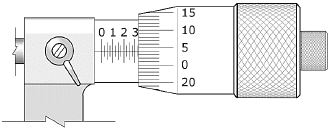
A leitura linear da dimensão correta, realizada no micrômetro de (0 a 1”) em polegada milesimal, é:
Provas
Questão presente nas seguintes provas
Um sistema de aquisição de dados possui um conversor A/D de 8 bits. Sabendo-se que a resolução do conversor é de 10 mV, qual o maior valor de tensão pode ser convertido?
Provas
Questão presente nas seguintes provas
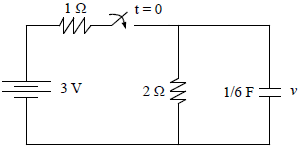
Analise o circuito abaixo. A potência média (W) consumida pelo resistor de 1 Ω após o fechamento da chave, considerando que o circuito já se encontra em regime permanente, é:
Provas
Questão presente nas seguintes provas
Um transformador trifásico de três enrolamentos possui os seguintes valores nominais:
• Primário: Ligado em estrela; 66 kV; 10 MVA
• Secundário: Ligado em estrela; 13,2 kV; 7,5 MVA
• Terciário: Ligado em delta; 2,3 kV; 5 MVA
As impedâncias de dispersão obtidas no ensaio de curto-circuito, desprezando as resistências, são:
• Zps = 7% na base 10 MVA, 66 kV
• Zpt = 9% na base 10 MVA, 66 kV
• Zst = 6% na base 7,5 MVA, 13,2 kV
As impedâncias por unidade dos três enrolamentos (primário, secundário e terciário) do transformador, calculadas para uma base de 10 MVA, 66 kV, serão, respectivamente:
Provas
Questão presente nas seguintes provas
Os principais itens a serem observados na especificação de disjuntores para sistemas de transmissão de energia elétrica são:
Provas
Questão presente nas seguintes provas
A projeção cartográfica é uma forma de representar a superfície da Terra em um mapa e, quando a superfície de projeção pode assumir três posições básicas (polar, equatorial ou oblíqua) em relação à superfície de referência, ela é denominada:
Provas
Questão presente nas seguintes provas
- Gestão EmpresarialCRM: Customer Relationship Management
- Gestão EmpresarialSistemas e Arquitetura SAP
São características do módulo de relacionamento com o cliente SAP CRM (Customer Relationship Management), EXCETO:
Provas
Questão presente nas seguintes provas
Cadernos
Caderno Container