Foram encontradas 50 questões.
Considere a obra A Literatura Inglesa, de Anthony Burguess, para responder à questão.
Shakespeare é, de acordo com Burguess (2006), o maior dramaturgo e, talvez, o maior escritor de todos os tempos. Acerca dele e de seu trabalho, leia as afirmações abaixo e marque cada uma delas como verdadeira (V) o falsa (F):
( ) Foi um escritor genial e sua formação superior em Cambridge deu-lhe ainda mais bases para escrever suas peças e montar personagens complexas.
( ) Para ele, era essencial manter uma intimidade com a plateia e envolvê-la na peça.
( ) O escritor gostava muito de pegar peças, tramas ou narrativas que já existiam e reelaborá-las, sempre as melhorando.
( ) A real intenção do escritor não era escrever textos literários, mas peças teatrais.
( ) Seu intuito primeiro ao produzir peças não era fomentar a arte, mas ganhar dinheiro e ascender socialmente.
( ) As personagens escritas por Shakespeare são, de longe, complexas e criadas sob toda uma história de vida anterior à da encenação (infância, juventude, casamentos etc.).
Assinale a alternativa que traz a sequência CORRETA de respostas, de cima para baixo:
Provas

Considere a obra A Literatura Inglesa, de Anthony Burguess, para responder à questão.
De acordo com Burguess (2006), pode-se afirmar que:
I Literatura Inglesa é toda literatura que usa a língua inglesa como veículo natural de comunicação, independente do lugar onde foi escrita e por quem.
II O Inglês arcaico deve ser aprendido e estudado como língua estrangeira “de fato” até mesmo pelos falantes nativos de Inglês.
III O período conhecido como Inglês médio é aquele em que já se é possível ler e entender as obras escritas nessa época sem a ajuda de uma gramática ou de um dicionário.
IV A Literatura que vem sendo produzida na Inglaterra há séculos é extremamente rica e bem diversa em vários aspectos, o que acaba contrariando a unidade linguística e o conservadorismo do povo inglês.
V As obras literárias produzidas na Inglaterra, bem como seus autores, são extremamente influenciadas por sua geografia, sua paisagem variada e pelo clima das estações do ano, muito bem delineadas.
Está CORRETO apenas o que se afirma em:
Provas
Considere a obra Procedimentos Técnicos da Tradução: Uma Nova proposta, de Heloisa Gonçalves Barbosa (1990) para responder à questão.
Observe o quadro abaixo:
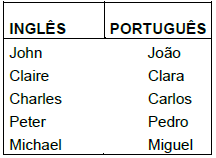
Como elucidado por Newmark (1981 apud Barbosa, 1990, p.55), o procedimento usado no quadro acima, que consiste em adaptar os nomes próprios da língua original para a língua traduzida, é chamado:
Provas
Considere a obra Procedimentos Técnicos da Tradução: Uma Nova proposta, de Heloisa Gonçalves Barbosa (1990) para responder à questão.
Na Tradução, o procedimento chamado equivalente descritivo, proposto por Newmark (1981 apud Barbosa, 1990), consiste em:
Provas
Considere a obra Procedimentos Técnicos da Tradução: Uma Nova proposta, de Heloisa Gonçalves Barbosa (1990) para responder à questão.
Qual alternativa traz o nome de um dos procedimentos da Tradução Oblíqua pontuados por Vinay e Darbelnet (1977 apud Barbosa, 1990) que consiste na mudança de categoria gramatical de um elemento no texto da língua original para outra categoria gramatical quando no texto traduzido, seja por escolha do tradutor ou por obrigatoriedade, sem que haja alteração de sentido?
Provas
Considere a obra Procedimentos Técnicos da Tradução: Uma Nova proposta, de Heloisa Gonçalves Barbosa (1990) para responder à questão.
Para Vinay e Darbelnet (1977 apud Barbosa, 1990), o processo de Tradução nada mais é do que uma aplicação prática da Estilística Comparada, o que pressupõe que o tradutor, de acordo com esse conceito, ao traduzir, deve:
Provas
Texto para responder à questão.
Coffee Drinking Linked to Less Depression in Women
By ANAHAD O'CONNOR
Morning pick-me-up? For many women, the mood-elevating effects of a cup of coffee may be more than fleeting.
A new study shows in women who regularly drink coffee — the fully caffeinated kind — have a 20 percent lower risk of depression than nondrinkers. Decaf, soft drinks, chocolate, tea and other sources of caffeine did not offer the same protection against depression, possibly because of their lower levels of caffeine, the authors say.
Dr. Albert Ascherio, an author of the study and professor of epidemiology and nutrition at the Harvard School of Public Health, said it was too early to recommend that women load up on extra lattes. More research is needed, he said, and “a very high level of caffeine can increase anxiety” and insomnia, potentially reversing any mood-lifting effects.
A link between caffeine intake and depression had been suspected for years. Previous research reported that the risk of suicide decreases with increasing coffee consumption. And a study of over 2,200 middle-aged men in Finland found that heavy coffee drinkers had a significantly lower risk of severe depression than men who avoided coffee, though the sample size was considered too small to be very definitive.
The new study, published in the latest issue of The Archives of Internal Medicine, was larger and more rigorous, analyzing data on nearly 51,000 women taking part in the famous Nurses’ Health Study. Between 1996 and 2006, the women provided detailed information every two years on their caffeine intake, depression risk factors and overall health, including their weight, their use of hormones and their levels of exercise and smoking. Women who reported a diagnosis of depression or showed signs of it at the start of the study were excluded from the analysis.
During the decade that the women were followed, 2,607 cases of clinical depression were diagnosed. Over all, women who regularly drank coffee had a lower risk of depression — about 20 percent — than the women who abstained, and the risk was dose-dependent. In other words, the likelihood of depression fell with each additional cup of coffee, in this case up to as many as six cups a day. (…)
The researchers aren’t sure why caffeine might keep depression at bay. “We know that caffeine enters the brain and activates the release of different neurotransmitters that are related to mood, like dopamine and serotonin,” Dr. Ascherio said. “That may explain the shorter-term effects on mood. But the long-term mechanisms of caffeine intake on mood we don’t really know.”(…)
The latest study looked only at women drinking as much as four to six cups of coffee a day, and not women drinking greater amounts. But earlier research on caffeine and suicide risk found that risk of suicide decreased progressively up to six or seven cups a day, then increased after eight or more cups a day.
“Some people may think ‘a bit is good, so more is better,’ but that’s not true,” Dr. Ascherio said. “We self-medicate ourselves with caffeine, and each person usually knows their optimal level.”
The New York Times, September 26, 2011.
In “Between 1996 and 2006, the women provided detailed information…” the word that could best replace the highlighted word is:
Provas
Texto para responder à questão.
Coffee Drinking Linked to Less Depression in Women
By ANAHAD O'CONNOR
Morning pick-me-up? For many women, the mood-elevating effects of a cup of coffee may be more than fleeting.
A new study shows in women who regularly drink coffee — the fully caffeinated kind — have a 20 percent lower risk of depression than nondrinkers. Decaf, soft drinks, chocolate, tea and other sources of caffeine did not offer the same protection against depression, possibly because of their lower levels of caffeine, the authors say.
Dr. Albert Ascherio, an author of the study and professor of epidemiology and nutrition at the Harvard School of Public Health, said it was too early to recommend that women load up on extra lattes. More research is needed, he said, and “a very high level of caffeine can increase anxiety” and insomnia, potentially reversing any mood-lifting effects.
A link between caffeine intake and depression had been suspected for years. Previous research reported that the risk of suicide decreases with increasing coffee consumption. And a study of over 2,200 middle-aged men in Finland found that heavy coffee drinkers had a significantly lower risk of severe depression than men who avoided coffee, though the sample size was considered too small to be very definitive.
The new study, published in the latest issue of The Archives of Internal Medicine, was larger and more rigorous, analyzing data on nearly 51,000 women taking part in the famous Nurses’ Health Study. Between 1996 and 2006, the women provided detailed information every two years on their caffeine intake, depression risk factors and overall health, including their weight, their use of hormones and their levels of exercise and smoking. Women who reported a diagnosis of depression or showed signs of it at the start of the study were excluded from the analysis.
During the decade that the women were followed, 2,607 cases of clinical depression were diagnosed. Over all, women who regularly drank coffee had a lower risk of depression — about 20 percent — than the women who abstained, and the risk was dose-dependent. In other words, the likelihood of depression fell with each additional cup of coffee, in this case up to as many as six cups a day. (…)
The researchers aren’t sure why caffeine might keep depression at bay. “We know that caffeine enters the brain and activates the release of different neurotransmitters that are related to mood, like dopamine and serotonin,” Dr. Ascherio said. “That may explain the shorter-term effects on mood. But the long-term mechanisms of caffeine intake on mood we don’t really know.”(…)
The latest study looked only at women drinking as much as four to six cups of coffee a day, and not women drinking greater amounts. But earlier research on caffeine and suicide risk found that risk of suicide decreased progressively up to six or seven cups a day, then increased after eight or more cups a day.
“Some people may think ‘a bit is good, so more is better,’ but that’s not true,” Dr. Ascherio said. “We self-medicate ourselves with caffeine, and each person usually knows their optimal level.”
The New York Times, September 26, 2011.
Considering “Decaf, soft drinks, chocolate, tea and other sources of caffeine did not offer the same protection against depression, possibly because of their lower levels of caffeine, the authors say.”. The highlighted word is an adverb of manner. Which of the following words can be classified the same way?
Provas
Texto para responder à questão.
Coffee Drinking Linked to Less Depression in Women
By ANAHAD O'CONNOR
Morning pick-me-up? For many women, the mood-elevating effects of a cup of coffee may be more than fleeting.
A new study shows in women who regularly drink coffee — the fully caffeinated kind — have a 20 percent lower risk of depression than nondrinkers. Decaf, soft drinks, chocolate, tea and other sources of caffeine did not offer the same protection against depression, possibly because of their lower levels of caffeine, the authors say.
Dr. Albert Ascherio, an author of the study and professor of epidemiology and nutrition at the Harvard School of Public Health, said it was too early to recommend that women load up on extra lattes. More research is needed, he said, and “a very high level of caffeine can increase anxiety” and insomnia, potentially reversing any mood-lifting effects.
A link between caffeine intake and depression had been suspected for years. Previous research reported that the risk of suicide decreases with increasing coffee consumption. And a study of over 2,200 middle-aged men in Finland found that heavy coffee drinkers had a significantly lower risk of severe depression than men who avoided coffee, though the sample size was considered too small to be very definitive.
The new study, published in the latest issue of The Archives of Internal Medicine, was larger and more rigorous, analyzing data on nearly 51,000 women taking part in the famous Nurses’ Health Study. Between 1996 and 2006, the women provided detailed information every two years on their caffeine intake, depression risk factors and overall health, including their weight, their use of hormones and their levels of exercise and smoking. Women who reported a diagnosis of depression or showed signs of it at the start of the study were excluded from the analysis.
During the decade that the women were followed, 2,607 cases of clinical depression were diagnosed. Over all, women who regularly drank coffee had a lower risk of depression — about 20 percent — than the women who abstained, and the risk was dose-dependent. In other words, the likelihood of depression fell with each additional cup of coffee, in this case up to as many as six cups a day. (…)
The researchers aren’t sure why caffeine might keep depression at bay. “We know that caffeine enters the brain and activates the release of different neurotransmitters that are related to mood, like dopamine and serotonin,” Dr. Ascherio said. “That may explain the shorter-term effects on mood. But the long-term mechanisms of caffeine intake on mood we don’t really know.”(…)
The latest study looked only at women drinking as much as four to six cups of coffee a day, and not women drinking greater amounts. But earlier research on caffeine and suicide risk found that risk of suicide decreased progressively up to six or seven cups a day, then increased after eight or more cups a day.
“Some people may think ‘a bit is good, so more is better,’ but that’s not true,” Dr. Ascherio said. “We self-medicate ourselves with caffeine, and each person usually knows their optimal level.”
The New York Times, September 26, 2011.
Considering “But earlier research on caffeine and suicide risk found that risk of suicide decreased progressively up to six or seven cups a day, then increased after eight or more cups a day.” , the highlighted verb is an example of:
Provas
Texto para responder à questão.
Coffee Drinking Linked to Less Depression in Women
By ANAHAD O'CONNOR
Morning pick-me-up? For many women, the mood-elevating effects of a cup of coffee may be more than fleeting.
A new study shows in women who regularly drink coffee — the fully caffeinated kind — have a 20 percent lower risk of depression than nondrinkers. Decaf, soft drinks, chocolate, tea and other sources of caffeine did not offer the same protection against depression, possibly because of their lower levels of caffeine, the authors say.
Dr. Albert Ascherio, an author of the study and professor of epidemiology and nutrition at the Harvard School of Public Health, said it was too early to recommend that women load up on extra lattes. More research is needed, he said, and “a very high level of caffeine can increase anxiety” and insomnia, potentially reversing any mood-lifting effects.
A link between caffeine intake and depression had been suspected for years. Previous research reported that the risk of suicide decreases with increasing coffee consumption. And a study of over 2,200 middle-aged men in Finland found that heavy coffee drinkers had a significantly lower risk of severe depression than men who avoided coffee, though the sample size was considered too small to be very definitive.
The new study, published in the latest issue of The Archives of Internal Medicine, was larger and more rigorous, analyzing data on nearly 51,000 women taking part in the famous Nurses’ Health Study. Between 1996 and 2006, the women provided detailed information every two years on their caffeine intake, depression risk factors and overall health, including their weight, their use of hormones and their levels of exercise and smoking. Women who reported a diagnosis of depression or showed signs of it at the start of the study were excluded from the analysis.
During the decade that the women were followed, 2,607 cases of clinical depression were diagnosed. Over all, women who regularly drank coffee had a lower risk of depression — about 20 percent — than the women who abstained, and the risk was dose-dependent. In other words, the likelihood of depression fell with each additional cup of coffee, in this case up to as many as six cups a day. (…)
The researchers aren’t sure why caffeine might keep depression at bay. “We know that caffeine enters the brain and activates the release of different neurotransmitters that are related to mood, like dopamine and serotonin,” Dr. Ascherio said. “That may explain the shorter-term effects on mood. But the long-term mechanisms of caffeine intake on mood we don’t really know.”(…)
The latest study looked only at women drinking as much as four to six cups of coffee a day, and not women drinking greater amounts. But earlier research on caffeine and suicide risk found that risk of suicide decreased progressively up to six or seven cups a day, then increased after eight or more cups a day.
“Some people may think ‘a bit is good, so more is better,’ but that’s not true,” Dr. Ascherio said. “We self-medicate ourselves with caffeine, and each person usually knows their optimal level.”
The New York Times, September 26, 2011.
According to the text:
Provas
Caderno Container