Foram encontradas 552 questões.
A professora Suzana, ao explicar operações com frações, apresentou a representação de um hexágono regular, conforme é apresentado abaixo, seguida de um comentário. Observe:
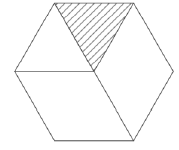
“(...) como podemos observar, !$ { \large 1 \over 6} !$ cabe duas vezes em !$ { \large 1 \over 3} !$ .”
A representação seguida da parte da explicação da professora diz respeito à operação
Provas
Questão presente nas seguintes provas

Sobre o grupo muscular isquiossurais, assinale a alternativa que corresponde aos músculos que o compõe e suas ações principais com relação à articulação do joelho.
Provas
Questão presente nas seguintes provas
Tornou-se célebre em aritmética devido a um dispositivo conhecido como crivo, usado para se acharem todos os números primos menores que um número n dado. Também efetuou uma medição famosa da circunferência máxima da Terra. O texto refere-se a
Provas
Questão presente nas seguintes provas
Numa loja de artigos femininos, o preço de uma bolsa é o triplo do preço de uma sandália. Wanda comprou 1 bolsa e 3 sandálias, pagando R$564,00 por tudo. Sendo assim, é correto afirmar que o preço de uma bolsa é
Provas
Questão presente nas seguintes provas
Choose one alternative to best fill in the blank of the sentence below.
According the São Paulo State Curriculum, nowadays the school should be regarded as an institution .
Provas
Questão presente nas seguintes provas
Assessment is Not a Dirty Word
We live in a time when the word “assessment” is synonymous with “test” and it is regarded as a dirty word, a fourletter word that connotes “high stakes testing,” “teaching to the test,” cramming, and cheating. There is much at stake regarding test results: graduation from high school, admission to college, merit pay for teachers, overhauling schools, and teacher certification programs. Real estate prices fluctuate when pass rates on statewide assessments are reported by school districts and published in the local newspapers, as parents pay a premium to live in school districts with a history of high performance among their students. Therefore, we should not be surprised about the importance placed on testing and assessment in education, nor its controversial nature.
A few years ago, after a lecture on the subject, many of the professors accosted me, shocked that I would suggest developing their tests before the course started and that I went so far as to state that someone else could develop their tests. After all, they were the professor and they knew what they had taught. My response was, “that is exactly the problem with most professor-and-teacher-designed assessments.”
So many teachers and professors teach very important and valuable information, but some of us drift from the curriculum that forms the instructional objectives. We often do not construct assessments that are directly tied to the curriculum we are to teach; rather we test some portion of what we have taught. What would happen if the medical professor spent a lot of time on the heart but really didn’t get a chance to spend any time on the kidneys? Do they still assess learning related to the understanding of the functioning of the kidneys?
If we expect students to transfer their learning to other situations and we know that these situations will be interdisciplinary in nature, as most of real life is, then we must teach them to do, learn, apply and transfer, and assess that as well. Unfortunately, we all too often develop assessments that are easier for us to administer and score, rather than an assessment that contains both the appropriate emphases on specific topics and skills, and that is related to what the final performance outcomes are. For example, while it may be appropriate to assess most beginning drivers with a multiple choice examination focusing on shapes of signs, braking distances, and required actions when approaching a school bus, we would still want a performance assessment of driving skills in various traffic situations. In the same sense, an art student would think it was an appropriate task to produce a drawing, painting or sculpture at the end of the semester, if that was the focus of the class, rather than a multiple choice exam of characteristics of famous styles and collections. In short: the goal is to assess learning in the most appropriate manner based on […]
BROWN, S. Interdisciplinary Assessment in Education, 2008.
According to the text,
Provas
Questão presente nas seguintes provas
Em relação à participação de capital estrangeiro, sobre a saúde no Brasil, é correto afirmar que
Provas
Questão presente nas seguintes provas
Em relação à febre amarela, analise as assertivas abaixo.
I. É uma doença infecciosa febril aguda, transmitida por vetores, que possui dois ciclos epidemiológicos distintos (silvestre e urbano).
II. Seu agente etiológico é um bacilo álcool-ácido resistente.
III. Na febre amarela urbana, o homem é o único hospedeiro com importância epidemiológica. Na febre amarela silvestre, os primatas não-humanos (macacos) são os principais hospedeiros do agente etiológico, sendo o homem um hospedeiro acidental.
IV. O mosquito da espécie Aedes aegypti é o principal transmissor da febre amarela urbana. Na febre amarela silvestre, os modos de transmissão podem ser através da picada de mosquitos infectados ou do contato com sangue ou secreções de primatas infectados.
V. Não existe tratamento específico para a febre amarela. O tratamento é apenas sintomático, com cuidadosa assistência ao paciente que, sob hospitalização, deve permanecer em repouso, com reposição de líquidos e das perdas sanguíneas, quando indicado.
É correto o que se afirma em
Provas
Questão presente nas seguintes provas
Assinale a alternativa que apresenta erro em relação ao uso do verbo.
Provas
Questão presente nas seguintes provas
O comprimento, em decímetros, do lado de um hexágono regular de 168cm de perímetro é
Provas
Questão presente nas seguintes provas
Cadernos
Caderno Container