Foram encontradas 1.714 questões.
Leia a charge.
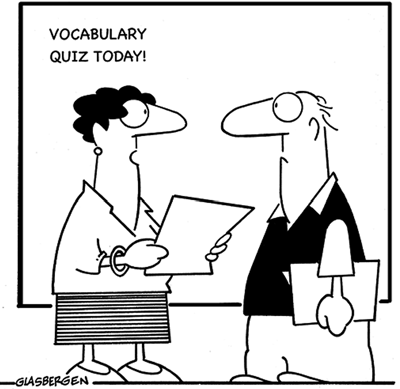
“Many kids never hear that word at home, So I added ‘no’ to our vocabulary lesson.”
(https://www.glasbergen.com)
The teacher’s words imply a criticism of
Provas

Leia os dois textos para responder às questões de números 55 a 59.
Text 1
When they talk about the teaching of vocabulary, teachers are usually referring to the teaching of single words. However, vocabulary knowledge involves considerably more than just knowing the meaning of a given word in isolation: it also involves knowing the words that, with very high frequency, tend to co-occur with it. These patterns, or collocations, are important in vocabulary learning because the meaning of a word has a great deal to do with the words with which it commonly associates. If collocational associations are not learned as part of L2 vocabulary knowledge, the resulting irregularities will immediately mark the learner’s speech or writing as deviant or odd in some way and as decidedly non-native. Native speakers of English, for example, refer to “spoiled” butter as rancid butter and “spoiled” milk as sour milk, but not as *sour butter or *rancid milk.
(Jeanette S. deCarrico. Vocabulary learning and teaching. In: Marianne Celce-Murcia. 3r ed. Teaching English as a second or foreign language. 3rd edition. Boston, Massachusstes: Heinle&Heinle. 2002. Adaptado)
Text 2
The most basic kind of lexical item is also the most familiar — the individual word. But there are in the English language common phrases which are found so frequently that they function almost like lexical items in their own right. Take phrases such as by the way, in a way, in the way. A good knowledge of the grammar of English, and an extensive vocabulary, will not be sufficient to ensure that the learner speaks English like a native, or speaks well, or effectively. Phrases such as “by the way”, and institutionalized expressions, such as “what’s the matter?” and “Nice to meet you” should be included in learning materials as they provide valuable resources to the acquisition of competence.
Students have a tendency to read word-by-word; even identifying any multi-word chunks is difficult without appropriate awareness-raising activities. Training in identification of multi-word items provide a new and important activity for teachers within the Lexical Approach.
(Michael Lewis. The lexical approach. HeinleCengage. 2002. Adaptado)
The discourse marker “as” can have a variety of meanings, depending on the context. In the fragment “as they provide valuable resources to the acquisition of competence” (Text 2, paragraph 1), it means the same as
Provas
Leia os dois textos para responder às questões de números 55 a 59.
Text 1
When they talk about the teaching of vocabulary, teachers are usually referring to the teaching of single words. However, vocabulary knowledge involves considerably more than just knowing the meaning of a given word in isolation: it also involves knowing the words that, with very high frequency, tend to co-occur with it. These patterns, or collocations, are important in vocabulary learning because the meaning of a word has a great deal to do with the words with which it commonly associates. If collocational associations are not learned as part of L2 vocabulary knowledge, the resulting irregularities will immediately mark the learner’s speech or writing as deviant or odd in some way and as decidedly non-native. Native speakers of English, for example, refer to “spoiled” butter as rancid butter and “spoiled” milk as sour milk, but not as *sour butter or *rancid milk.
(Jeanette S. deCarrico. Vocabulary learning and teaching. In: Marianne Celce-Murcia. 3r ed. Teaching English as a second or foreign language. 3rd edition. Boston, Massachusstes: Heinle&Heinle. 2002. Adaptado)
Text 2
The most basic kind of lexical item is also the most familiar — the individual word. But there are in the English language common phrases which are found so frequently that they function almost like lexical items in their own right. Take phrases such as by the way, in a way, in the way. A good knowledge of the grammar of English, and an extensive vocabulary, will not be sufficient to ensure that the learner speaks English like a native, or speaks well, or effectively. Phrases such as “by the way”, and institutionalized expressions, such as “what’s the matter?” and “Nice to meet you” should be included in learning materials as they provide valuable resources to the acquisition of competence.
Students have a tendency to read word-by-word; even identifying any multi-word chunks is difficult without appropriate awareness-raising activities. Training in identification of multi-word items provide a new and important activity for teachers within the Lexical Approach.
(Michael Lewis. The lexical approach. HeinleCengage. 2002. Adaptado)
A correct example of institutionalized language in the classroom is found in alterntaive:
Provas
Leia os dois textos para responder às questões de números 55 a 59.
Text 1
When they talk about the teaching of vocabulary, teachers are usually referring to the teaching of single words. However, vocabulary knowledge involves considerably more than just knowing the meaning of a given word in isolation: it also involves knowing the words that, with very high frequency, tend to co-occur with it. These patterns, or collocations, are important in vocabulary learning because the meaning of a word has a great deal to do with the words with which it commonly associates. If collocational associations are not learned as part of L2 vocabulary knowledge, the resulting irregularities will immediately mark the learner’s speech or writing as deviant or odd in some way and as decidedly non-native. Native speakers of English, for example, refer to “spoiled” butter as rancid butter and “spoiled” milk as sour milk, but not as *sour butter or *rancid milk.
(Jeanette S. deCarrico. Vocabulary learning and teaching. In: Marianne Celce-Murcia. 3r ed. Teaching English as a second or foreign language. 3rd edition. Boston, Massachusstes: Heinle&Heinle. 2002. Adaptado)
Text 2
The most basic kind of lexical item is also the most familiar — the individual word. But there are in the English language common phrases which are found so frequently that they function almost like lexical items in their own right. Take phrases such as by the way, in a way, in the way. A good knowledge of the grammar of English, and an extensive vocabulary, will not be sufficient to ensure that the learner speaks English like a native, or speaks well, or effectively. Phrases such as “by the way”, and institutionalized expressions, such as “what’s the matter?” and “Nice to meet you” should be included in learning materials as they provide valuable resources to the acquisition of competence.
Students have a tendency to read word-by-word; even identifying any multi-word chunks is difficult without appropriate awareness-raising activities. Training in identification of multi-word items provide a new and important activity for teachers within the Lexical Approach.
(Michael Lewis. The lexical approach. HeinleCengage. 2002. Adaptado)
The phrase “in the way” (Text 2) fits the context in alternative:
Provas
Leia os dois textos para responder às questões de números 55 a 59.
Text 1
When they talk about the teaching of vocabulary, teachers are usually referring to the teaching of single words. However, vocabulary knowledge involves considerably more than just knowing the meaning of a given word in isolation: it also involves knowing the words that, with very high frequency, tend to co-occur with it. These patterns, or collocations, are important in vocabulary learning because the meaning of a word has a great deal to do with the words with which it commonly associates. If collocational associations are not learned as part of L2 vocabulary knowledge, the resulting irregularities will immediately mark the learner’s speech or writing as deviant or odd in some way and as decidedly non-native. Native speakers of English, for example, refer to “spoiled” butter as rancid butter and “spoiled” milk as sour milk, but not as *sour butter or *rancid milk.
(Jeanette S. deCarrico. Vocabulary learning and teaching. In: Marianne Celce-Murcia. 3r ed. Teaching English as a second or foreign language. 3rd edition. Boston, Massachusstes: Heinle&Heinle. 2002. Adaptado)
Text 2
The most basic kind of lexical item is also the most familiar — the individual word. But there are in the English language common phrases which are found so frequently that they function almost like lexical items in their own right. Take phrases such as by the way, in a way, in the way. A good knowledge of the grammar of English, and an extensive vocabulary, will not be sufficient to ensure that the learner speaks English like a native, or speaks well, or effectively. Phrases such as “by the way”, and institutionalized expressions, such as “what’s the matter?” and “Nice to meet you” should be included in learning materials as they provide valuable resources to the acquisition of competence.
Students have a tendency to read word-by-word; even identifying any multi-word chunks is difficult without appropriate awareness-raising activities. Training in identification of multi-word items provide a new and important activity for teachers within the Lexical Approach.
(Michael Lewis. The lexical approach. HeinleCengage. 2002. Adaptado)
Um professor que adequadamente compreenda os conteúdos dos dois textos tenderá a
Provas
Leia os dois textos para responder às questões de números 55 a 59.
Text 1
When they talk about the teaching of vocabulary, teachers are usually referring to the teaching of single words. However, vocabulary knowledge involves considerably more than just knowing the meaning of a given word in isolation: it also involves knowing the words that, with very high frequency, tend to co-occur with it. These patterns, or collocations, are important in vocabulary learning because the meaning of a word has a great deal to do with the words with which it commonly associates. If collocational associations are not learned as part of L2 vocabulary knowledge, the resulting irregularities will immediately mark the learner’s speech or writing as deviant or odd in some way and as decidedly non-native. Native speakers of English, for example, refer to “spoiled” butter as rancid butter and “spoiled” milk as sour milk, but not as *sour butter or *rancid milk.
(Jeanette S. deCarrico. Vocabulary learning and teaching. In: Marianne Celce-Murcia. 3r ed. Teaching English as a second or foreign language. 3rd edition. Boston, Massachusstes: Heinle&Heinle. 2002. Adaptado)
Text 2
The most basic kind of lexical item is also the most familiar — the individual word. But there are in the English language common phrases which are found so frequently that they function almost like lexical items in their own right. Take phrases such as by the way, in a way, in the way. A good knowledge of the grammar of English, and an extensive vocabulary, will not be sufficient to ensure that the learner speaks English like a native, or speaks well, or effectively. Phrases such as “by the way”, and institutionalized expressions, such as “what’s the matter?” and “Nice to meet you” should be included in learning materials as they provide valuable resources to the acquisition of competence.
Students have a tendency to read word-by-word; even identifying any multi-word chunks is difficult without appropriate awareness-raising activities. Training in identification of multi-word items provide a new and important activity for teachers within the Lexical Approach.
(Michael Lewis. The lexical approach. HeinleCengage. 2002. Adaptado)
The two texts have the following idea in common:
Provas
Leia o texto para responder às questões de 37 a 48.
Making a career choice
A recently published study was interested in identifying the reasons why people pursue specific educational and career trajectories – like choosing a science, technology, engineering and mathematics major versus a non-STEM1 major in college. We know that having a specific academic identity, like considering oneself a “math person”, is one of the reasons people choose a corresponding career path. The study aimed at finding out when some kids start to lean toward identifying this way. It focused on math and language arts because they are the most common subjects in the U.S. K-12 system2; for example, the SAT3 has two main sections: English and math. There is also a gender stereotype that reading is for girls and math is for boys.
The investigation team analyzed data involving 142 independent samples across the world, featuring almost 211,000 students from 16 countries and regions. This data includes self-reported confidence and interest in math and language arts from students in different grades. It was found that during primary school, students who reported high confidence and interest in language arts were also likely to report high confidence and interest in math.
However, as students progress though the school years, this pattern gradually changes. In high school, students who reported high confidence and interest in language arts reported lower confidence and interest, on average, in math, and vice versa. In other words, students become more likely to think that they’re either a math person or a reading person as they progress through their school years.
The study suggests that some students develop a misconception that they can only be either a math or a reading person as they move from primary to secondary school. This misconception can have a dark side: students might disengage from subjects that they perceive as their relative weaknesses even when they are actually good at these subjects relative to other students. In other words, the misconception found in our study can lead some students to miss out on educational opportunities.
(Sirui Wan. www.theconversation.com, 29.08.2022. Adaptado)
1 STEM: Science, Technology, Engineering and Mathematics.
2 the publicly-supported school years prior to college, from kindergarden to 12th grade.
3 a standardized test widely used for college admissions in the United States.
The final -ed in English verbs has more than one pronunciation. From the verbs below, taken from the text, choose the one in which the ending is pronounced as /id/, which means a syllable is added to the word.
Provas
Leia o texto para responder às questões de 37 a 48.
Making a career choice
A recently published study was interested in identifying the reasons why people pursue specific educational and career trajectories – like choosing a science, technology, engineering and mathematics major versus a non-STEM1 major in college. We know that having a specific academic identity, like considering oneself a “math person”, is one of the reasons people choose a corresponding career path. The study aimed at finding out when some kids start to lean toward identifying this way. It focused on math and language arts because they are the most common subjects in the U.S. K-12 system2; for example, the SAT3 has two main sections: English and math. There is also a gender stereotype that reading is for girls and math is for boys.
The investigation team analyzed data involving 142 independent samples across the world, featuring almost 211,000 students from 16 countries and regions. This data includes self-reported confidence and interest in math and language arts from students in different grades. It was found that during primary school, students who reported high confidence and interest in language arts were also likely to report high confidence and interest in math.
However, as students progress though the school years, this pattern gradually changes. In high school, students who reported high confidence and interest in language arts reported lower confidence and interest, on average, in math, and vice versa. In other words, students become more likely to think that they’re either a math person or a reading person as they progress through their school years.
The study suggests that some students develop a misconception that they can only be either a math or a reading person as they move from primary to secondary school. This misconception can have a dark side: students might disengage from subjects that they perceive as their relative weaknesses even when they are actually good at these subjects relative to other students. In other words, the misconception found in our study can lead some students to miss out on educational opportunities.
(Sirui Wan. www.theconversation.com, 29.08.2022. Adaptado)
1 STEM: Science, Technology, Engineering and Mathematics.
2 the publicly-supported school years prior to college, from kindergarden to 12th grade.
3 a standardized test widely used for college admissions in the United States.
Words in which the prefixes mis- and dis- have the same meaning as in “misconception” and “disengage” (fourth paragraph) can be found in alternative
Provas
Leia o texto para responder às questões de 37 a 48.
Making a career choice
A recently published study was interested in identifying the reasons why people pursue specific educational and career trajectories – like choosing a science, technology, engineering and mathematics major versus a non-STEM1 major in college. We know that having a specific academic identity, like considering oneself a “math person”, is one of the reasons people choose a corresponding career path. The study aimed at finding out when some kids start to lean toward identifying this way. It focused on math and language arts because they are the most common subjects in the U.S. K-12 system2; for example, the SAT3 has two main sections: English and math. There is also a gender stereotype that reading is for girls and math is for boys.
The investigation team analyzed data involving 142 independent samples across the world, featuring almost 211,000 students from 16 countries and regions. This data includes self-reported confidence and interest in math and language arts from students in different grades. It was found that during primary school, students who reported high confidence and interest in language arts were also likely to report high confidence and interest in math.
However, as students progress though the school years, this pattern gradually changes. In high school, students who reported high confidence and interest in language arts reported lower confidence and interest, on average, in math, and vice versa. In other words, students become more likely to think that they’re either a math person or a reading person as they progress through their school years.
The study suggests that some students develop a misconception that they can only be either a math or a reading person as they move from primary to secondary school. This misconception can have a dark side: students might disengage from subjects that they perceive as their relative weaknesses even when they are actually good at these subjects relative to other students. In other words, the misconception found in our study can lead some students to miss out on educational opportunities.
(Sirui Wan. www.theconversation.com, 29.08.2022. Adaptado)
1 STEM: Science, Technology, Engineering and Mathematics.
2 the publicly-supported school years prior to college, from kindergarden to 12th grade.
3 a standardized test widely used for college admissions in the United States.
In a more formal context, the discourse marker “however” could be replaced, with no change in meaning, by
Provas
Leia o texto para responder às questões de 37 a 48.
Making a career choice
A recently published study was interested in identifying the reasons why people pursue specific educational and career trajectories – like choosing a science, technology, engineering and mathematics major versus a non-STEM1 major in college. We know that having a specific academic identity, like considering oneself a “math person”, is one of the reasons people choose a corresponding career path. The study aimed at finding out when some kids start to lean toward identifying this way. It focused on math and language arts because they are the most common subjects in the U.S. K-12 system2; for example, the SAT3 has two main sections: English and math. There is also a gender stereotype that reading is for girls and math is for boys.
The investigation team analyzed data involving 142 independent samples across the world, featuring almost 211,000 students from 16 countries and regions. This data includes self-reported confidence and interest in math and language arts from students in different grades. It was found that during primary school, students who reported high confidence and interest in language arts were also likely to report high confidence and interest in math.
However, as students progress though the school years, this pattern gradually changes. In high school, students who reported high confidence and interest in language arts reported lower confidence and interest, on average, in math, and vice versa. In other words, students become more likely to think that they’re either a math person or a reading person as they progress through their school years.
The study suggests that some students develop a misconception that they can only be either a math or a reading person as they move from primary to secondary school. This misconception can have a dark side: students might disengage from subjects that they perceive as their relative weaknesses even when they are actually good at these subjects relative to other students. In other words, the misconception found in our study can lead some students to miss out on educational opportunities.
(Sirui Wan. www.theconversation.com, 29.08.2022. Adaptado)
1 STEM: Science, Technology, Engineering and Mathematics.
2 the publicly-supported school years prior to college, from kindergarden to 12th grade.
3 a standardized test widely used for college admissions in the United States.
A palavra ‘however’, que introduz o terceiro parágrafo, estabelece entre este e o parágrafo anterior uma relação de
Provas
Caderno Container