Foram encontradas 800 questões.
Candau (2000) destaca o papel da educação e da escola no cenário nacional, alertando para as configurações das produções do conhecimento relativas à educação formal e também à educação popular, a partir das quais propõe reinventar a escola, apontando, no entanto, alguns grandes desafios a enfrentar. Avalie os desafios apresentados abaixo.
I- necessidade de questionar o caráter monocultural da cultura escolar
II- implementação de movimentos que efetivem a promoção do ser humano e que atendam a determinadas etnias sociais
III- revisão da rigidez da organização e da dinâmica pedagógica escolar
IV- necessidade de novas leis e diretrizes para a educação
V- atrelamento da reinvenção da escola à promoção de múltiplos ecossistemas educativos
De acordo com a autora, os desafios a serem enfrentados na reinvenção da escola são:
Provas
Questão presente nas seguintes provas

Teoria e prática assumem relevância na formação do professor. Face ao exposto, é correto afirmar que:
Provas
Questão presente nas seguintes provas
“A atividade industrial é muito importante nas economias dos países desenvolvidos e de muitos países em desenvolvimento, especialmente dos emergentes”.
(SENE, Eustáquio e MOREIRA, João Carlos. Geografia Geral e do Brasil:
espaço geográfico e globalização. São Paulo: Scipione, 2010, p. 317)
Observe, abaixo, o gráfico sobre a produção industrial no mundo.
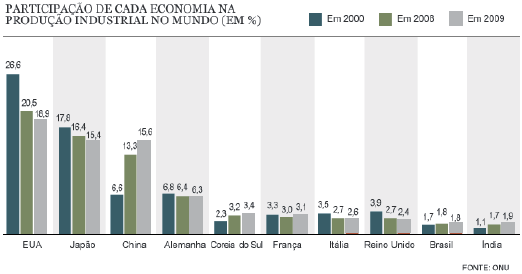
Tendo como base a afirmação e o gráfico anteriores, e o índice de competitividade industrial, índice medido pela Organização de Desenvolvimento Industrial das Nações Unidas (UNIDO), constata-se que:
Provas
Questão presente nas seguintes provas
2409333
Ano: 2011
Disciplina: Inglês (Língua Inglesa)
Banca: CEPERJ
Orgão: Pref. São Gonçalo-RJ
Disciplina: Inglês (Língua Inglesa)
Banca: CEPERJ
Orgão: Pref. São Gonçalo-RJ
Provas:
Read the text carefully and answer question below:
WHAT MAKES A GOOD EFL TEACHER?
By Chris Soames
http://www.aussieschoolpals.com/education/what-makes-a-good-efl -teacher/
http://www.aussieschoolpals.com/education/what-makes-a-good-efl -teacher/
You’re probably asking this question because you are already or soon plan to be an EFL teacher. This means that you probably like working with people, that you prefer variety to routine, and that you don’t mind taking calculated risks. As a rule, Teaching English as a Foreign Language is one of the most satisfying jobs you can do because the vast majority of learners are highly-motivated. Therefore, all you need to do is try to recognise which aspect of your teaching skills needs to be used at any given time. Below are some roles an EFL teacher would play – all of which combine to make a good teacher.
This job is about getting people chatting and communicating as much as possible, so a good EFL teacher needs to be approachable and create a friendly atmosphere in which plenty of communication can take place. At times, this means you are more of an opportunity provider, making sure each class member interacts with the others. You should organise and set up activities whereby learners get to know one another and talk freely about their opinions and their lives, just as they would if they met through a mutual friend. Once they are chatting, just stand back and quietly observe; only join in when the conversation dries up. This minimizes your ‘Teacher Talking Time’ and maximizes ‘Student Talking Time’, which is one of your main goals as a teacher.
If you are new to EFL teaching, you might not feel like much of a specialist. However, because you can speak English better than your students, so you certainly have something unique and valuable to share. A good EFL teacher may not know every single rule off by heart, but, hopefully, will have some idea of where to find out a rule for the next lesson if the students want it.
Occasionally, students may have doubts related to a certain piece of grammar or grasping the meaning and usage of some vocabulary. A good EFL teacher will work out why this is an issue. For example, it could be interference from the way their L1 is organised. To tackle this, the teacher may draw a sketch to explain meaning, or might produce a good timeline which sheds light on how a particular tense, for example, works. A golden rule for awareness raising, especially at lower levels, is ‘show, don’t tell’.
Another role is that of giving advice when people ask for help and suggestions. Many students ask their teacher, “How can I learn new vocabulary?”, “How can I remember the grammar rules?” An efficient EFL instructor creates a mental resource file with some of these answers ready to go. But remember – you are not expected to be an Oracle. You can always throw the question open to the rest of the class first; then ask colleagues for their opinions and, pretty soon, you will learn a whole pool of wisdom that you can pass on to future classes. Beyond your immediate instructional goals, keep reminding your learners to take responsibility for their own learning by working out rules for themselves and infering meaning of unknown vocabulary.
The final role is related to syllabus design and procedural repertoire. Such accomplishments provide triggering to get a class moving together towards a common aim. Each lesson should have a clear goal and resources prepared to guide learners towards this goal. Good EFL teachers know where they are going with each class. They want the lesson to be fun, interesting, motivating and generally enjoyable so that effective learning takes place. They employ a variety of activities with plenty of pair and group work to encourage communication. Moreover, they make sure that all 4 skills (reading, writing, listening and speaking) are touched upon regularly and that learners develop awareness of their progress. In all, through well-prepared instruction, the teacher sets up activities followed by appropriate praise, feedback and correction.
Questions inserted in texts may serve different purposes.
The intention behind the inclusion of questions such as “How can I learn new vocabulary?”, “How can I remember the grammar rules?” is to:
Provas
Questão presente nas seguintes provas
2409317
Ano: 2011
Disciplina: Legislação de Trânsito
Banca: CEPERJ
Orgão: Pref. São Gonçalo-RJ
Disciplina: Legislação de Trânsito
Banca: CEPERJ
Orgão: Pref. São Gonçalo-RJ
Provas:
O Art. 89 do CTB estabelece, para a sinalização de trânsito, uma ordem de prevalência. A norma que se sobrepõe aos demais sinais de trânsito é aquela definida por:
Provas
Questão presente nas seguintes provas
A professora Clara, que atua no Ensino Fundamental, acredita que os alunos não podem ser considerados como seres passivos na aquisição do conhecimento. Ela entende que o conhecimento ocorre quando os alunos interagem com os objetos, formulando hipóteses sobre eles, testando essas hipóteses e modificando-as. Assim, Clara planeja suas ações pedagógicas de modo a criar situações-problema que desafiem os alunos e os levem a buscar soluções. A prática pedagógica dessa professora inspira-se nas ideias de:
Provas
Questão presente nas seguintes provas
2409259
Ano: 2011
Disciplina: Legislação de Trânsito
Banca: CEPERJ
Orgão: Pref. São Gonçalo-RJ
Disciplina: Legislação de Trânsito
Banca: CEPERJ
Orgão: Pref. São Gonçalo-RJ
Provas:
A sinalização de Advertência tem por finalidade alertar os usuários da via para condições potencialmente perigosas, indicando sua natureza. O sinal de advertência contido na figura apresentada abaixo indica:

Provas
Questão presente nas seguintes provas
Conforme estabelece o artigo 154 da Lei Orgânica do Município de São Gonçalo quanto ao dever do Município com a saúde, cabe ao Poder Público Municipal, dentre outras incumbências:
Provas
Questão presente nas seguintes provas
2409200
Ano: 2011
Disciplina: Legislação Municipal
Banca: CEPERJ
Orgão: Pref. São Gonçalo-RJ
Disciplina: Legislação Municipal
Banca: CEPERJ
Orgão: Pref. São Gonçalo-RJ
Provas:
Segundo o artigo 191 do Estatuto dos Servidores Públicos do Município de São Gonçalo, em caso de negligência por parte do servidor, será aplicada verbalmente, bem como comunicada ao órgão de pessoal, a pena de:
Provas
Questão presente nas seguintes provas
Vygotsky (2008) esclarece que a internalização das atividades socialmente enraizadas e historicamente desenvolvidas constitui o aspecto característico da psicologia humana. Nesse sentido, as funções psicológicas superiores, que caracterizam o seu modo de pensar, são:
Provas
Questão presente nas seguintes provas
Cadernos
Caderno Container