Foram encontradas 96 questões.
Disciplina: Inglês (Língua Inglesa)
Banca: AMEOSC
Orgão: Pref. São José do Cedro-SC
When rock music met ancient archeology: the enduring power of Pink Floyd Live at Pompeii
The 1972 concert film Pink Floyd Li
The performance was filmed over six days in October 1971 in the ancient amphitheatre, with the band playing three songs in the ancient venue: Echoes, A Saucerful of Secrets, and One of These Days.
Ancient history professor Ugo Carputi of the University of Naples, a Pink Floyd fan, had persuaded authorities to allow the band to film and to close the site for the duration of filming. Besides the film crew, the band's road crew − and a few children who snuck in to watch − the venue was closed to the public.
In addition to the performance, the four band members were filmed walking over the volcanic mud around Boscoreale, and their performances in the film both were interspersed with images of antiquities from Pompeii.
The movie itself was fleshed out with studio performances in a Paris TV studio and rehearsals at Abbey Road Studios.
Marrying art and music
Famously the Pink Floyd film blends images of antiquities from the Naples Archaeological Museum with the band's performances.
Roman frescoes and mosaics are highlighted during particular songs. Profiles of bronze statues meld with the faces of band members, linking past and present.
Later scenes have the band backdropped by images of frescoes from the famed Villa of the Mysteries and of the plaster casts of eruption victims.
The band's musical themes of death and mystery link with ancient imagery, and it would have been the first time many audience members had seen these masterpieces of Roman art.

The Memento mori mosaic features significantly during the performance of the song Careful with that Axe, Eugene. Naples National Archaeological Museum/Wikimedia Commons
Pink Floyd Live at Pompeii marked a brave experiment in rock concert movies.
Watching it more than 50 years later, it is a timepiece of early 70s rock and a remarkable document of a band on the brink of fame.
Because of their progressive rock sound, sonic experimentation and philosophical lyrics, it was often said by Pink Floyd's fans that they were "the first band in space". They even eventually had a cassette of their music played in space.
But many are not aware of their earlier roots in the dust of ancient Pompeii. The re-release of the film gives an opportunity to enjoy the site's unlikely role in music history.
Pink Floyd at Pompeii − MCMLXXII is in cinemas from Thursday.
https://theconversation.com/when-rock-music-met-ancient-archeology-t he-enduring-power-of-pink-floyd-live-at-pompeii-252744
The 1972 film Pink Floyd Live at Pompeii presents a unique articulation between music, visual imagery and historical location. Far from the typical concert films of the era, the production proposes a redefinition of how sound and space interact in audiovisual narratives. Based on the text, which element most strongly characterizes the distinctiveness of this film compared to its contemporaries?
Provas

Disciplina: Inglês (Língua Inglesa)
Banca: AMEOSC
Orgão: Pref. São José do Cedro-SC
When rock music met ancient archeology: the enduring power of Pink Floyd Live at Pompeii
The 1972 concert film Pink Floyd Li
The performance was filmed over six days in October 1971 in the ancient amphitheatre, with the band playing three songs in the ancient venue: Echoes, A Saucerful of Secrets, and One of These Days.
Ancient history professor Ugo Carputi of the University of Naples, a Pink Floyd fan, had persuaded authorities to allow the band to film and to close the site for the duration of filming. Besides the film crew, the band's road crew − and a few children who snuck in to watch − the venue was closed to the public.
In addition to the performance, the four band members were filmed walking over the volcanic mud around Boscoreale, and their performances in the film both were interspersed with images of antiquities from Pompeii.
The movie itself was fleshed out with studio performances in a Paris TV studio and rehearsals at Abbey Road Studios.
Marrying art and music
Famously the Pink Floyd film blends images of antiquities from the Naples Archaeological Museum with the band's performances.
Roman frescoes and mosaics are highlighted during particular songs. Profiles of bronze statues meld with the faces of band members, linking past and present.
Later scenes have the band backdropped by images of frescoes from the famed Villa of the Mysteries and of the plaster casts of eruption victims.
The band's musical themes of death and mystery link with ancient imagery, and it would have been the first time many audience members had seen these masterpieces of Roman art.
The Memento mori mosaic features significantly during the performance of the song Careful with that Axe, Eugene. Naples National Archaeological Museum/Wikimedia Commons
Pink Floyd Live at Pompeii marked a brave experiment in rock concert movies.
Watching it more than 50 years later, it is a timepiece of early 70s rock and a remarkable document of a band on the brink of fame.
Because of their progressive rock sound, sonic experimentation and philosophical lyrics, it was often said by Pink Floyd's fans that they were "the first band in space". They even eventually had a cassette of their music played in space.
But many are not aware of their earlier roots in the dust of ancient Pompeii. The re-release of the film gives an opportunity to enjoy the site's unlikely role in music history.
Pink Floyd at Pompeii − MCMLXXII is in cinemas from Thursday.
https://theconversation.com/when-rock-music-met-ancient-archeology-t he-enduring-power-of-pink-floyd-live-at-pompeii-252744
A student needs to write a descriptive essay about a cultural event that combines historical significance with contemporary relevance. Based on the Pink Floyd at Pompeii text structure, which organizational pattern would be pedagogically effective?
Provas
A história de São José do Cedro (SC) remonta ao período em que tropeiros e cargueiros percorriam a picada que ligava Vila Oeste (atual São Miguel do Oeste) a Barracão. Durante o trajeto, um ponto estratégico servia de repouso e acabou marcando a origem do município. Sobre esse processo de formação, é correto afirmar que:
Provas
Disciplina: Direito Administrativo
Banca: AMEOSC
Orgão: Pref. São José do Cedro-SC
De acordo com a legislação que disciplina os servidores públicos, os cargos de confiança possuem caráter especial e exigem atenção quanto à forma de ocupação. Sobre esse tema, assinale a alternativa correta:
Provas
A taxa Selic é um dos principais instrumentos de política monetária utilizados no Brasil. Seu aumento tem como efeito principal:
Provas
Quanto às estações, também não "as teríamos" e haveria um grande impacto nos padrões climáticos em todo o mundo.
Fonte: https://www.bbc.com/portuguese/articles/czdz14w0qwdo. adaptado
A norma-padrão de colocação pronominal destacada na frase denomina-se:
Provas
"A estação de transição entre o inverno e o verão começa oficialmente nesta quarta-feira" e vai até o dia 21 de junho.
Fonte: https://www.bbc.com/portuguese/articles/czdz14w0qwdo. adaptado
Sintaticamente, é correto afirmar que, na oração destacada:
Provas
O equinócio acontece quando a luz solar "incide" da mesma forma sobre os dois hemisférios, fazendo com que os dias e as noites tenham a mesma duração.
Fonte: https://www.bbc.com/portuguese/articles/czdz14w0qwdo. adaptado
O verbo destacado, nesta frase, comporta-se como um verbo:
Provas
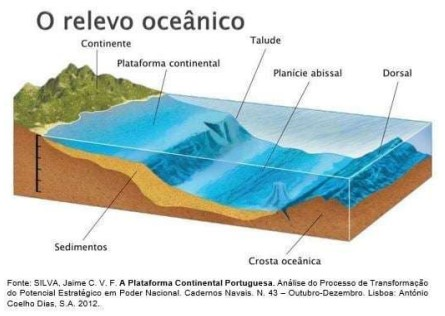
A imagem acima detalha os compartimentos fundamentais do relevo oceânico: plataforma continental, talude, planície abissal e dorsal oceânica, destacando a relação entre o continente e o fundo dos oceanos. Considerando os diferentes usos econômicos e os problemas ambientais associados às águas oceânicas e continentais, assinale a alternativa correta sobre a interação entre esses ambientes e os desafios socioambientais e econômicos presentes nessas áreas:
Provas
A consolidação da Geografia como ciência implicou não apenas no acúmulo de conhecimentos empíricos sobre o mundo, mas na sistematização de categorias analíticas que permitem compreender os processos de produção, apropriação, simbolização e transformação do espaço. As categorias espaço, lugar, território e paisagem expressam diferentes dimensões da realidade geográfica e dialogam com diversas correntes teóricas ao longo do tempo. Com base nesse contexto, analise as afirmativas a seguir:
I. O espaço geográfico, enquanto categoria central da Geografia crítica, é concebido como uma totalidade concreta, resultado da articulação dialética entre estrutura social, relações de produção, técnica e natureza, rompendo com a visão fragmentada herdada das abordagens naturalistas.
II. O conceito de lugar remete à experiência vivida e à construção simbólica do espaço pela subjetividade dos indivíduos, sendo reduzido, em abordagens funcionalistas, a um mero ponto de localização, mas ressignificado, nas abordagens humanistas e culturais, como território de afetos, identidades e práticas cotidianas.
III. O território é entendido como espaço dotado de poder, juridicamente normatizado pelo Estado. No entanto, abordagens recentes ampliam esse entendimento, reconhecendo a territorialidade de grupos sociais diversos, como povos indígenas, quilombolas e movimentos sociais urbanos.
IV. A paisagem, apesar de sua dimensão visível, não se limita à aparência sensorial do espaço. Enquanto expressão das ações humanas acumuladas no tempo, ela permite identificar contradições socioespaciais e revelar processos históricos ocultos, ainda que não seja considerada uma categoria analítica relevante pelas correntes críticas da Geografia.
Assinale a alternativa correta:
Provas
Caderno Container