Foram encontradas 60 questões.
Read the text below in order to answer questions 19 and 20.
WHEN APPLYING FOR AN INSURANCE POLICY...
When you apply for an insurance policy, you will be asked all sorts of questions. For example, the agent will ask you demographic questions such as your age, gender, address, etc. You will also be asked questions which will be used to determine what type of risk you are. For example, when a company is deciding whether or not to offer you automobile insurance, it will want to know about your driving record, whether you have any recent accidents or tickets, and what type of car you drive. This information will help them decide whether your profile is consistent with the type of risks they are trying to attract. Some insurers specialize in offering insurance only to very safe drivers and will only accept applications from people who fit the profile of a safe driver. Once the insurer has decided your profile is consistent with the types of risks it accepts, your information will be used to determine which rate to charge you. For example, the company will decide whether you should be offered insurance at the high-risk driver rate or the low-risk driver rate. Collectively, this entire process is known as the underwriting process. Once a company's underwriting department has decided to offer you insurance, it next determines the "quality" of the risk so the proper premium can be charged. That is, high-risk people should pay more than low-risk people.
Provas

Read the text below in order to answer questions 16 to 18.
INSURANCE AGENTS
Insurers deliver their insurance products to policyowners primarily through independent or exclusive agents. Historically, almost all insurance agents were independent business people paid on commission. More recently, many insurance companies have adopted a system where the agent is a paid employee of the firm. These agents are referred to as exclusive agents. Economists studying the differences between these two distribution systems have long argued that the independent agency system is a less efficient method of getting the product to the customer as measured by the ratio of expenses incurred to premiums written and other statistics. But recent studies suggest the reason for the higher expenses with independent agents is that they offer higher quality to policyowners through more personalized service, more advice on policy limits as well as more help when a claim is filed with the company. So one thing you could consider is how much guidance and service you want.
Provas
Read the text below in order to answer questions 16 to 18.
INSURANCE AGENTS
Insurers deliver their insurance products to policyowners primarily through independent or exclusive agents. Historically, almost all insurance agents were independent business people paid on commission. More recently, many insurance companies have adopted a system where the agent is a paid employee of the firm. These agents are referred to as exclusive agents. Economists studying the differences between these two distribution systems have long argued that the independent agency system is a less efficient method of getting the product to the customer as measured by the ratio of expenses incurred to premiums written and other statistics. But recent studies suggest the reason for the higher expenses with independent agents is that they offer higher quality to policyowners through more personalized service, more advice on policy limits as well as more help when a claim is filed with the company. So one thing you could consider is how much guidance and service you want.
According to the text, economists
Provas
Read the text below in order to answer questions 16 to 18.
INSURANCE AGENTS
Insurers deliver their insurance products to policyowners primarily through independent or exclusive agents. Historically, almost all insurance agents were independent business people paid on commission. More recently, many insurance companies have adopted a system where the agent is a paid employee of the firm. These agents are referred to as exclusive agents. Economists studying the differences between these two distribution systems have long argued that the independent agency system is a less efficient method of getting the product to the customer as measured by the ratio of expenses incurred to premiums written and other statistics. But recent studies suggest the reason for the higher expenses with independent agents is that they offer higher quality to policyowners through more personalized service, more advice on policy limits as well as more help when a claim is filed with the company. So one thing you could consider is how much guidance and service you want.
Provas
Assinale a opção em que o texto está de acordo com as exigências da norma culta escrita.
Provas
Numere os trechos de forma a compor um texto coeso e coerente e assinale a seqüência correta.
( ) Mas, atualmente, uma nova forma de garantia está começando a se tornar comum no mercado. É a chamada garantia estendida ou complementar, que garante o produto por um prazo além da garantia legal e contratual e é oferecida a quem adquire bens duráveis.
( ) Esse alongamento do prazo de garantia é adquirido como um serviço à parte do produto, pelo qual o consumidor desembolsa um determinado valor, no ato da compra, e é oferecido, em geral, por outra empresa, não pelo fabricante do produto adquirido.
( ) Essa é a garantia legal, conforme o Código de Defesa do Consumidor (CDC). Em seu artigo 26 estipula 30 dias de garantia para produtos não-duráveis (alimentos, cosméticos, etc.) e 90 para produtos duráveis.
( ) Sempre que adquire um produto ou contrata um serviço, o consumidor deve ter suas ex-pectativas correspondidas, no que diz respeito à sua quantidade, qualidade e eficiência.
( ) Além dessa garantia legal, a maioria dos produtos conta também com a garantia contratual, oferecida pelo fabricante, por meio do termo de garantia, no qual o prazo e o lugar em que ela deve ser exigida devem estar explicitamente informados.
(Garantia estendida: o que é e como funciona, Jornal da Tarde, estadao.com.br, 10/03/2001, com adaptações)
Provas
No que se refere à pontuação do texto, assinale a opção correta.
Provas
Leia o texto para responder às questões 11 e 12.
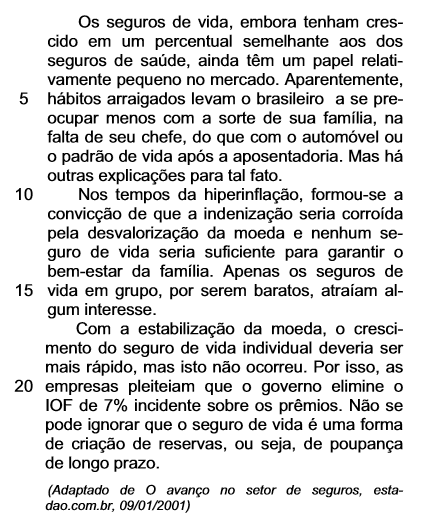
Assinale a opção que está em desacordo com o texto.
Provas
Leia o texto para responder às questões 11 e 12.
Provas
As sociedades seguradoras podem distribuir lucros ou quaisquer fundos correspondentes às reservas patrimoniais, desde que:
Provas
Caderno Container