Foram encontradas 353 questões.
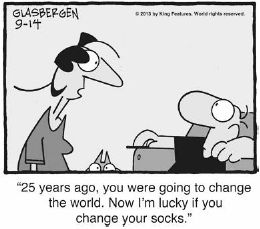
Randy Glasbergen. Internet: <www.weeklystorybook.com>.
In the cartoon above, the woman is complaining because
Provas

If the economy of the nineteenth-century world was formed mainly under the influence of the British Industrial Revolution, its politics and ideology were formed mainly by the French. Britain provided the model for its railways and factories, the economic explosive which cracked open the traditional economic and social structures of the non-European world; but France made its revolutions and gave them their ideas, to the point where a tricolour flag of some kind became the emblem of virtually every emerging nation, and European (or indeed world) politics between 1789 and 1917 were largely the struggle for and against the principles of 1789.
France provided the vocabulary and the issues of liberal and radical-democratic politics for most of the world. France provided the first great example, the concept and the vocabulary of nationalism. France provided the codes of law, the model of scientific and technical organization, the metric system of measurement for most countries. The ideology of the modern world first penetrated the ancient civilizations which had until then resisted European ideas through French influence. This was the work of the French Revolution.
Eric Hobsbawm. The age of revolution: 1789-1848. Abacus: London, 2007, p. 73-4 (adapted).
Judge the following item based on the text presented above.
As highlighted in the first paragraph, “cracked open” can correctly be replaced by revealed.
Provas
How can we ever change the world? Military leaders have certainly managed to change large parts of it; scientists devising cures and vaccines for disease can spread a more benign influence across whole continents; the thoughts of religious leaders or philosophers can sweep through generations like fire. But books?
Reading books is generally a solitary pastime: bookishness is the very antithesis of the man-of-action qualities that seem to shake the world. The pen may boast of being mightier than the sword, but it is generally the sword that wins in the short term. It is that phrase, though, which gives the game away: in the short term, writers can be imprisoned or executed, their work censored, and their books burned, but over history, it is books and the ideas expressed within them that have transformed the world.
But which books can be said to have changed the world? There are few better ways of starting an argument than producing a list, and I have no doubt that not everyone will be happy about the books I included in my list. About some, like the Bible, Shakespeare’s First Folio and Darwin’s On the Origin of Species, there can be little argument — but what about Euclid’s Elements, Thomas Paine’s Rights of Man or A Vindication of the Rights of Women by Mary Wollstonecraft? The answer is that any list can only be subjective.
Andrew Taylor. Books that changed the world: the 50 most influential books in human history. Quercus Editions, 2014 (adapted).
Judge the following item according to the text presented.
As highlighted in the second paragraph, the author presents two widely accepted and not always true views: one about the habit of reading books and the other about the kind of people who are believed to be able to change the world.
Provas
Caderno Container