Foram encontradas 175 questões.
Interactive Lecture:
Small Changes for Improved Engagement and Learning
Traditionally, undergraduate education has been predominately lecture-based instruction and passive lecturing continues to be the most widely used instructional strategy. However, educational research over the past decades has shown that students retain more course content when active learning techniques are correctly implemented. Furthermore, evidence shows that active learning lessens learning and achievement gaps for historically marginalized students
One method for starting the shift to active learning is the use of interactive lectures, those that incorporate short activities that give students opportunities to engage with the materials just covered in class. The main advantages of interactive lectures for instructors are the ease of implementation and the variety of activities that can be explored and incorporated into a course. Students benefit through increased engagement, learning, and long-term retention of course ideas, topics, and materials (Ernst and Colthorpe 2007, Revell and Wainwright 2009, Miller et al. 2013, Hadie et al. 2018).
So, how do you create an interactive lecture?
The preparation for an interactive lecture begins with revisiting the student learning objectives. Student learning objectives are key to determining which topics are essential to the course and aids in attending to these ideas, materials, and topics for lectures.
Once you are clear on the learning objective(s), review the topic content to determine which aspects of the lecture are key points or required topics and which can be eliminated or covered using methods such as textbook readings, introductory videos, homework assignments etc.
Finally, determine the smallest units of content that can be given and remain coherent. For each small section of information, reframe the content to answer a question. Use awareness-raising questions for structuring lectures; this will allow many strategies to be employed to increase student engagement through analysis and discussion. You could use one same question and have students brainstorm possible answers in pairs or small groups. The method helps students determine their prior knowledge and has them think critically about the topic.
(Michele Larson. https://teaching.unl.edu, 24.05.2022. Adaptado)
The same suffixation process which resulted in “lessen” (paragraph 1) is found in the following word:
Provas

Interactive Lecture:
Small Changes for Improved Engagement and Learning
Traditionally, undergraduate education has been predominately lecture-based instruction and passive lecturing continues to be the most widely used instructional strategy. However, educational research over the past decades has shown that students retain more course content when active learning techniques are correctly implemented. Furthermore, evidence shows that active learning lessens learning and achievement gaps for historically marginalized students
One method for starting the shift to active learning is the use of interactive lectures, those that incorporate short activities that give students opportunities to engage with the materials just covered in class. The main advantages of interactive lectures for instructors are the ease of implementation and the variety of activities that can be explored and incorporated into a course. Students benefit through increased engagement, learning, and long-term retention of course ideas, topics, and materials (Ernst and Colthorpe 2007, Revell and Wainwright 2009, Miller et al. 2013, Hadie et al. 2018).
So, how do you create an interactive lecture?
The preparation for an interactive lecture begins with revisiting the student learning objectives. Student learning objectives are key to determining which topics are essential to the course and aids in attending to these ideas, materials, and topics for lectures.
Once you are clear on the learning objective(s), review the topic content to determine which aspects of the lecture are key points or required topics and which can be eliminated or covered using methods such as textbook readings, introductory videos, homework assignments etc.
Finally, determine the smallest units of content that can be given and remain coherent. For each small section of information, reframe the content to answer a question. Use awareness-raising questions for structuring lectures; this will allow many strategies to be employed to increase student engagement through analysis and discussion. You could use one same question and have students brainstorm possible answers in pairs or small groups. The method helps students determine their prior knowledge and has them think critically about the topic.
(Michele Larson. https://teaching.unl.edu, 24.05.2022. Adaptado)
In the fragment from the first paragraph “Evidence shows that active learning lessens learning and achievement gaps”, the underlined word means to
Provas
Interactive Lecture:
Small Changes for Improved Engagement and Learning
Traditionally, undergraduate education has been predominately lecture-based instruction and passive lecturing continues to be the most widely used instructional strategy. However, educational research over the past decades has shown that students retain more course content when active learning techniques are correctly implemented. Furthermore, evidence shows that active learning lessens learning and achievement gaps for historically marginalized students
One method for starting the shift to active learning is the use of interactive lectures, those that incorporate short activities that give students opportunities to engage with the materials just covered in class. The main advantages of interactive lectures for instructors are the ease of implementation and the variety of activities that can be explored and incorporated into a course. Students benefit through increased engagement, learning, and long-term retention of course ideas, topics, and materials (Ernst and Colthorpe 2007, Revell and Wainwright 2009, Miller et al. 2013, Hadie et al. 2018).
So, how do you create an interactive lecture?
The preparation for an interactive lecture begins with revisiting the student learning objectives. Student learning objectives are key to determining which topics are essential to the course and aids in attending to these ideas, materials, and topics for lectures.
Once you are clear on the learning objective(s), review the topic content to determine which aspects of the lecture are key points or required topics and which can be eliminated or covered using methods such as textbook readings, introductory videos, homework assignments etc.
Finally, determine the smallest units of content that can be given and remain coherent. For each small section of information, reframe the content to answer a question. Use awareness-raising questions for structuring lectures; this will allow many strategies to be employed to increase student engagement through analysis and discussion. You could use one same question and have students brainstorm possible answers in pairs or small groups. The method helps students determine their prior knowledge and has them think critically about the topic.
(Michele Larson. https://teaching.unl.edu, 24.05.2022. Adaptado)
Correct use of a perfect tense is found in alternative:
Provas
Interactive Lecture:
Small Changes for Improved Engagement and Learning
Traditionally, undergraduate education has been predominately lecture-based instruction and passive lecturing continues to be the most widely used instructional strategy. However, educational research over the past decades has shown that students retain more course content when active learning techniques are correctly implemented. Furthermore, evidence shows that active learning lessens learning and achievement gaps for historically marginalized students
One method for starting the shift to active learning is the use of interactive lectures, those that incorporate short activities that give students opportunities to engage with the materials just covered in class. The main advantages of interactive lectures for instructors are the ease of implementation and the variety of activities that can be explored and incorporated into a course. Students benefit through increased engagement, learning, and long-term retention of course ideas, topics, and materials (Ernst and Colthorpe 2007, Revell and Wainwright 2009, Miller et al. 2013, Hadie et al. 2018).
So, how do you create an interactive lecture?
The preparation for an interactive lecture begins with revisiting the student learning objectives. Student learning objectives are key to determining which topics are essential to the course and aids in attending to these ideas, materials, and topics for lectures.
Once you are clear on the learning objective(s), review the topic content to determine which aspects of the lecture are key points or required topics and which can be eliminated or covered using methods such as textbook readings, introductory videos, homework assignments etc.
Finally, determine the smallest units of content that can be given and remain coherent. For each small section of information, reframe the content to answer a question. Use awareness-raising questions for structuring lectures; this will allow many strategies to be employed to increase student engagement through analysis and discussion. You could use one same question and have students brainstorm possible answers in pairs or small groups. The method helps students determine their prior knowledge and has them think critically about the topic.
(Michele Larson. https://teaching.unl.edu, 24.05.2022. Adaptado)
In the sentence from the first paragraph “However, educational research over the past decades has shown that students retain more course content when active learning techniques are correctly implemented.”, the underlined verb phrase indicates
Provas
Interactive Lecture:
Small Changes for Improved Engagement and Learning
Traditionally, undergraduate education has been predominately lecture-based instruction and passive lecturing continues to be the most widely used instructional strategy. However, educational research over the past decades has shown that students retain more course content when active learning techniques are correctly implemented. Furthermore, evidence shows that active learning lessens learning and achievement gaps for historically marginalized students
One method for starting the shift to active learning is the use of interactive lectures, those that incorporate short activities that give students opportunities to engage with the materials just covered in class. The main advantages of interactive lectures for instructors are the ease of implementation and the variety of activities that can be explored and incorporated into a course. Students benefit through increased engagement, learning, and long-term retention of course ideas, topics, and materials (Ernst and Colthorpe 2007, Revell and Wainwright 2009, Miller et al. 2013, Hadie et al. 2018).
So, how do you create an interactive lecture?
The preparation for an interactive lecture begins with revisiting the student learning objectives. Student learning objectives are key to determining which topics are essential to the course and aids in attending to these ideas, materials, and topics for lectures.
Once you are clear on the learning objective(s), review the topic content to determine which aspects of the lecture are key points or required topics and which can be eliminated or covered using methods such as textbook readings, introductory videos, homework assignments etc.
Finally, determine the smallest units of content that can be given and remain coherent. For each small section of information, reframe the content to answer a question. Use awareness-raising questions for structuring lectures; this will allow many strategies to be employed to increase student engagement through analysis and discussion. You could use one same question and have students brainstorm possible answers in pairs or small groups. The method helps students determine their prior knowledge and has them think critically about the topic.
(Michele Larson. https://teaching.unl.edu, 24.05.2022. Adaptado)
In the first paragraph, the discourse markers “However” and “Furthermore” indicate, respectively,
Provas
Leia o cartoon.
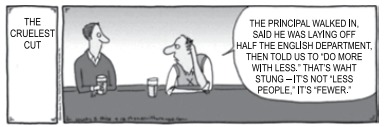
Leia o cartoon.
As far as standard English is concerned, the teacher’s correction of the principal’s words “It’s not ‘less people’, it’s ‘fewer’” is
Provas
The twenties were strange and wonderful years in America. “The uncertainties of 1919 were over – there seemed little doubt about what was going to happen – America was going on the greatest, gaudiest spree in history.” These are the words of F. Scott Fitzgerald (1896-1940). Fitzgerald’s best books form a kind of spiritual history of the “Lost Generation” (a phrase first used by Gertrude Stein). Many young people in the post-World War I had ‘lost’ their American ideals. At the same time America ‘lost’ many fine young writers – like e.e. cummings and Hemingway – because they had moved to Paris.
Ernest Hemingway was one of the writers who spoke for the lost generation. He drove an ambulance in WWI and then decided to become a writer. His first novel, The Sun Also Rises (1926), is a portrait of young adults living in the postwar era. The characters are young Americans living in Paris. Some have fought bravely for their country. But now they are completely useless in peacetime. Others in the novel are simply expatriates, people without a land.
You're an expatriate. You’ve lost touch with the
soil. Fake European standards have ruined you.
You drink yourself to death. You become obsessed
by sex. You spend all your time talking. You’re an
expatriate, you see? You hang around cafés.
Without hope or ambition, they try to enjoy each day as it comes. All they want to know is how to live in the emptiness of the world. The typical Hemingway hero must always fight against the Nada (nothingness in Spanish) of the world. He must never give up trying to live life as fully as possible.
(Peter High. Outline of American Literature. Essex, Longman. 1996. p. 146-7. Adaptado)
Partindo do excerto de Peter High, um professor de língua inglesa, em conformidade com abordagens comunicativas, propõe a seus alunos
Provas
The twenties were strange and wonderful years in America. “The uncertainties of 1919 were over – there seemed little doubt about what was going to happen – America was going on the greatest, gaudiest spree in history.” These are the words of F. Scott Fitzgerald (1896-1940). Fitzgerald’s best books form a kind of spiritual history of the “Lost Generation” (a phrase first used by Gertrude Stein). Many young people in the post-World War I had ‘lost’ their American ideals. At the same time America ‘lost’ many fine young writers – like e.e. cummings and Hemingway – because they had moved to Paris.
Ernest Hemingway was one of the writers who spoke for the lost generation. He drove an ambulance in WWI and then decided to become a writer. His first novel, The Sun Also Rises (1926), is a portrait of young adults living in the postwar era. The characters are young Americans living in Paris. Some have fought bravely for their country. But now they are completely useless in peacetime. Others in the novel are simply expatriates, people without a land.
You're an expatriate. You’ve lost touch with the
soil. Fake European standards have ruined you.
You drink yourself to death. You become obsessed
by sex. You spend all your time talking. You’re an
expatriate, you see? You hang around cafés.
Without hope or ambition, they try to enjoy each day as it comes. All they want to know is how to live in the emptiness of the world. The typical Hemingway hero must always fight against the Nada (nothingness in Spanish) of the world. He must never give up trying to live life as fully as possible.
(Peter High. Outline of American Literature. Essex, Longman. 1996. p. 146-7. Adaptado)
A palavra “as” pode assumir uma variedade de significados em Língua Inglesa, a depender do contexto. Assinale a alternativa em que a palavra está relacionada às ideias de “quando” ou “à medida que”, conforme o trecho do quarto parágrafo “They try to enjoy each day as it comes”.
Provas
The twenties were strange and wonderful years in America. “The uncertainties of 1919 were over – there seemed little doubt about what was going to happen – America was going on the greatest, gaudiest spree in history.” These are the words of F. Scott Fitzgerald (1896-1940). Fitzgerald’s best books form a kind of spiritual history of the “Lost Generation” (a phrase first used by Gertrude Stein). Many young people in the post-World War I had ‘lost’ their American ideals. At the same time America ‘lost’ many fine young writers – like e.e. cummings and Hemingway – because they had moved to Paris.
Ernest Hemingway was one of the writers who spoke for the lost generation. He drove an ambulance in WWI and then decided to become a writer. His first novel, The Sun Also Rises (1926), is a portrait of young adults living in the postwar era. The characters are young Americans living in Paris. Some have fought bravely for their country. But now they are completely useless in peacetime. Others in the novel are simply expatriates, people without a land.
You're an expatriate. You’ve lost touch with the
soil. Fake European standards have ruined you.
You drink yourself to death. You become obsessed
by sex. You spend all your time talking. You’re an
expatriate, you see? You hang around cafés.
Without hope or ambition, they try to enjoy each day as it comes. All they want to know is how to live in the emptiness of the world. The typical Hemingway hero must always fight against the Nada (nothingness in Spanish) of the world. He must never give up trying to live life as fully as possible.
(Peter High. Outline of American Literature. Essex, Longman. 1996. p. 146-7. Adaptado)
The second and last paragraphs in Peter High’s text are basically in the simple present tense to
Provas
The twenties were strange and wonderful years in America. “The uncertainties of 1919 were over – there seemed little doubt about what was going to happen – America was going on the greatest, gaudiest spree in history.” These are the words of F. Scott Fitzgerald (1896-1940). Fitzgerald’s best books form a kind of spiritual history of the “Lost Generation” (a phrase first used by Gertrude Stein). Many young people in the post-World War I had ‘lost’ their American ideals. At the same time America ‘lost’ many fine young writers – like e.e. cummings and Hemingway – because they had moved to Paris.
Ernest Hemingway was one of the writers who spoke for the lost generation. He drove an ambulance in WWI and then decided to become a writer. His first novel, The Sun Also Rises (1926), is a portrait of young adults living in the postwar era. The characters are young Americans living in Paris. Some have fought bravely for their country. But now they are completely useless in peacetime. Others in the novel are simply expatriates, people without a land.
You're an expatriate. You’ve lost touch with the
soil. Fake European standards have ruined you.
You drink yourself to death. You become obsessed
by sex. You spend all your time talking. You’re an
expatriate, you see? You hang around cafés.
Without hope or ambition, they try to enjoy each day as it comes. All they want to know is how to live in the emptiness of the world. The typical Hemingway hero must always fight against the Nada (nothingness in Spanish) of the world. He must never give up trying to live life as fully as possible.
(Peter High. Outline of American Literature. Essex, Longman. 1996. p. 146-7. Adaptado)
Hemingway is remarkable for the conciseness of his style. The quotation from his book The Sun Also Rises illustrates one such feature in his writing, namely,
Provas
Caderno Container