Foram encontradas 60 questões.
Trekking é u m esporte constituído de provas onde se devem percorrer trilhas preestabelecidas em planilhas. Nelas há informações como figuras representativas sobre o caminho, direções para navegação por bússola, velocidade de caminhada e comprimento dos trechos do percurso. Considere que em um trecho de uma prova, uma pessoa parte de um ponto A e anda 120 m para o leste chegando a um ponto B. Em seguida, partindo do ponto B anda 80 m para o sul chegando ao ponto C e, em seguida, anda mais 60 m para o oeste, chegando ao ponto D. O módulo do vetor deslocamento sofrido pela pessoa em todo o percurso foi de:
Provas

Trying to Plant a Trillion Trees Won’t Solve Anything
Only a monster would say no to this pitch: The best way to beat climate change - the warming of Earth caused by gases like carbo dioxide emitted by human industry, leading to rising sea levels, worsening fires and storms, drought and disease – is simple. Plant a trillion trees. It’d be “one of the most effective carbon drawdowns to date,” said an article on the idea in the journal Science this past summer. And who doesn’t love trees, right?
Except the math turned out to be a little shady. Last month a bunch of climate scientists and ecologists piled onto that tree research in the same journal, calling out numerous errors in the first team’s calculations. At about the same time, a whole other bunch of ecologists started pushing back on the agriculture - tech startup Indigo for pitching a similar land-based carbon sequestration strategy, the “Terraton Initiative”, paying farmers to use new methods that could suck down a trillion metric tons (a teraton) of carbon. These goals are critical and the ideals are noble - who doesn’t want to stop climate change? Pretty much everyone except the US government agrees on that. It’s the numbers that are the problem. Take the trees thing. The scientists who proposed it made careful maps of where trees grow today, all over the planet. They had a census of how many were there, combined with satellite data, all used to estimate how many potential trees could grow - and how much carbon those trees would slurp out of the atmosphere, a nontrivial calculation. There’s room for 0.9 billion hectares of new trees, they said - 2.2 billion acres of tree cover, which draws down 205 metric gigatons of carbon, or 225 billion tons in US non-metric. That’s in line with the goal of keeping warming at or below 1.5 degrees, per the Intergovernmental Panel on Climate Change. World: saved! But then the bills started coming due. The team forgot that 55 percent of all historically emitted carbon got absorbed by the oceans, not the land, and so underestimated the total amount of carbon by about one half. They overestimated carbon uptake by trees, and suggested putting trees where they’ve never been, or where they’d actually make the planet hotter (by darkening planetary albedo over icy, more reflective terrain). They didn’t take into account that the ecosystems where they wanted to plant trees already sequestered carbon. And so on. “We’re not talking about small errors here. We’re talking about a huge difference in the total amount of carbon you could sequester,” says Carla Staver, an ecologist at Yale University.
(Adam Rogers, www.wired.com, 25/10/2019)
Consider the fragment from the first paragraph: “the warming of Earth caused by gases like carbon dioxide emitted by human industry, leading to rising sea levels, worsening fires and storms, drought and disease.” The best definition for the underlined word is:
Provas
Trying to Plant a Trillion Trees Won’t Solve Anything
Only a monster would say no to this pitch: The best way to beat climate change - the warming of Earth caused by gases like carbo dioxide emitted by human industry, leading to rising sea levels, worsening fires and storms, drought and disease – is simple. Plant a trillion trees. It’d be “one of the most effective carbon drawdowns to date,” said an article on the idea in the journal Science this past summer. And who doesn’t love trees, right?
Except the math turned out to be a little shady. Last month a bunch of climate scientists and ecologists piled onto that tree research in the same journal, calling out numerous errors in the first team’s calculations. At about the same time, a whole other bunch of ecologists started pushing back on the agriculture - tech startup Indigo for pitching a similar land-based carbon sequestration strategy, the “Terraton Initiative”, paying farmers to use new methods that could suck down a trillion metric tons (a teraton) of carbon. These goals are critical and the ideals are noble - who doesn’t want to stop climate change? Pretty much everyone except the US government agrees on that. It’s the numbers that are the problem. Take the trees thing. The scientists who proposed it made careful maps of where trees grow today, all over the planet. They had a census of how many were there, combined with satellite data, all used to estimate how many potential trees could grow - and how much carbon those trees would slurp out of the atmosphere, a nontrivial calculation. There’s room for 0.9 billion hectares of new trees, they said - 2.2 billion acres of tree cover, which draws down 205 metric gigatons of carbon, or 225 billion tons in US non-metric. That’s in line with the goal of keeping warming at or below 1.5 degrees, per the Intergovernmental Panel on Climate Change. World: saved! But then the bills started coming due. The team forgot that 55 percent of all historically emitted carbon got absorbed by the oceans, not the land, and so underestimated the total amount of carbon by about one half. They overestimated carbon uptake by trees, and suggested putting trees where they’ve never been, or where they’d actually make the planet hotter (by darkening planetary albedo over icy, more reflective terrain). They didn’t take into account that the ecosystems where they wanted to plant trees already sequestered carbon. And so on. “We’re not talking about small errors here. We’re talking about a huge difference in the total amount of carbon you could sequester,” says Carla Staver, an ecologist at Yale University.
(Adam Rogers, www.wired.com, 25/10/2019)
Consider the fragment from the third paragraph:“They had a census of how many were there, combined with satellite data, all used to estimate how many potential trees could grow - and how much carbon those trees would slurp out of the atmosphere, a nontrivial calculation.” The best definition for the underlined word is:
Provas
A criptografia é muito utilizada em situações nas quais é necessária uma comunicação confidencial, como por exemplo: via internet e em transações eletrônicas envolvendo senhas. A criptografia atual é constituída por estudo de algoritmos criptográficos que podem ser implantados em computadores. As matrizes são usadas na criptografia para codificar e decodificar mensagens, sendo que o remetente usará uma chave para codificar e o destinatário usará outra chave para decodificar. Para criptografar mensagens, considere a associação entre letras do alfabeto e demais símbolos apresentada na tabela a seguir, ou seja, A = 1, B = 2, C = 3, e assim sucessivamente até Z = 26, considere o símbolo * que deverá ser usado para representar espaço entre as palavras.
| A | B | C | D | E | F | G | H | I | J |
| 1 | 2 | 3 | 4 | 5 | 6 | 7 | 8 | 9 | 10 |
| K | L | M | N | O | P | Q | R | S | T |
| 11 | 12 | 13 | 14 | 15 | 16 | 17 | 18 | 19 | 20 |
| U | V | W | X | Y | Z | ? | ! | * | . |
| 21 | 22 | 23 | 24 | 25 | 26 | 27 | 28 | 29 | 30 |
A mensagem a ser criptografada é convertida em uma matriz M de 2 linhas, onde cada letra, na sequência de cada linha, corresponde as letras da mensagem. Por exemplo, a mensagem MEU AMIGO. é representada pela matriz:

A última coisa a ser feita para terminar a criptografia é multiplicar uma matriz de codificação A quadrada de ordem 2 pela matriz M, obtendo, assim, a matriz com a mensagem codificada.
Considere a matriz C, cujos elementos possuem uma mensagem codificada:

Sabendo que C =A . M, onde A = !$ \begin{pmatrix} 2 & 5 \\ 1 & 3 \end{pmatrix} !$ e M é a matriz cujos elementos fornecem a mensagem desejada, de acordo com a tabela, conclui-se que a mensagem contida em M é:
Provas
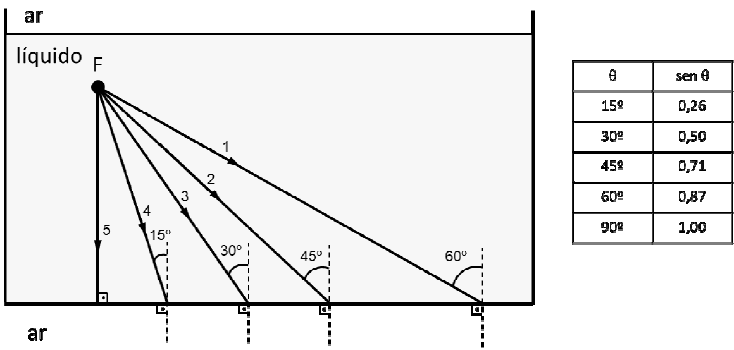
Um recipiente contém um líquido de índice de refração absoluto 1,5. No interior do líquido, uma fonte de luz monocromática F emite raios de luz numerados de 1 a 5 conforme indica a figura abaixo. Considerando o índice de refração do ar igual a 1, dos raios indicados, os que sofrem reflexão total no fundo do recipiente são:
Provas
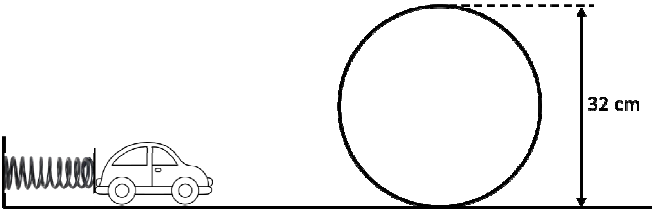
Um carrinho de massa 100 g deve ser capaz de completar um looping circular de 32 cm de diâmetro conforme mostra a figura abaixo. Para isso, ele é preso a uma mola de constante elástica 320 N/m que, quando liberada, empurra o carrinho. Desprezando as perdas de energia e adotando g = 10 m/s², a menor deformação da mola necessária para que o carrinho complete o looping é:
Provas
Os Estados Unidos e a Rússia encerraram no dia 02.08.2019 o tratado de desarmamento nuclear (INF), assinado nos anos da Guerra Fria, em uma decisão que reacende o medo de uma corrida armamentista entre as potências mundiais. O secretário de Estado americano, Mike Pompeo, anunciou a retirada formal de Washington em um comunicado num fórum regional em Bangcoc, minutos após a Rússia ter declarado o fim do tratado. O governo americano voltou a acusar a Rússia de violar o emblemático texto bilateral com seu sistema de mísseis 9M729.
Disponível em: https://g1.globo.com/mundo/noticia/2019/08/02/governo-americano-confirma-saida-do-tratado-dedesarmamento. ghtml. Acesso em: 27/10/2019.
O tratado de desarmamento nuclear sobre mísseis de alcance intermediário que os Estados Unidos e a Rússia encerraram consistia:
Provas
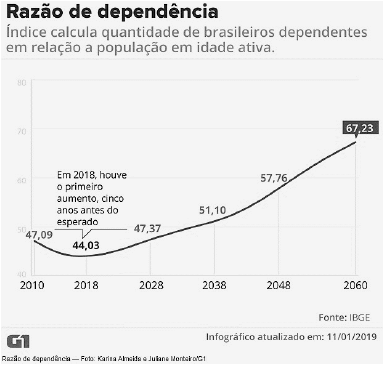
Observe o gráfico abaixo:
https://www.google.com/search?q=raz%C3%A3o+de+dependencia+alta&source=lnms&tbm=isch&sa=X&ved=0ahUKEwiX4 8Db48nlAhVhH7kGHe26DCYQ_AUIEigB&biw=1366&bih=625&safe=active&ssui=on#imgdii=k4IPoSMWqBElM:& imgrc=FIiZFV4Iky1BuM:
Considerando os seus conhecimentos sobre demografia, a maneira como um país com uma razão de dependência alta pode promover o desenvolvimento:
Provas
Em 2019 a Anatel regulamentou o uso das faixas de 2,3 GHz e 3,5 GHz para serem usadas para a internet móvel de quinta geração, o 5 G. Segundo a Anatel, a faixa de 2,3 GHz é importante para alinhamento com sistemas mundiais do tipo IMT (sigla em inglês para Telecomunicações Móveis Internacionais), enquanto que a faixa de 3,5 GHz é tida por muitos como a porta de entrada para as redes de altíssima velocidade da quinta geração de telefonia. Disponível em: https://g1.globo.com/economia/tecnologia/noticia/2019/05/24/anatel-aprova-frequencias-que-servirao-para- 5g-no-brasil.ghtml
Sabendo que as ondas eletromagnéticas se propagam com a velocidade da luz (c = 3 x 10⁸ m/s), o menor comprimento de onda utilizado pelo 5 G será de aproximadamente:
Provas
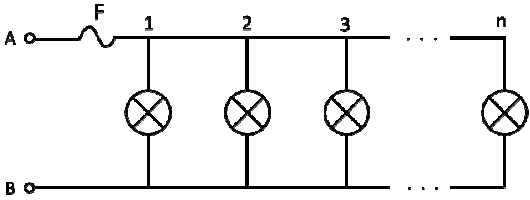
As lâmpadas d o circuito abaixo são idênticas e cada uma é percorrida por uma corrente elétrica de 0,8 A. O fusível F suporta uma corrente máxima de 20 A. Sendo a diferença de potencial elétrico entre os pontos A e B igual a 120 V, o número máximo n de lâmpadas que podem ser ligadas sem queimar o fusível e a potência total dissipada por todas as n lâmpadas valem, respectivamente:
Provas
Caderno Container