Foram encontradas 70 questões.
Uma empresa, sediada em certo país, teve os seguintes valores nominais de faturamento em três anos consecutivos: Ano I: S 105 milhões, Ano Il: $ 120 milhões e Ano Ill: S 148 milhões, em que $ indica a moeda local. Nesses três anos, o país passava por um cenário de inflação constante de 20% ao ano. Considerando a depreciação da moeda pela inflação, o faturamento real pode ser ordenado, do melhor para o pior ano, como
Provas

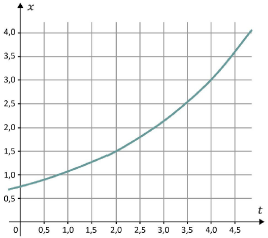
O gráfico mostra a evolução de uma grandeza x em função do tempo t, em unidades de medida fixadas, caracterizando uma função x(t). Sabe-se que essa função é perfeitamente exponencial, isto é, a razão entre os valores de x no final e no começo de qualquer intervalo de t só depende do tamanho desse intervalo. O valor de x(7) é mais próximo de
Provas
Assinale a alternativa verdadeira:
Provas
Leia o texto:
Toyama has striven to become a more hospitable place to grow old. One key initiative is the Kadokawa Preventive Care Center, which has exercise pools fed by hot springs. Every day, about 250 older adults work out at the facility.
Disponível em https://www .nationalgeographic.com/magazine/article/japan-agingadapting- shrinking-population-feature (adaptado).
Considerado o contexto, há emprego de forma verbal na voz passiva no trecho
Provas
Texto para à questão seguinte.
With nearly 30 percent of its people 65 and over, Japan has the oldest population on Earth (except tiny Monaco). Its median age of 48.7 far exceeds the world's, at 30.2.
The numbers, though stark, don't convey how profoundly this demographic shift is playing out day to day. The increasingly disproportionate mix of more and more seniors and fewer and fewer young people is already altering every aspect of life in Japan, from its physical appearance to its social policies, from business strategy to the labor market, from public spaces to private homes.
If Japan is any guide, aging will change the fabric of society in ways both obvious and subtle. It will run up a huge tab that governments will struggle to pay. Meeting the challenge won't be easy, but the future isn't necessarily all downhill. Japan's experience, with its characteristic attention to detail and design, suggests extreme aging may inspire an era of innovation.
In 2020, Japan's health ministry launched eight “living labs” dedicated to developing nursing-care robots. Yet in a way, the entire country is one big living lab grappling with the repercussions of a rapidly aging society. In business, academia, and communities around Japan, countless experiments are under way, all aiming to keep the old healthy for as long as possible while easing the burden of caring for society's frailest.
Disponível em https://www .nationalgeographic.com/magazine/article/japan-agingadapting- shrinking-population-feature (adaptado).
Identifica-se emprego de adjetivo no grau superlativo no trecho
Provas
Texto para à questão seguinte.
With nearly 30 percent of its people 65 and over, Japan has the oldest population on Earth (except tiny Monaco). Its median age of 48.7 far exceeds the world's, at 30.2.
The numbers, though stark, don't convey how profoundly this demographic shift is playing out day to day. The increasingly disproportionate mix of more and more seniors and fewer and fewer young people is already altering every aspect of life in Japan, from its physical appearance to its social policies, from business strategy to the labor market, from public spaces to private homes.
If Japan is any guide, aging will change the fabric of society in ways both obvious and subtle. It will run up a huge tab that governments will struggle to pay. Meeting the challenge won't be easy, but the future isn't necessarily all downhill. Japan's experience, with its characteristic attention to detail and design, suggests extreme aging may inspire an era of innovation.
In 2020, Japan's health ministry launched eight “living labs” dedicated to developing nursing-care robots. Yet in a way, the entire country is one big living lab grappling with the repercussions of a rapidly aging society. In business, academia, and communities around Japan, countless experiments are under way, all aiming to keep the old healthy for as long as possible while easing the burden of caring for society's frailest.
Disponível em https://www .nationalgeographic.com/magazine/article/japan-agingadapting- shrinking-population-feature (adaptado).
Depreende-se do texto que diversos projetos de pesquisa em curso no Japão têm como objetivo
Provas
Texto para à questão seguinte.
With nearly 30 percent of its people 65 and over, Japan has the oldest population on Earth (except tiny Monaco). Its median age of 48.7 far exceeds the world's, at 30.2.
The numbers, though stark, don't convey how profoundly this demographic shift is playing out day to day. The increasingly disproportionate mix of more and more seniors and fewer and fewer young people is already altering every aspect of life in Japan, from its physical appearance to its social policies, from business strategy to the labor market, from public spaces to private homes.
If Japan is any guide, aging will change the fabric of society in ways both obvious and subtle. It will run up a huge tab that governments will struggle to pay. Meeting the challenge won't be easy, but the future isn't necessarily all downhill. Japan's experience, with its characteristic attention to detail and design, suggests extreme aging may inspire an era of innovation.
In 2020, Japan's health ministry launched eight “living labs” dedicated to developing nursing-care robots. Yet in a way, the entire country is one big living lab grappling with the repercussions of a rapidly aging society. In business, academia, and communities around Japan, countless experiments are under way, all aiming to keep the old healthy for as long as possible while easing the burden of caring for society's frailest.
Disponível em https://www .nationalgeographic.com/magazine/article/japan-agingadapting- shrinking-population-feature (adaptado).
Em “The numbers, though stark, don't convey how profoundly this demographic shift is playing out”, o segmento “though stark” equivale, em português, a
Provas
Texto para à questão seguinte.
I get asked quite a lot if I'm optimistic or pessimistic. Optimism, pessimism, hope and despair are not useful ways of thinking about the present crisis. They are transient and not to be relied upon, however much they might help us to bear the awful weight of everyday, actual living.
Optimism and pessimism, in particular, are conditions of foresight, they are predictions about the future, not guides to living in the present moment. | don't care about the future, as | don't care about predictions. “Means, not ends”, as Aldous Huxley endlessly reminds us. We make the future, moment by moment, by our actions in the present, which is the place in which we have agency.
Hope, meanwhile, is a fickle thing — the last little bug at the bottom of Pandora's pot, drying its wet wings in the hot sun. Nice to look at, sure, but liable to flit off again when startled. Hope needs a place to perch. To have any meaning, any validity, any use or power, it must be founded upon agency, upon the deep-seated capacity to change. To change first oneself — already a process of negotiation with the world — and then to change everything else. BRIDLE, James. Hope needs a place to perch.
Disponível em https://booktwo.org. Publicado em: 18.07.2022. Texto adaptado.
Nos trechos do texto “however much they might help us” e “it must be founded upon agency”, os verbos modais sublinhados expressam, respectivamente,
Provas
Texto para à questão seguinte.
I get asked quite a lot if I'm optimistic or pessimistic. Optimism, pessimism, hope and despair are not useful ways of thinking about the present crisis. They are transient and not to be relied upon, however much they might help us to bear the awful weight of everyday, actual living.
Optimism and pessimism, in particular, are conditions of foresight, they are predictions about the future, not guides to living in the present moment. | don't care about the future, as | don't care about predictions. “Means, not ends”, as Aldous Huxley endlessly reminds us. We make the future, moment by moment, by our actions in the present, which is the place in which we have agency.
Hope, meanwhile, is a fickle thing — the last little bug at the bottom of Pandora's pot, drying its wet wings in the hot sun. Nice to look at, sure, but liable to flit off again when startled. Hope needs a place to perch. To have any meaning, any validity, any use or power, it must be founded upon agency, upon the deep-seated capacity to change. To change first oneself — already a process of negotiation with the world — and then to change everything else. BRIDLE, James. Hope needs a place to perch.
Disponível em https://booktwo.org. Publicado em: 18.07.2022. Texto adaptado.
A frase atribuída a Aldous Huxley (“Means, not ends”), no 3º parágrafo, embasa a opinião de James Bridle, segundo a qual
Provas
Observe o seguinte cartaz.

Disponível em www .unesco.org.
No trecho “content potentially harmful to democracy and human rights”, o termo sublinhado pode ser substituído, sem prejuízo de sentido, por
Provas
Caderno Container