Foram encontradas 294 questões.
Dados os conjuntos !$ A = \{ (x,y) | y \ge 3 + 2x, x ∈ R \} !$, !$ B = \{(x,y) | y \ge 3 + 3x, x ∈ R \} !$, !$ C = \{(x,y) | y \ge 2 + 2x, x ∈ R \} !$.
Item 0: Todo elemento de C pertence a B.
Provas

THE EFFECTS OF DOMESTIC ENVIRONMENTAL POLICIES ON PATTERNS OF WORLD TRADE: AN EMPIRICAL TEST
James A. Tobey
In theory, environmental control costs encourage reduced specialization in the production of polluting outputs in countries with stringent environmental regulations (Pethig, 1976; Siebert, 1977; McGuire, 1982). In contrast, countries that fail to undertake an environmental protection program presumably increase their comparative advantage in the production of items that damage the invironment. This relationship between trade and environmental policy receives considerable attention whenever countries are in the process of passing new pollution control measures. Groups who oppose existing measures, of the implementation of stiffer measures, argue that they reduce the ability of polluting industries to compete internationally. With foreign trade an increasingly important sector in many of the world’s economies, the arguments of such groups are now frequently weighted very heavily.
The premise that trade suffers from the imposition of environmental policy has a strong element of a priori plausibility but, surprisingly, has little empirical support. Several macroeconometric models (D’Arge, 1974; Robison, 1986; OECD, 1985) have predicted that pollution control measures should lead to a small but discernible effect on the balance of trade, but there are few studies to confirm this prediction.
The location-of-industry studies (Leonard, 1988; Pearson, 1987, 1985; Walter, 1985) have explored the related ideas that stringent pollution control measures push industries out of the U.S. (the ‘industrial-flight’ hypothesis), and that less-developed countries compete to attract multinational industries by minimizing their own environmental policies (the ‘pollution-haven’ hypothesis). Their investigations, however, have been unable to find evidence in support of either hypothesis.
The present paper complement the results of the less rigorous location of industy studies by providing an empirical test of the hypothesis that stringent environmental policy has caused trade patterns to deviate in commodities produced by the world’s ‘dirty’ industries.
Extraído de: TOBEY, James A. The effects of domestic environmental policies on patterns of world trade: an empirical test. Kiklos; international review for social science, Basel, v.43, n.2, p.191-209.
Still in the first paragraph:
Item 3: the author stricks to the argument that polluting industries will lose bargaining power at the international market under rigid environmental regulations.
Provas
THE EFFECTS OF DOMESTIC ENVIRONMENTAL POLICIES ON PATTERNS OF WORLD TRADE: AN EMPIRICAL TEST
James A. Tobey
In theory, environmental control costs encourage reduced specialization in the production of polluting outputs in countries with stringent environmental regulations (Pethig, 1976; Siebert, 1977; McGuire, 1982). In contrast, countries that fail to undertake an environmental protection program presumably increase their comparative advantage in the production of items that damage the invironment. This relationship between trade and environmental policy receives considerable attention whenever countries are in the process of passing new pollution control measures. Groups who oppose existing measures, of the implementation of stiffer measures, argue that they reduce the ability of polluting industries to compete internationally. With foreign trade an increasingly important sector in many of the world’s economies, the arguments of such groups are now frequently weighted very heavily.
The premise that trade suffers from the imposition of environmental policy has a strong element of a priori plausibility but, surprisingly, has little empirical support. Several macroeconometric models (D’Arge, 1974; Robison, 1986; OECD, 1985) have predicted that pollution control measures should lead to a small but discernible effect on the balance of trade, but there are few studies to confirm this prediction.
The location-of-industry studies (Leonard, 1988; Pearson, 1987, 1985; Walter, 1985) have explored the related ideas that stringent pollution control measures push industries out of the U.S. (the ‘industrial-flight’ hypothesis), and that less-developed countries compete to attract multinational industries by minimizing their own environmental policies (the ‘pollution-haven’ hypothesis). Their investigations, however, have been unable to find evidence in support of either hypothesis.
The present paper complement the results of the less rigorous location of industy studies by providing an empirical test of the hypothesis that stringent environmental policy has caused trade patterns to deviate in commodities produced by the world’s ‘dirty’ industries.
Extraído de: TOBEY, James A. The effects of domestic environmental policies on patterns of world trade: an empirical test. Kiklos; international review for social science, Basel, v.43, n.2, p.191-209.
As put in the third paragraph:
Item 1: these authors state that some multinational industries are definitely transferring their plants to Third World countries with no stringent pollution regulation.
Provas
THE EFFECTS OF DOMESTIC ENVIRONMENTAL POLICIES ON PATTERNS OF WORLD TRADE: AN EMPIRICAL TEST
James A. Tobey
In theory, environmental control costs encourage reduced specialization in the production of polluting outputs in countries with stringent environmental regulations (Pethig, 1976; Siebert, 1977; McGuire, 1982). In contrast, countries that fail to undertake an environmental protection program presumably increase their comparative advantage in the production of items that damage the invironment. This relationship between trade and environmental policy receives considerable attention whenever countries are in the process of passing new pollution control measures. Groups who oppose existing measures, of the implementation of stiffer measures, argue that they reduce the ability of polluting industries to compete internationally. With foreign trade an increasingly important sector in many of the world’s economies, the arguments of such groups are now frequently weighted very heavily.
The premise that trade suffers from the imposition of environmental policy has a strong element of a priori plausibility but, surprisingly, has little empirical support. Several macroeconometric models (D’Arge, 1974; Robison, 1986; OECD, 1985) have predicted that pollution control measures should lead to a small but discernible effect on the balance of trade, but there are few studies to confirm this prediction.
The location-of-industry studies (Leonard, 1988; Pearson, 1987, 1985; Walter, 1985) have explored the related ideas that stringent pollution control measures push industries out of the U.S. (the ‘industrial-flight’ hypothesis), and that less-developed countries compete to attract multinational industries by minimizing their own environmental policies (the ‘pollution-haven’ hypothesis). Their investigations, however, have been unable to find evidence in support of either hypothesis.
The present paper complement the results of the less rigorous location of industy studies by providing an empirical test of the hypothesis that stringent environmental policy has caused trade patterns to deviate in commodities produced by the world’s ‘dirty’ industries.
Extraído de: TOBEY, James A. The effects of domestic environmental policies on patterns of world trade: an empirical test. Kiklos; international review for social science, Basel, v.43, n.2, p.191-209.
As seen in the first paragraph in the text above
Item 1: “environmental control costs” can be understood as “custos ambientais controlados”.
Provas
Classifique, como V ou F, a afirmativa abaixo:
Item 2: Os monetaristas advogam uma regra de expansão monetária constante porque esta regra implica uma taxa de inflação constante no curto e no longo prazo.
Provas
A lei dos retornos físicos marginais decrescentes diz que, quando a quantidade de um insumo variável é aumentada, dadas as quantidades dos demais insumos, um ponto é alcançado a partir do qual o produto marginal decresce. A curva abaixo representa a produtividade total.
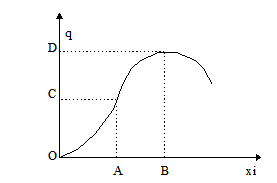
Item 1: A lei dos retornos físicos marginais decrescentes só é verificado para níveis de insumo maiores que OB.
Provas
Dada uma função de produção homogênea é correto afirmar que:
Item 1: A taxa marginal de substituição técnica é constante ao longo de uma isoquantia.
Provas
Seja uma amostra aleatória !$ x_1 !$, !$ x_2 !$, .... , !$ x_n !$ de uma população com média !$ μ !$ e variância !$ σ^2 !$. Considere os estimadores para a média:
!$ μ_1 = x_1 !$, !$ μ_2 = { \large 1 \over n} \sum^n_{i-1} xi !$, !$ μ_3 = x_{(n/2)} !$.
onde !$ x_{(n/2)} !$ corresponde ao (n/2)-ésimo elemento da amostra após a ordenação da mesma em forma crescente.
Item 2: Se o tamanho da amostra cresce o único estimador consistente é !$ μ_2 !$.
Provas
Sobre a Teoria de Consumidor é correto afirmar que:
Item 0: Na abordagem ordinal a utilidade marginal é suposta decrescente.
Provas
Considere um mercado descrito pela curva inversa de demanda P(Q) = 11 - Q, sendo que para Q>11, P = 0. Suponha que haja duas firmas produtoras que possuam custos dados por:
!$ C_1(q_1) = q^2_1 !$ e !$ C_2(q_2) = { \large q^2_2 \over 2} + q_2 !$
Item 1: A curva de oferta da firma !$ 2 !$ é !$ q_2(p) = p - 1 !$, quando !$ p > 1 !$ e !$ q_2(p) = 0 !$ se !$ p < 1 !$.
Provas
Caderno Container