Foram encontradas 350 questões.
Os erros inatos do metabolismo são condições muitas vezes graves e que ainda não têm cura, uma vez que são doenças genéticas. Uma destas condições é conhecida por fenilcetunúria (PKU), em que o indivíduo é incapaz de metabolizar a fenilalanina presente em certos produtos da sua dieta. O acúmulo deste aminoácido pode ser extremamente deletério, pois é neurotóxico. O tratamento padrão para esta condição é a restrição alimentar por meio de dieta estritamente controlada na ingestão de proteínas, com a suplementação de aminoácidos e elementos traços para a prevenção de deficiências nutricionais. Além desta terapêutica, diversas abordagens foram realizadas para o tratamento da PKU. Recentemente, E. coli foram modificadas a fim de se obter um produto de fácil manipulação e com uma melhor resposta dos pacientes. Este fato se deve a:
Provas
Questão presente nas seguintes provas

This study explores the implementation of the multimodality theory for high school students of English as a Foreign Language in a Brazilian context. This implementation was based on a study conducted by Almeida (2011), in which she proposed a multimodality framework for teaching multimodal texts. By using the framework, Almeida tried to establish a bridge between a theory designed to analyze visual structures (e.g., Kress & van Leeuwen, 2006) and its adaptation to the educational context (e.g., Browett, 2007; Jewitt, 2008; Oliveira, 2006; Riesland, 2005).
(…)
In Brazil, the importance of implementing activities in the classroom that focus on literacy, multiliteracy, multimodality and hypertext is highlighted by the Ministerio da Educação Secretaria de Educação Básica’s (Ministry of Education District of Basic Education) Curricular Orientations for Secondary School-OCEMs (2006), an official curriculum document. This document guides the curriculum of all schools in Brazil and it includes suggestions about the teaching of multimodality. To achieve this goal, the grammar of visual design (Kress & van Leeuwen, 2006) is seen as an important starting point for the professional learning of teachers in visual literacy because it can help them understand how to read images and associate both kinds of text, visual and written.
(…)
Thus, we applied this approach in two classrooms where we could observe whether knowledge of multimodality theory affected the students’ reading of the texts. To this end, we prepared two activities focusing on the same multimodal text; the first activity was given to students before teaching them multimodality theory and the second one after instruction.
The picture used for Exercise 1 and 2 was the same. It was the picture of a man whose face looked like the face of a fish. The man was looking up and was wearing a blue shirt. At the bottom of the picture, centered in relation to the picture, and in capital letters was the following text: “STOP CLIMATE CHANGE BEFORE IT CHANGES YOU.” Below the text and centered in relation to the text, there was a panda picture with the WWF acronym below it followed by the text “for a living planet” in lowercase.
(…)
The students participated in the activities and had to point to us what aspects they had noticed in the text for the linguistic dimension (the colors, the size of the pictures, the way pictures were disposed in the text, their background, framing, degree of salience and eye contact, distance). For the socio-cultural dimension, they had to be able to answer wh- questions (who, why, where, when, which attitudes and values) and observe the emotions, situations, relations, symbols, power relations, characters and cultures involved in the picture. Finally, for the situational dimension, they had to analyze who created the picture, who it was targeted at, where it appeared, how much background knowledge was required to understand the picture, and its explicit and implicit ideological values.
(…)
Overall, we noticed that instruction on the theory helped students to understand better the context around them, mainly the socio-cultural context, and it helped students to improve their reading because the answers given before instruction on multimodality were very simple and did not point to a critical reading; they only focused on what was on the surface of the text like “the text tells about environment,” “if man does not stop destroying the environment, he will die” or “the man will become a fish if he keeps on destroying the environment”.
The answers given after those classes were more critical, the students used some concepts from the theory and were able to point to some aspects of the three dimensions, like who was in the picture, what the writer’s intention was; they also talked about the colors and the background of the picture pointing to the dark color, why the writer had used that image and not another one, they associated the man’s face to the words accompanying the visual.
(…)
The situational dimension seemed to be easier for students to understand and write about, mainly when it guided them to reflect about some aspect of production, circulation and consumption of the images. The socio-cultural context of images emphasized questions related to worldview, emotion, attitudes, values and power relationships and was easy for learners to understand. In contrast, students did not explore the linguistic aspect of the pictures; they did not mention colors, size, focus, background, or sharpness, perhaps because in everyday classes the students are not encouraged to talk about them.
(SOUZA, V.G. & ALMEIDA, D..Towards a Multimodal Critical Approach to the Teaching of EFL in Brazil. Published in Kamhi-Stein, L., Diaz Maggioli, G., & de Oliveira, L. C. (Eds.) (2017). English language teaching in South America: Policy, preparation, and practices. Multilingual Matters).
According to the authors, it is important to develop this type of activity in the classroom because in Brazil
Provas
Questão presente nas seguintes provas
Tempestades atingem Havai e Japão
O furacão Lane causa os primeiros estragos no Hawai e a
tempestade tropical Cimarron passou pela zona oeste do Japão.
O furacão Lane causa os primeiros estragos no Hawai. Big Island foi a primeira ilha atingida pelos ventos fortes e chuvas torrenciais chegaram ao arquipélago na quinta-feira. Provocaram enchentes e deslizamentos de terra.
Vídeos publicados nas redes sociais mostram as águas turbulentas do rio Wailuku. O furacão de categoria 4 numa escala de 5 chegou com ventos de 209 km/h provocando ondas perigosas. Donald Trump declarou estado de emergência no Hawai.
Disponível em: http://pt.euronews.com/2018/08/23/tempestades-atingem-havai-e-japao
A respeito do noticiado acima, sabemos que na atmosfera se estabelecem circulações de diversas escalas,
desde imperceptíveis movimentações moleculares até grandes oscilações. Sobre a dinâmica da circulação atmosférica, é correto afirmar:
Provas
Questão presente nas seguintes provas
Os seres humanos surgiram da célula primordial ou zigoto. Esta célula é considerada tronco, pois guarda uma série de características, dentre as mais importantes, a capacidade de se dividir (autorrenovação) e a de poder se diferenciar em outros tipos celulares. Associe, a seguir, os tipos de células-tronco (na coluna da esquerda) com as suas características (na coluna da direita). A cada item da primeira coluna, apenas um item faz correspondência na segunda coluna.
I - Totipotentes
II - Pluripotentes
III - Multipotentes
IV - Oligopotentes
V - Unipotentes
1. Células tronco capazes de se diferenciarem em apenas um tipo de célula.
2. Células artificialmente transformadas em células-tronco, geralmente se originam de células adultas diferenciadas.
3. Células tronco capazes de se diferenciarem em qualquer tipo celular dos discos germinativos: endoderme, mesoderme e ectoderme.
4. Células progenitoras com o seu potencial de diferenciação bastante limitado. Por exemplo, a célula linfoide, capaz de diferenciar-se em linfócitos B e T.
5. Célula capaz de se diferenciar de todos os tipos celulares do organismo.
6. Células progenitoras e que seu potencial de ativação gênica permite a elas diferenciar- se em tipos discretos de células. Por exemplo, a célula-tronco sanguínea, capaz de diferenciar-se na linhagem mieloide de células ou na linfoide.
Qual alternativa apresenta a associação correta entre as duas colunas?
Provas
Questão presente nas seguintes provas
Os fungos estão entre os principais patógenos causadores de doenças de plantas. São capazes de atacar toda o ciclo das plantas desde a semeadura ou plantio até a fase de produção de frutos e sementes. Nesse processo de infecção podem infectar e ser transmitidos pelas sementes. São exemplos de doenças cujo patógeno é transmitido pelas sementes:
Provas
Questão presente nas seguintes provas
O conceito de região hidrográfica, apesar de ser baseado na distribuição natural das bacias hidrográficas, considera o aspecto administrativo. As diferentes regiões hidrográficas são definidas legalmente com base no planejamento de gestão dos recursos hídricos nacionais. Abaixo, o mapa das bacias hidrográficas do Brasil.
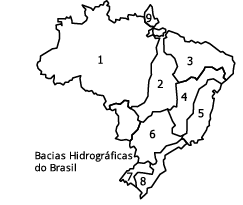
Considerando seus conhecimentos sobre a hidrografia brasileira, assinale a alternativa que apresenta a correspondência exata entre os números e as bacias:
Provas
Questão presente nas seguintes provas
O conhecimento acerca das moléculas capazes de diminuir ou bloquear o crescimento de microrganismos (especialmente bactérias, no caso dos antibióticos) remonta a um passado longínquo, quando as antigas civilizações (egípcios e gregos) utilizavam-se de leveduras ou extratos de plantas para combater infecções. Porém, somente no início do século XX, foram sintetizados os primeiros antibióticos utilizados no tratamento da sífilis. Atualmente há uma gama de antibióticos utilizados na clínica e na pesquisa para o tratamento de bactérias ou seleção daquelas que apresentam modificações genéticas de interesse, respectivamente. Porém, pouco cuidado tem sido dispensado no descarte deste material em todo o planeta, e o problema torna- se especialmente grave naqueles países em que o saneamento básico é muito deficiente. Este descarte inapropriado tem acelerado a evolução e a disseminação de patógenos resistentes a antibióticos. Neste cenário, qual das alternativas a seguir apresenta a(s) forma(s) mais eficaz(es) de eliminar os antibióticos?
Provas
Questão presente nas seguintes provas
This study explores the implementation of the multimodality theory for high school students of English as a Foreign Language in a Brazilian context. This implementation was based on a study conducted by Almeida (2011), in which she proposed a multimodality framework for teaching multimodal texts. By using the framework, Almeida tried to establish a bridge between a theory designed to analyze visual structures (e.g., Kress & van Leeuwen, 2006) and its adaptation to the educational context (e.g., Browett, 2007; Jewitt, 2008; Oliveira, 2006; Riesland, 2005).
(…)
In Brazil, the importance of implementing activities in the classroom that focus on literacy, multiliteracy, multimodality and hypertext is highlighted by the Ministerio da Educação Secretaria de Educação Básica’s (Ministry of Education District of Basic Education) Curricular Orientations for Secondary School-OCEMs (2006), an official curriculum document. This document guides the curriculum of all schools in Brazil and it includes suggestions about the teaching of multimodality. To achieve this goal, the grammar of visual design (Kress & van Leeuwen, 2006) is seen as an important starting point for the professional learning of teachers in visual literacy because it can help them understand how to read images and associate both kinds of text, visual and written.
(…)
Thus, we applied this approach in two classrooms where we could observe whether knowledge of multimodality theory affected the students’ reading of the texts. To this end, we prepared two activities focusing on the same multimodal text; the first activity was given to students before teaching them multimodality theory and the second one after instruction.
The picture used for Exercise 1 and 2 was the same. It was the picture of a man whose face looked like the face of a fish. The man was looking up and was wearing a blue shirt. At the bottom of the picture, centered in relation to the picture, and in capital letters was the following text: “STOP CLIMATE CHANGE BEFORE IT CHANGES YOU.” Below the text and centered in relation to the text, there was a panda picture with the WWF acronym below it followed by the text “for a living planet” in lowercase.
(…)
The students participated in the activities and had to point to us what aspects they had noticed in the text for the linguistic dimension (the colors, the size of the pictures, the way pictures were disposed in the text, their background, framing, degree of salience and eye contact, distance). For the socio-cultural dimension, they had to be able to answer wh- questions (who, why, where, when, which attitudes and values) and observe the emotions, situations, relations, symbols, power relations, characters and cultures involved in the picture. Finally, for the situational dimension, they had to analyze who created the picture, who it was targeted at, where it appeared, how much background knowledge was required to understand the picture, and its explicit and implicit ideological values.
(…)
Overall, we noticed that instruction on the theory helped students to understand better the context around them, mainly the socio-cultural context, and it helped students to improve their reading because the answers given before instruction on multimodality were very simple and did not point to a critical reading; they only focused on what was on the surface of the text like “the text tells about environment,” “if man does not stop destroying the environment, he will die” or “the man will become a fish if he keeps on destroying the environment”.
The answers given after those classes were more critical, the students used some concepts from the theory and were able to point to some aspects of the three dimensions, like who was in the picture, what the writer’s intention was; they also talked about the colors and the background of the picture pointing to the dark color, why the writer had used that image and not another one, they associated the man’s face to the words accompanying the visual.
(…)
The situational dimension seemed to be easier for students to understand and write about, mainly when it guided them to reflect about some aspect of production, circulation and consumption of the images. The socio-cultural context of images emphasized questions related to worldview, emotion, attitudes, values and power relationships and was easy for learners to understand. In contrast, students did not explore the linguistic aspect of the pictures; they did not mention colors, size, focus, background, or sharpness, perhaps because in everyday classes the students are not encouraged to talk about them.
(SOUZA, V.G. & ALMEIDA, D..Towards a Multimodal Critical Approach to the Teaching of EFL in Brazil. Published in Kamhi-Stein, L., Diaz Maggioli, G., & de Oliveira, L. C. (Eds.) (2017). English language teaching in South America: Policy, preparation, and practices. Multilingual Matters).
According to the text, choose the correct affirmative.
The study had as an aim to know the students’ performance in:
Provas
Questão presente nas seguintes provas
O solo e a água são fundamentais para a produção de alimentos, fibras e biocombustíveis. Nesse contexto, o manejo e conservação deve ser praticado em cada sistema, objetivando a sustentabilidade da produção agrícola. Entretanto, existe um quadro de degradação de extensas áreas pelo uso incorreto e sem práticas de conservação à medida que a agricultura se intensifica e busca novas áreas agricultáveis. Entre as práticas mecânicas de manejo do solo estão:
Provas
Questão presente nas seguintes provas
A coluna da esquerda apresenta as partes integrantes de um sistema de esgotamento sanitário, e a da direita, seus significados. Numere a coluna da direita de acordo com a da esquerda.
1 - Sifão invertido
2 - Estação elevatória
3 - Emissário
4 - Interceptor
( ) Canalização que recebe coletores ao longo de seu comprimento, não recebendo ligações prediais diretas.
( ) Canalização distinta a conduzir os esgotos a um destino conveniente (ETE e/ou lançamento) sem receber contribuições de marcha.
( ) Obra destinada à transposição de obstáculo pela tubulação de esgoto, funcionando sob pressão.
( ) Conjunto de instalações destinadas a transferir os esgotos de uma cota mais baixa para uma cota mais alta.
Marque a sequência CORRETA:
Provas
Questão presente nas seguintes provas
Cadernos
Caderno Container