Foram encontradas 45 questões.
Assinale a alternativa na qual o conectivo sublinhado pode ser substituído pelo que está entre parênteses, sem modificar o sentido do excerto.
Provas

Functions and apps: Ready-made for language learning.
By R. Godwin-Jones.
Smartphones and tablets have a variety of built-in functions that support communication and multimedia use. They offer an efficient way for students to work with language, whether written or spoken. Because they are networked, they support peer collaboration and offer the opportunity to virtually bring into class individuals from outside the classroom, including more proficient speakers. Some of the built-in
capabilities that support text and media use include:
• note taking;
• photo capture and editing;
• audio and video playback, recording and editing;
• email;
• text messaging;
• web browsing.
In addition to the default functions and applications present in phones and tablets today, they also offer access to a large variety of third-party apps, which in fact is a major reason for smartphone popularity. Apps were available before the iPhone arrived in 2007, but were of minor importance and not widely used. Today, the Apple App Store (for iOS devices) and Google Play (for Android devices) offer countless apps that can be easily added to phones to enhance their functionality. In contrast to traditional computer software, apps tend to be inexpensive, installed easily, and feature intuitive interfaces requiring minimal instructions for use. Many apps today offer the ability to store or sync data from the phone or tablet with an online server, often called cloud services. This enables sharing of created artefacts and thus collaborative opportunities.
The kinds of apps students are likely to have already on their devices, or that can be installed for free, include the following:
• mobile versions of social media, such as Facebook and Twitter;
• video-conferencing services like Skype or Google Hangouts;
• messaging and multimodal texting apps including Snapchat and Instagram;
• personal journaling apps like Penzu or Journey;
• video-streaming players such as YouTube or VLC media player.
None of these were developed for language learning, but all clearly have potential for language practice and socially oriented learning. Apps already used by students offer the advantage of familiarity and integration of life and learning.
Even apps and online services that were not developed for use by learners can be helpful for both language and culture learning in a variety of ways. That might include
topics such as transportation (in-class groups using an online train timetable to plan a trip), entertainment (discussing movie or music reviews), shopping (furnishing an apartment), or dining (choosing a restaurant based on online menus). Such activities are well adapted to small group work, with the added opportunity of sharing created artefacts online.
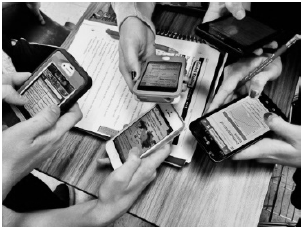
Source: https://forum.easyuni.my/t/do-smartphones-have-any-place-in-the-high-schoolclassroom/ 2152
In addition to general-purpose apps, there are many designed specifically for language and culture learning (see the recommended resources at the end of this paper). Many such apps are in the category of phrase books, vocabulary flash cards, tourist guides, or grammar tutorials (Chinnery, 2006). Pronunciation apps are also common, such as Sounds Right (British Council) or Sounds: The Pronunciation App (Macmillan); see Kaiser, 2016 for reviews of pronunciation apps. These kinds of apps are designed to be used by individual users, but some could be adapted to collaborative use in the classroom. Tuttle (2013) suggests having students in pairs
extract phrases from a phrase book app and then use them to create a dialogue, or as the basis of an in-class skit. Other kinds of single-purpose apps could be used in a similar fashion.
Full-featured language-learning apps are available as well, including mobile versions of services such as Duolingo or Babbel. Teachers might have students, individually or in small groups, assigned to download, try out, and then report in class on the experience of using such services. This could also be done with other language related apps such as games, ranging from very simple concentration style to much more sophisticate. The latter include innovative place-based games using artificial intelligence or augmented reality (see Godwin-Jones, 2014, 2016). Some games (as well as some flash card and polling apps) can be set up as competitions that can be played in class with individual students or with groups.
Apps already used by students offer the advantage of familiarity and integration of life and learning.
One of the cautions in the use of third-party apps in the classroom is compatibility. While the most popular apps are normally available for both iOS and Android, this is not necessarily the case for all. Another consideration is cost: many apps are free, but some are not. Increasingly, apps are released as ‘freemium’, meaning that some features or functions are free, but others must be purchased. If students are using their own devices, one might assign installation of the app before the start of class, so that class time is not taken up with getting started.
GODWIN-JONES, R. (2018). Using mobile devices in the language classroom: Part of the Cambridge Papers in ELT series. [pdf] Cambridge: Cambridge University Press
In the sentence, “Increasingly, apps are released as ‘freemium’, meaning that some features or functions are free, but others must be purchased. [...]” the word Increasingly (paragraph, 11, line 4) can be considered:
Provas
Nonverbal information is useful for readers because it can help them to understand the text better. So, in which alternative below is there a nonverbal element found in the text above?
Provas
In the following paragraph from the text above (paragraph 5), “Different teachers use TBL in different ways. Some integrate it into the existing syllabus, some use it to replace the syllabus altogether, some use it as an ‘extra’ to their traditional classroom activities. [...]”, all the pronouns it, in bold, are referring to:
Provas
Anualmente, a Organização das Nações Unidas – ONU aborda temáticas relacionadas a aspectos relevantes para a humanidade. Em 2019, será a vez de celebrar o Ano Internacional das Línguas Indígenas. Dessa forma, o Brasil se torna um dos maiores contemplados da comemoração, visto que possui uma das maiores diversidades étnicas do mundo. Segundo o Instituto Brasileiro de Geografia e Estatística – IBGE, o país abriga 305 povos indígenas e 274 línguas originárias. Para se ter uma ideia da riqueza cultural, o país possui mais línguas autóctones do que toda a Europa – por lá, são 140, segundo o Instituto de História Europeia. (Adaptado)
Disponível em: <http://www.funai.gov.br/index.php/comunicacao/noticias/5310-conservacao-deidiomas- autoctones-norteia-ano-internacional-das-linguas-indigenas-celebrado-pela-unesco> Acesso em: 12/07/2019.
A relação semântica, que traduz a existência de significado equivalente entre duas ou mais unidades lexicais, é conhecida como sinonímia. Avalie as afirmações abaixo sobre expressões sinônimas, presentes no texto:
I – A expressão ‘línguas autóctones’ constitui, no contexto, sinônimo de ‘línguas indígenas’
II – A expressão ‘línguas originárias’ constitui, no contexto, sinônimo de ‘línguas indígenas’
III – A expressão ‘diversidades étnicas’ constitui, no contexto, sinônimo de ‘povos indígenas’
É correto o que se afirma em:
Provas
No âmbito de estudos da linguagem, o termo discurso é polissêmico. Os discursos direto e indireto são formas de se reproduzir as vozes de outrem. Assinale a alternativa na qual há o emprego do discurso indireto:
Provas
Functions and apps: Ready-made for language learning.
By R. Godwin-Jones.
Smartphones and tablets have a variety of built-in functions that support communication and multimedia use. They offer an efficient way for students to work with language, whether written or spoken. Because they are networked, they support peer collaboration and offer the opportunity to virtually bring into class individuals from outside the classroom, including more proficient speakers. Some of the built-in
capabilities that support text and media use include:
• note taking;
• photo capture and editing;
• audio and video playback, recording and editing;
• email;
• text messaging;
• web browsing.
In addition to the default functions and applications present in phones and tablets today, they also offer access to a large variety of third-party apps, which in fact is a major reason for smartphone popularity. Apps were available before the iPhone arrived in 2007, but were of minor importance and not widely used. Today, the Apple App Store (for iOS devices) and Google Play (for Android devices) offer countless apps that can be easily added to phones to enhance their functionality. In contrast to traditional computer software, apps tend to be inexpensive, installed easily, and feature intuitive interfaces requiring minimal instructions for use. Many apps today offer the ability to store or sync data from the phone or tablet with an online server, often called cloud services. This enables sharing of created artefacts and thus collaborative opportunities.
The kinds of apps students are likely to have already on their devices, or that can be installed for free, include the following:
• mobile versions of social media, such as Facebook and Twitter;
• video-conferencing services like Skype or Google Hangouts;
• messaging and multimodal texting apps including Snapchat and Instagram;
• personal journaling apps like Penzu or Journey;
• video-streaming players such as YouTube or VLC media player.
None of these were developed for language learning, but all clearly have potential for language practice and socially oriented learning. Apps already used by students offer the advantage of familiarity and integration of life and learning.
Even apps and online services that were not developed for use by learners can be helpful for both language and culture learning in a variety of ways. That might include
topics such as transportation (in-class groups using an online train timetable to plan a trip), entertainment (discussing movie or music reviews), shopping (furnishing an apartment), or dining (choosing a restaurant based on online menus). Such activities are well adapted to small group work, with the added opportunity of sharing created artefacts online.
Source: https://forum.easyuni.my/t/do-smartphones-have-any-place-in-the-high-schoolclassroom/ 2152
In addition to general-purpose apps, there are many designed specifically for language and culture learning (see the recommended resources at the end of this paper). Many such apps are in the category of phrase books, vocabulary flash cards, tourist guides, or grammar tutorials (Chinnery, 2006). Pronunciation apps are also common, such as Sounds Right (British Council) or Sounds: The Pronunciation App (Macmillan); see Kaiser, 2016 for reviews of pronunciation apps. These kinds of apps are designed to be used by individual users, but some could be adapted to collaborative use in the classroom. Tuttle (2013) suggests having students in pairs
extract phrases from a phrase book app and then use them to create a dialogue, or as the basis of an in-class skit. Other kinds of single-purpose apps could be used in a similar fashion.
Full-featured language-learning apps are available as well, including mobile versions of services such as Duolingo or Babbel. Teachers might have students, individually or in small groups, assigned to download, try out, and then report in class on the experience of using such services. This could also be done with other language related apps such as games, ranging from very simple concentration style to much more sophisticate. The latter include innovative place-based games using artificial intelligence or augmented reality (see Godwin-Jones, 2014, 2016). Some games (as well as some flash card and polling apps) can be set up as competitions that can be played in class with individual students or with groups.
Apps already used by students offer the advantage of familiarity and integration of life and learning.
One of the cautions in the use of third-party apps in the classroom is compatibility. While the most popular apps are normally available for both iOS and Android, this is not necessarily the case for all. Another consideration is cost: many apps are free, but some are not. Increasingly, apps are released as ‘freemium’, meaning that some features or functions are free, but others must be purchased. If students are using their own devices, one might assign installation of the app before the start of class, so that class time is not taken up with getting started.
GODWIN-JONES, R. (2018). Using mobile devices in the language classroom: Part of the Cambridge Papers in ELT series. [pdf] Cambridge: Cambridge University Press
In the following paragraph “One of the cautions in the use of third-party apps in the classroom is compatibility. While the most popular apps are normally available for both iOS and Android, this is not necessarily the case for all. Another consideration is cost: many apps are free, but some are not” (paragraph 11, line 3), the underlined word refers to:
Provas
No que diz respeito à remuneração, ao regime de trabalho e ao estágio probatório dos servidores do plano de carreiras e cargos de magistério federal, prevista na lei nº 12.772 de 28 de dezembro de 2012, é correto afirmar que:
Provas
Boa notícia para os professores de Português do Fundamental 1 e 2: a BNCC mantém muitos dos princípios adotados nos Parâmetros Curriculares Nacionais (PCNs). Um deles é a centralidade do texto e dos gêneros textuais. Isso quer dizer que o ensino de português precisa continuar contextualizado, articulado ao uso social da língua. No entanto, entre as duas décadas que separam os dois documentos, os estudos de linguagens evoluíram bastante. Da mesma forma, a sociedade também passou por profundas alterações, sobretudo por conta da ampliação do uso da tecnologia. A BNCC reflete esse avanço, que se manifesta, principalmente, em dois aspectos: a presença de textos multimodais – popularizados pela democratização das tecnologias digitais – e as questões de multiculturalismo – uma demanda política da contemporaneidade.
Disponível em: <https://novaescola.org.br/bncc/conteudo/22/propostas-em-lingua-portuguesa-dabncc- focam-na-gramatica-e-nos-generos-digitais> Acesso em: 12/07/2019.
Acerca dos recursos de progressão e coesão textuais, pode-se afirmar que:
I – O pronome ‘deles’ em ‘um deles’ (linha 3) refere-se a ‘professores de Português’.
II – ‘Os dois documentos’ (linha 5) são os Parâmetros Curriculares Nacionais, já mencionados no primeiro período.
III – A locução adversativa ‘No entanto’ indica oposição das ideias expressas, no período iniciado pela locução, e no imediatamente anterior.
Está correto o que se afirma em:
Provas
The Importance of Motivation.
By R. Bambirra
Many first time learners are faced with challenges in learning a second language. This can include many different variables, among which are motivation (intrinsic and extrinsic), lack of orientation, self-confidence, interest and practical goals/objectives.
However, lack of orientation, self-confidence, interest and practical objectives are all intertwined with the broader issue, which is motivation, either intrinsic or extrinsic, and therefore they can be grouped and referred to simultaneously as aspects of motivation. The focus of this paper is on the relationship between students’ needs, interests, goals and expectations towards learning EFL and teachers’ roles as motivators. There is an extensive body of literature addressing the issue of students’ motivation in the classroom. My primary intention is to refer to the main authors that have done research on this field, coming up with the most important theories and thoughts, as well as some of the most controversial ones and see how they can be applied in the Cape Verdean context.
Accounting for my own experience, though brief, as a teacher at Domingos Ramos high school and the experiences of other teachers, comments from students suggest that besides the basic fear that all students have when learning a foreign language (language ego), which prevents them from using it in the class, students also show a strong pessimism towards learning the English language. These common statements include, “I can’t make it!” “It’s no use trying!” “English is too difficult!” “I don’t feel like speaking!” “I will never be able to speak English!” and so on. These comments inevitably lead one to think that these students have low intrinsic or extrinsic motivation to learn English. Whatever the case may be, a basic truth is that students, who are not motivated to learn, do not learn.
Unfortunately, there is no magic bullet for motivating students. Many factors influence students’ motivation to learn: interest in the subject matter, perception of its usefulness, general desire to attain, self-confidence and self-esteem, as well as patience and persistence (Bligh, 1971; Sass, 1989 as cited in Davis 1999). It is also important to take into account that not all students are motivated by the same values, needs, desires, or wants. Some students may be motivated by the approval of others (peer acceptance), some by defeating challenges, while others seem naturally excited about learning. However, many students need or expect their teachers to inspire, challenge, and stimulate them. Ericksen stated that, “effective learning in the classroom depends on the teacher’s ability ... to maintain the interest that brought students to the course in the first place” (1978 p. 3). Whatever level of motivation students bring to the classroom will be converted, for better or worse, by what happens in that classroom.
Thus this paper will attempt to address this issue by asking the following thesis question: what is the relationship between students’ needs, interests, goals and expectations to learn English as a foreign language and the teachers’ roles as facilitators and motivators? With this question in mind, I will be focusing on intrinsic and extrinsic motivation for first time learners as they affect learning and try to discover whether or not Cape Verdean students at this level fall in the category of those who are motivated by extrinsic rewards rather than those who are called intrinsically motivated students.
The main objective of this study is to find out what are Cape Verdean first time learners attitudes, expectations and priorities towards learning EFL and what the teachers do or can do to meet the students needs and interests. I plan to carry out this study with regard to the following specific objectives:
• define intrinsic and extrinsic motivators, and explain how they are used to increase motivation and which are found to be the most effective ones;
• compare intrinsic and extrinsic motivation and explain how they affect foreign language learning regarding first time learners in the Cape Verdean context;
• identify the level of motivation that the students bring into the English classroom, their expectations, interests and goals;
• develop strategies that grab students’ attention and maintain their involvement in the learning situation.
As educators, it is our duty to seek ways to motivate our students in order to promote a personal interest towards the English language. What often happens in the foreign language classroom is that students are expected to learn the language whether they are interested in learning it or not. Therefore, it is necessary to take into consideration what students’ attitudes towards the subject are, what their perceived challenges are, and what they would consider as helpful for them to learn the language. In summary, it is important to consider what their needs and interests are. In this way, we as teachers can make our lessons more of a science than a hit or miss attempt at education, and certainly, more enjoyable for our students.
BAMBIRRA, R. (2017). Motivation to learn English as a foreign language in Brazil – giving voice to a group of students at a public secondary school. Linguagem em (Dis)curso, 17(2), 215-236. Recuperado de http://www.portaldeperiodicos.unisul.br/index.php/Linguagem_Discurso/article/view/5339. Acesso em: 08 jul 2019.
The word formation of Unfortunately (paragraph 3, line 1) is considered:
Provas
Caderno Container