Foram encontradas 1.316 questões.
Provas

Observe a figura a seguir.
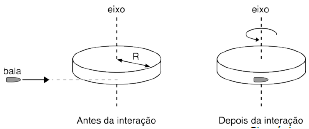
Disponível em: <https://edisciplinas.usp.br/pluginfile.php/7795179/mod_resource/content/0/aula_exercicios_P3.pdf>.
Acesso em: 25 jun. 2024. [Adaptado].
Uma bala de massa m se move horizontalmente com velocidade v. A bala atinge a borda de um disco sólido, que está inicialmente em repouso, ficando cravada nele (ver a figura). O disco tem massa M, raio R, momento de inércia MR2/2 e está livre para girar em torno de seu eixo.
Qual é a velocidade angular do disco imediatamente após a bala ser cravada nele?
Provas
Provas
Provas
Provas
Um bloco A de massa \( m_1 \) está sobre uma mesa horizontal.
O coeficiente de atrito cinético entre o bloco e a mesa é \( u_k. \)
Um fio inextensível e de massa desprezível, conectado ao bloco A, passa por uma polia de massa e atrito desprezíveis.
Na outra extremidade do fio, está um bloco B de massa \( m_2 \) suspenso. Quando o bloco A desliza sobre a mesa, puxado pelo bloco B, a tensão no fio é igual a
Provas
Provas
If those who declare that there is no best method are asked why, the most immediate and frequent answer is likely to be "Because it all depends," meaning that what is best depends on whom the method is for, in what circumstances, for what purpose, and so on. That there is no best method therefore means that no single method is best for everyone, as there are important variations in the teaching context that influence what is best. The variations are of several kinds, relating to social situation, educational organization, teacher-related factors, and learner-related factors. There have been several attempts to categorize such variables systematically and comprehensively, but even the brief and random listing above shows that they are at different levels of generality, as well as of discreteness and tangibility.
PRABHU, N. S. There Is No Best Method-Why? TESOL Quarterly, Vol. 24, No. 2. (Summer, 1990), p. 161-176. [Adapted].
According to the text, the main reason why there is no best method in teaching is because
Provas
Observe the images below.
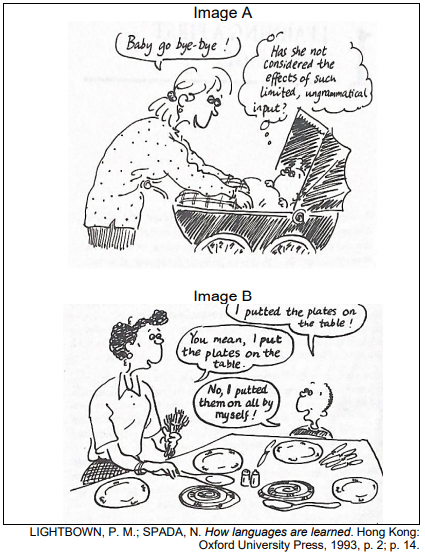
The cartoons refer to two different theoretical views regarding language acquisition/learning that serve as the base for some well-known methods of language teaching. Comparing both images, what can be affirmed about these two theories?
Provas
Provas
Caderno Container