Foram encontradas 100 questões.
Considere as seguintes afirmações:
I. As energias do átomo de Hidrogênio do modelo de Bohr satisfazem à relação, !$ E_n\,=\,-13,6/n^2 !$ e !$ V !$, com !$ n !$ = 1, 2, 3, · · ·; portanto, o elétron no estado fundamental do átomo de Hidrogênio pode absorver energia menor que 13,6 e !$ V !$.
II. Não existe um limiar de frequência de radiação no efeito fotoelétrico.
III. O modelo de Bohr, que resulta em energias quantizadas, viola o princípio da incerteza de Heisenberg.
Então, pode-se afirmar que
Provas
Questão presente nas seguintes provas

Considere os seguintes potenciais de eletrodo em relação ao eletrodo padrão de hidrogênio nas condições-padrão !$ (E^º) !$: !$ E^º_{M^{3+}/M^{2+}} !$= 0,80!$ V !$ e !$ E^º_{M^{2+}/Mº} !$= -0,20 !$ V !$. Assinale a opção que apresenta o valor, em !$ V !$, de !$ E^º_{M^{3+}/Mº} !$.
Provas
Questão presente nas seguintes provas
Thursday, Feb. 10, 2011
2045: The Year Man Becomes Immortal
By Lev Grossman
(…), Kurzweil believes that we’re approaching a moment when computers will become intelligent, and not just intelligent but more intelligent than humans. When that happens, humanity – our bodies, our minds, our civilization – will be completely and irreversibly transformed. He believes that this moment is not only inevitable but imminent. According to his calculations, the end of human civilization as we know it is about 35 years away.
Computers are getting faster. Everybody knows that. Also, computers are getting faster faster – that is, the rate at which they’re getting faster is increasing.
True? True.
So if computers are getting so much faster, so incredibly fast, there might conceivably come a moment when they are capable of something comparable to human intelligence. Artificial intelligence. All that horsepower could be put in the service of emulating whatever it is our brains are doing when they create consciousness – not just doing arithmetic very quickly or composing piano music but also driving cars, writing books, making ethical decisions, appreciating fancy paintings, making witty observations at cocktail parties.
If you can swallow that idea, and Kurzweil and a lot of other very smart people can, then all bets are off. From that point on, there’s no reason to think computers would stop getting more powerful. They would keep on developing until they were far more intelligent than we are. Their rate of development would also continue to increase, because they would take over their own development from their slower-thinking human creators. Imagine a computer scientist that was itself a super-intelligent computer. It would work incredibility quickly. It could draw on huge amounts of data effortlessly. It wouldn’t even take breaks to play Farmville.
(…)
http://www.time.com/printout/0,8816,2048138,00.html. Acesso em 07/04/2011. Adaptado.
De acordo com o texto,
Provas
Questão presente nas seguintes provas
Considere as seguintes misturas (soluto/solvente) na concentração de 10 % em mol de soluto:
I. acetona/clorofórmio II. água/etanol III. água/metanol
IV. benzeno/tolueno V. !$ n !$-hexano/!$ n !$-heptano
Assinale a opção que apresenta a(s) mistura(s) para a(s) qual(is) a pressão de vapor do solvente na mistura é aproximadamente igual à sua pressão de vapor quando puro multiplicada pela sua respectiva fração molar.
Provas
Questão presente nas seguintes provas
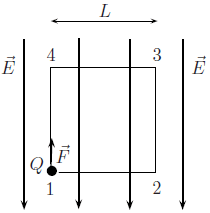
A figura mostra uma região espacial de campo elétrico uniforme de módulo !$ E\,=\,20\,N/C !$. Uma carga !$ Q\,=\,4\,C !$ é deslocada com velocidade constante ao longo do perímetro do quadrado de lado !$ L\,=\,1\,m !$, sob ação de uma força !$ \vec{F} !$ igual e contrária à força coulombiana que atua na carga !$ Q !$. Considere, então, as seguintes afirmações:
I. O trabalho da força !$ \vec{F} !$ para deslocar a carga !$ Q !$ do ponto 1 para 2 é o mesmo do dispendido no seu deslocamento ao longo do caminho fechado 1-2-3-4-1.
II. O trabalho de !$ \vec{F} !$ para deslocar a carga !$ Q !$ de 2 para 3 é maior que o para deslocá-la de 1 para 2.
III. É nula a soma do trabalho da força !$ \vec{F} !$ para deslocar a carga !$ Q !$ de 2 para 3 com seu trabalho para deslocá-la de 4 para 1.
Então, pode-se afirmar que
Provas
Questão presente nas seguintes provas
Time, May 24, 2010. Adaptado.
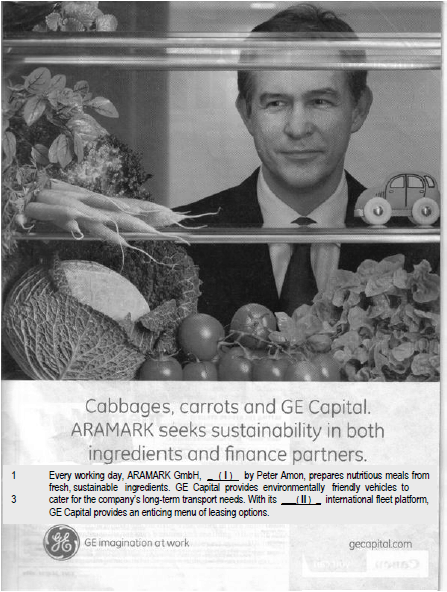
Que tipo de serviço é anunciado pela GE Capital?
Provas
Questão presente nas seguintes provas
Considere um número real !$ a ≠ 1 !$ positivo, fixado, e a equação em !$ x !$
!$ a^{2x} + 2βa^x − β = 0, β \in \mathbb{R} !$
Das afirmações:
I · Se !$ \beta < 0 !$, então existem duas soluções reais distintas;
II · Se !$ \beta = -1 !$, então existe apenas uma solução real;
III · Se !$ \beta = 0 !$, então não existem soluções reais;
IV · Se !$ \beta > 0 !$, então existem duas soluções reais distintas,
é (são) sempre verdadeira(s) apenas
Provas
Questão presente nas seguintes provas
Considere volumes iguais dos gases !$ NH_3 !$, !$ CH_4 !$ e !$ O_2 !$ nas CNTP. Assinale a opção que apresenta o(s) gás(es) que se comporta(m) idealmente.
Provas
Questão presente nas seguintes provas
Considere os seguintes pares de moléculas:
I. !$ LiCl !$ e !$ KCl !$
II. !$ AlCl_3 !$ e !$ PCl_3 !$
III. !$ NCl_3 !$ e !$ AsCl_3 !$
Assinale a opção com as três moléculas que, cada uma no seu respectivo par, apresentam ligações com o maior caráter covalente.
Provas
Questão presente nas seguintes provas
Thursday, Feb. 10, 2011
2045: The Year Man Becomes Immortal
By Lev Grossman
(…), Kurzweil believes that we’re approaching a moment when computers will become intelligent, and not just intelligent but more intelligent than humans. When that happens, humanity – our bodies, our minds, our civilization – will be completely and irreversibly transformed. He believes that this moment is not only inevitable but imminent. According to his calculations, the end of human civilization as we know it is about 35 years away.
Computers are getting faster. Everybody knows that. Also, computers are getting faster faster – that is, the rate at which they’re getting faster is increasing.
True? True.
So if computers are getting so much faster, so incredibly fast, there might conceivably come a moment when they are capable of something comparable to human intelligence. Artificial intelligence. All that horsepower could be put in the service of emulating whatever it is our brains are doing when they create consciousness – not just doing arithmetic very quickly or composing piano music but also driving cars, writing books, making ethical decisions, appreciating fancy paintings, making witty observations at cocktail parties.
If you can swallow that idea, and Kurzweil and a lot of other very smart people can, then all bets are off. From that point on, there’s no reason to think computers would stop getting more powerful. They would keep on developing until they were far more intelligent than we are. Their rate of development would also continue to increase, because they would take over their own development from their slower-thinking human creators. Imagine a computer scientist that was itself a super-intelligent computer. It would work incredibility quickly. It could draw on huge amounts of data effortlessly. It wouldn’t even take breaks to play Farmville.
(…)
http://www.time.com/printout/0,8816,2048138,00.html. Acesso em 07/04/2011. Adaptado.
Na sentença They would keep on developing until they were far more intelligent than we are, destacado no texto, o vocábulo grifado poderia ser substituído por
Provas
Questão presente nas seguintes provas
Cadernos
Caderno Container