Foram encontradas 258 questões.
Durante a segunda metade do século XIX, Émile Zola foi um dos nomes mais importantes na constituição do teatro naturalista.
A respeito do teatro naturalista, considere as seguintes afirmativas:
1. No final do século XIX, o teatro naturalista escandalizava muita gente.
2. A principal força do teatro naturalista era explorar fórmulas de provocar lágrimas e risos na plateia.
3. No Brasil, o teatro naturalista não se desenvolveu, em função da resistência às influências europeias.
4. O teatro naturalista tinha como efeito criar na mente do espectador a ilusão de estar diante da realidade.
Assinale a alternativa correta.
Provas
Questão presente nas seguintes provas

640785
Ano: 2014
Disciplina: Direito da Criança e do Adolescente
Banca: UFPR
Orgão: Pref. Curitiba-PR
Disciplina: Direito da Criança e do Adolescente
Banca: UFPR
Orgão: Pref. Curitiba-PR
Provas:
- ECAGeralDireitos Fundamentais (art. 7º ao 69)Do Direito à Educação, à Cultura, ao Esporte e ao Lazer (Art. 53 a 59)
De acordo com o Estatuto da Criança e do Adolescente (ECA, Lei nº 8.069/1990) assinale a alternativa INCORRETA.
Provas
Questão presente nas seguintes provas
640749
Ano: 2014
Disciplina: Direito Educacional e Tecnológico
Banca: UFPR
Orgão: Pref. Curitiba-PR
Disciplina: Direito Educacional e Tecnológico
Banca: UFPR
Orgão: Pref. Curitiba-PR
Provas:
A valorização da cultura corporal de movimento, a realização das práticas e a relação da Educação Física com a qualidade de vida são as três dimensões indicadas pelos Parâmetros Curriculares Nacionais para se desenvolver a avaliação da Educação Física na escola. Portanto, é INCORRETO afirmar que o professor deve observar:
Provas
Questão presente nas seguintes provas
Pensando na escola brasileira e na pluralidade cultural em que vivemos, Isabel Marques organiza uma proposta de ensino de dança na escola que se afina com a perspectiva freiriana de um tema gerador significativo ao aluno. Para Marques, uma proposta de ensino de dança deve se fundamentar no que ela chama de “contexto ampliado” dos alunos, que é constituído pela intersecção móvel e não hierárquica entre os espaços:
Provas
Questão presente nas seguintes provas
A comemoração de 25 anos de uma escola foi realizada em um teatro com capacidade de 2.173 lugares. Compareceram ao evento 1.500 pessoas. A porcentagem aproximada de lugares vazios durante o evento foi de:
Provas
Questão presente nas seguintes provas
O texto abaixo é referência para a questão.
Fizzy drinks ‘disrupt children’s sleep’
It is something parents have long suspected – now scientists have confirmed that fizzy drinks affect children’s behaviour.
Teenagers who drink more caffeinated soft drinks sleep less, are more likely to wake during the night and tend to be sleepier during the day, a study has found.
And with one in eight teenagers now drinking more than 22 cans of cola a week, the findings will add to concerns about the effects on their health.
It will also lead to calls for schools to withdraw their lucrative drinks vending machines.
The experts tracked nearly 200 teenagers, aged 14 to 16, for two weeks, recording their sleep patterns and daily intake of caffeinated drinks and foods.
The average daily intake of caffeine was just 63mg, equivalent to half a cup of coffee, but some of the teenagers in the study were taking in up to 800mg.
Boys tended to consume more caffeine than girls – about 70mg daily, compared with 55mg.
Those who reported higher intakes of caffeine had disrupted sleep patterns – being more likely to wake during the night and to sleep for less time. But during the day, the same teenagers tended to be sleepier. The experts say the result means that even small amounts of caffeine can affect children, and soft drinks vending machines should be banned from schools.
The study, published in the journal Paediatrics today, was led by Dr. Charles Pollack of Ohio State University in the U.S.
He said: “The increasing availability of soft drink dispensing machines in schools is apparently welcomed by students and is profitable to school boards, but our findings suggest that it may be interfering with the night-time sleep of teenagers”.
Dr. Pollack said the time may come when soft drinks manufacturers would be forced to either limit the caffeine content in their products or not target children with them.
The research adds to the findings of a UK study published in October, which concluded that additives used in hundreds of children’s foods and drinks can cause disruptive behaviour.
The Government-funded report involved 227 three-year-olds from the Isle of Wight.
It found that colourings in products such as Jammie Dodgers, Smarties and Jelly Tots as well as in fizzy drinks could spark behavioural changes in up to a quarter of children.
(Retrieved from: newspaper Daily Mail, January 8, 2003, p. 19).
A palavra “disrupted” pode ser substituída por um sinônimo sem prejudicar o sentido do texto. Esse sinônimo seria:
Provas
Questão presente nas seguintes provas
Em relação à dança, considere as seguintes afirmativas:
1. Na escola, a dança deve ser desenvolvida mais numa perspectiva de expressão e vivência de movimentos, sobrepondo-se à padronização dos gestos.
2. A dança, independentemente de sua modalidade, tem como objetivo buscar a expressão individual de pensamentos e sentimentos, desenvolvendo ações motoras que influenciam os fatores intelectuais, afetivos e culturais.
3. A dança é um meio de expressão, presente em todas as épocas da história e considerada uma das mais antigas artes criadas pelo ser humano, usada para exprimir os sentimentos e expandir-se por movimentos e vínculos emocionais.
4. As danças acompanham as transformações sociais, de modo que se deve verificar na estruturação de cada uma delas a estreita relação com o contexto histórico e social em que se originou.
Assinale a alternativa correta.
Provas
Questão presente nas seguintes provas
O funcionamento de uma comunidade depende das diversas relações ou interações entre os organismos que a compõem. Essas relações podem ser intraespecíficas, quando ocorrem entre seres da mesma espécie ou interespecíficas, quando ocorrem entre seres de espécies diferentes. Quanto a essas relações, identifique as afirmativas a seguir como verdadeiras (V) ou falsas (F):
( ) Sociedade é um grupamento permanente de indivíduos da mesma espécie.
( ) Como exemplos de organismos que vivem em uma colônia, temos os cupins e as abelhas.
( ) Na protocooperação, as espécies associadas trocam benefícios mútuos sem que haja dependência entre elas.
( ) No comensalismo, há beneficiamento recíproco entre as espécies que participam da relação ecológica, sendo que essa dependência é fundamental para a sobrevivência delas.
( ) São exemplos de relações ecológicas desarmônicas o mutualismo, a protocooperação e a sociedade.
( ) Algumas vezes um animal se alimenta de outro da mesma espécie, fenômeno esse conhecido como canibalismo.
Assinale a alternativa que apresenta a sequência correta, de cima para baixo.
Provas
Questão presente nas seguintes provas
O trecho a seguir, extraído do livro English as a global language de David Crystal [1997], 2003, é referência para a questão.
What is a global language?
“A language achieves a genuinely global status when it develops a special role that is recognized in every country. This might seem like stating the obvious, but it is not, for the notion of ‘special role’ has many facets. Such a role will be most evident in countries where large numbers of the people speak the language as a mother tongue – in the case of English, this would mean the USA, Canada, Britain, Ireland, Australia, New Zealand, South Africa, several Caribbean countries and a sprinkling of other territories. However, no language has ever been spoken by a mother-tongue majority in more than a few countries (Spanish leads, in this respect, in some twenty countries, chiefly in Latin America), so mother-tongue use by itself cannot give a language global status. To achieve such a status, a language has to be taken up by other countries around the world. They must decide to give it a special place within their communities, even though they may have few (or no) mother-tongue speakers.
There are two main ways in which this can be done. Firstly, a language can be made the official language of a country, to be used as a medium of communication in such domains as government, the law courts, the media, and the educational system. To get on in these societies, it is essential to master the official language as early in life as possible. Such a language is often described as a ‘second language’, because it is seen as a complement to a person’s mother tongue, or ‘first language’. The role of an official language is today best illustrated by English, which now has some kind of special status in over seventy countries, such as Ghana, Nigeria, India, Singapore and Vanuatu. This is far more than the status achieved by any other language – though French, German, Spanish, Russian and Arabic are among those which have also developed a considerable official use. New political decisions on the matter continue to be made: for example, Rwanda gave English official status in 1996.
Secondly, a language can be made priority in a country’s foreign-language teaching, even though this language has no official status. It becomes the language which children are most likely to be taught when they arrive in school, and the one most available to adults who – for whatever reason – never learned it, or learned it badly, in their early educational years. Russian, for example, held privileged status for many years among the countries of the former Soviet Union. Mandarin Chinese continues to play an important role in South-east Asia. English is now the language most widely taught as a foreign language – in over 100 countries, such as China, Russia, Germany, Spain, Egypt and Brazil – and in most of these countries it is emerging as the chief foreign language to be encountered in schools, often displacing another language in the process. In 1996, for example, English replaced French as the chief foreign language in schools in Algeria (a former French colony).
In reflecting on these observations, it is important to note that there are several ways in which a language can be official. It may be the sole language of a country, or it may share this status with other languages. And it may have a ‘semi-official’ status, being used only in certain domains, or taking second place to other languages while still performing certain official roles. Many countries formally acknowledge a language’s status in their constitution (e.g. India); some make no special mention of it (e.g. Britain). In certain countries, the question of whether the special status should be legally recognized is a source of considerable controversy – notably, in the USA.” (. . .)
(CRYSTAL, David. English as a global Language. Cambridge: CUP, [1997] 2003, p. 03-05.)
De acordo com o texto, o grupo de países onde o inglês é a língua materna de grande parte da população inclui:
Provas
Questão presente nas seguintes provas
Considere a figura abaixo:
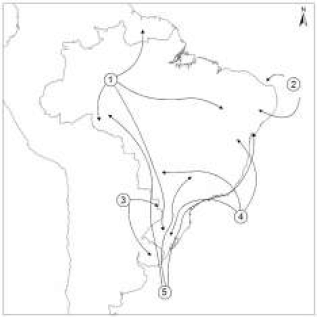
Fonte: Adaptado de Monteiro (1963).
Com base na figura e nos conhecimentos sobre as massas de ar atuantes no Brasil, identifique afirmativas a seguir como verdadeiras (V) ou falsas (F):
( ) As massas de ar atuantes no Brasil, com exceção da Polar Atlântica (5), têm como característica todas serem quentes e úmidas.
( ) As massas de ar com significativa atuação na região Sul do Brasil são a Polar Atlântica (5), a Equatorial Atlântica (4) e a Equatorial Continental (1).
( ) A massa de ar Equatorial Continental (1), com origem na planície amazônica, é quente e muito úmida e atua o ano inteiro, sendo que, no verão, avança para o sul.
( ) A Polar Atlântica (5) é fria e úmida, atua o ano inteiro, sendo mais expressiva no período de inverno. Quando atua com mais força, pode chegar até o nordeste da Amazônia.
Assinale a alternativa que apresenta a sequência correta, de cima para baixo.
Provas
Questão presente nas seguintes provas
Cadernos
Caderno Container