Foram encontradas 430 questões.
Read Text 1 and answer question.
TEXT 1
English Language Teaching in Brazil:
A Gap in Policy, Problems in Practice
Only three percent of Brazilians are estimated to speak English despite the status of this language as a mandatory subject in grades 10 to 12 of basic education and preferred foreign language in grades 5 to 9. The widespread concept in the Brazilian society that speaking English is beneficial to individuals because it provides access to the globalised world does not seem to be enough to promote the actual learning of the language by the majority of the population, and it is argued here that this fact has to do with a gap in the foreign language teaching policy documents: the 2015 National Education Guidelines and Framework Law (LDB 2015), the Brazilian National Curriculum Parameters for Primary Education (PCN-EF), and the Brazilian National Curriculum Parameters for Secondary Education (PCN-EM). These documents do not prescribe the necessary conditions for English Language Teaching (ELT) to take place effectively, but, instead, provide suggestions for teachers on how to adapt to the status quo, which means focusing on reading to the detriment of the other aspects of the English language due to a number of factors ranging from a lack of resources to a large number of students per class.
Both PCN-EF (Brazil, 1998) and PCN-EM (Brazil, 2000) present progressive ideas about how a foreign language should be taught in the basic education classroom. Such ideas include a social interactionist view of language, which aligns with contemporary research in second language teaching and means a shift from the traditional grammar-translation method largely employed in Brazilian schools in previous decades. The Parameters also recommend interdisciplinary work, the implementation of cross-curricular themes, formative assessment in addition to summative, a value of students’ prior knowledge and position as critical subjects, and, thus, an approach to teaching as negotiation that aims to educate students for the full exercise of citizenship, which includes the notions of respect for difference and diversity that can be promoted by the teaching and learning of foreign languages.
However, the Parameters fail in pointing out the necessary conditions for this teaching and learning process to occur. For example, they acknowledge that reading and writing should be focused on to the detriment of listening and speaking due to the difficulties faced by the teacher in basic education (Brazil, 1998): large classrooms, lack of appropriate resources including class and preparation time for the teacher and opportunities for the students to be exposed to the language outside the classroom, and, in many situations, teachers’ lack of knowledge of the subject matter. Instead, what they should do is to actively propose that a smaller number of students sit in English classes – as it was allowed by LDB 1996 and continues to be so by LDB 2015, that more class and preparation time be granted the teacher, that schools have English resources that students can access to familiarise themselves with the language, and that better teacher education be implemented.
BATISTA, Fernanda. English Language Teaching in Brazil: A Gap in Policy, Problems in Practice. 2020. Disponível em: https://files.eric.ed.gov/fulltext/EJ1262339.pdf. Acesso em 30/12/2023 Adaptado.
Provas

Read Text 1 and answer question.
TEXT 1
English Language Teaching in Brazil:
A Gap in Policy, Problems in Practice
Only three percent of Brazilians are estimated to speak English despite the status of this language as a mandatory subject in grades 10 to 12 of basic education and preferred foreign language in grades 5 to 9. The widespread concept in the Brazilian society that speaking English is beneficial to individuals because it provides access to the globalised world does not seem to be enough to promote the actual learning of the language by the majority of the population, and it is argued here that this fact has to do with a gap in the foreign language teaching policy documents: the 2015 National Education Guidelines and Framework Law (LDB 2015), the Brazilian National Curriculum Parameters for Primary Education (PCN-EF), and the Brazilian National Curriculum Parameters for Secondary Education (PCN-EM). These documents do not prescribe the necessary conditions for English Language Teaching (ELT) to take place effectively, but, instead, provide suggestions for teachers on how to adapt to the status quo, which means focusing on reading to the detriment of the other aspects of the English language due to a number of factors ranging from a lack of resources to a large number of students per class.
Both PCN-EF (Brazil, 1998) and PCN-EM (Brazil, 2000) present progressive ideas about how a foreign language should be taught in the basic education classroom. Such ideas include a social interactionist view of language, which aligns with contemporary research in second language teaching and means a shift from the traditional grammar-translation method largely employed in Brazilian schools in previous decades. The Parameters also recommend interdisciplinary work, the implementation of cross-curricular themes, formative assessment in addition to summative, a value of students’ prior knowledge and position as critical subjects, and, thus, an approach to teaching as negotiation that aims to educate students for the full exercise of citizenship, which includes the notions of respect for difference and diversity that can be promoted by the teaching and learning of foreign languages.
However, the Parameters fail in pointing out the necessary conditions for this teaching and learning process to occur. For example, they acknowledge that reading and writing should be focused on to the detriment of listening and speaking due to the difficulties faced by the teacher in basic education (Brazil, 1998): large classrooms, lack of appropriate resources including class and preparation time for the teacher and opportunities for the students to be exposed to the language outside the classroom, and, in many situations, teachers’ lack of knowledge of the subject matter. Instead, what they should do is to actively propose that a smaller number of students sit in English classes – as it was allowed by LDB 1996 and continues to be so by LDB 2015, that more class and preparation time be granted the teacher, that schools have English resources that students can access to familiarise themselves with the language, and that better teacher education be implemented.
BATISTA, Fernanda. English Language Teaching in Brazil: A Gap in Policy, Problems in Practice. 2020. Disponível em: https://files.eric.ed.gov/fulltext/EJ1262339.pdf. Acesso em 30/12/2023 Adaptado.
Provas
Read Text 1 and answer question.
TEXT 1
English Language Teaching in Brazil:
A Gap in Policy, Problems in Practice
Only three percent of Brazilians are estimated to speak English despite the status of this language as a mandatory subject in grades 10 to 12 of basic education and preferred foreign language in grades 5 to 9. The widespread concept in the Brazilian society that speaking English is beneficial to individuals because it provides access to the globalised world does not seem to be enough to promote the actual learning of the language by the majority of the population, and it is argued here that this fact has to do with a gap in the foreign language teaching policy documents: the 2015 National Education Guidelines and Framework Law (LDB 2015), the Brazilian National Curriculum Parameters for Primary Education (PCN-EF), and the Brazilian National Curriculum Parameters for Secondary Education (PCN-EM). These documents do not prescribe the necessary conditions for English Language Teaching (ELT) to take place effectively, but, instead, provide suggestions for teachers on how to adapt to the status quo, which means focusing on reading to the detriment of the other aspects of the English language due to a number of factors ranging from a lack of resources to a large number of students per class.
Both PCN-EF (Brazil, 1998) and PCN-EM (Brazil, 2000) present progressive ideas about how a foreign language should be taught in the basic education classroom. Such ideas include a social interactionist view of language, which aligns with contemporary research in second language teaching and means a shift from the traditional grammar-translation method largely employed in Brazilian schools in previous decades. The Parameters also recommend interdisciplinary work, the implementation of cross-curricular themes, formative assessment in addition to summative, a value of students’ prior knowledge and position as critical subjects, and, thus, an approach to teaching as negotiation that aims to educate students for the full exercise of citizenship, which includes the notions of respect for difference and diversity that can be promoted by the teaching and learning of foreign languages.
However, the Parameters fail in pointing out the necessary conditions for this teaching and learning process to occur. For example, they acknowledge that reading and writing should be focused on to the detriment of listening and speaking due to the difficulties faced by the teacher in basic education (Brazil, 1998): large classrooms, lack of appropriate resources including class and preparation time for the teacher and opportunities for the students to be exposed to the language outside the classroom, and, in many situations, teachers’ lack of knowledge of the subject matter. Instead, what they should do is to actively propose that a smaller number of students sit in English classes – as it was allowed by LDB 1996 and continues to be so by LDB 2015, that more class and preparation time be granted the teacher, that schools have English resources that students can access to familiarise themselves with the language, and that better teacher education be implemented.
BATISTA, Fernanda. English Language Teaching in Brazil: A Gap in Policy, Problems in Practice. 2020. Disponível em: https://files.eric.ed.gov/fulltext/EJ1262339.pdf. Acesso em 30/12/2023 Adaptado.
Provas
Read Text 1 and answer question.
TEXT 1
English Language Teaching in Brazil:
A Gap in Policy, Problems in Practice
Only three percent of Brazilians are estimated to speak English despite the status of this language as a mandatory subject in grades 10 to 12 of basic education and preferred foreign language in grades 5 to 9. The widespread concept in the Brazilian society that speaking English is beneficial to individuals because it provides access to the globalised world does not seem to be enough to promote the actual learning of the language by the majority of the population, and it is argued here that this fact has to do with a gap in the foreign language teaching policy documents: the 2015 National Education Guidelines and Framework Law (LDB 2015), the Brazilian National Curriculum Parameters for Primary Education (PCN-EF), and the Brazilian National Curriculum Parameters for Secondary Education (PCN-EM). These documents do not prescribe the necessary conditions for English Language Teaching (ELT) to take place effectively, but, instead, provide suggestions for teachers on how to adapt to the status quo, which means focusing on reading to the detriment of the other aspects of the English language due to a number of factors ranging from a lack of resources to a large number of students per class.
Both PCN-EF (Brazil, 1998) and PCN-EM (Brazil, 2000) present progressive ideas about how a foreign language should be taught in the basic education classroom. Such ideas include a social interactionist view of language, which aligns with contemporary research in second language teaching and means a shift from the traditional grammar-translation method largely employed in Brazilian schools in previous decades. The Parameters also recommend interdisciplinary work, the implementation of cross-curricular themes, formative assessment in addition to summative, a value of students’ prior knowledge and position as critical subjects, and, thus, an approach to teaching as negotiation that aims to educate students for the full exercise of citizenship, which includes the notions of respect for difference and diversity that can be promoted by the teaching and learning of foreign languages.
However, the Parameters fail in pointing out the necessary conditions for this teaching and learning process to occur. For example, they acknowledge that reading and writing should be focused on to the detriment of listening and speaking due to the difficulties faced by the teacher in basic education (Brazil, 1998): large classrooms, lack of appropriate resources including class and preparation time for the teacher and opportunities for the students to be exposed to the language outside the classroom, and, in many situations, teachers’ lack of knowledge of the subject matter. Instead, what they should do is to actively propose that a smaller number of students sit in English classes – as it was allowed by LDB 1996 and continues to be so by LDB 2015, that more class and preparation time be granted the teacher, that schools have English resources that students can access to familiarise themselves with the language, and that better teacher education be implemented.
BATISTA, Fernanda. English Language Teaching in Brazil: A Gap in Policy, Problems in Practice. 2020. Disponível em: https://files.eric.ed.gov/fulltext/EJ1262339.pdf. Acesso em 30/12/2023 Adaptado.
Provas
et
de faim.
«Ma voix fait encore
écho aux vers perplexes».
Dans ce passage, l’adverbe:
Provas
et
de faim.
Sur la forme verbale «menant», il est correcte d’affirmer qu’elle:
Provas
et
de faim.
Provas
et
de faim.
Les passages du poème Voix-Femmes qui portent sur le champ lexical de « l’activité d’écriture poétique » et sur une métaphore à propos du « pouvoir de la transmission [orale]» sont respectivement:
Provas
Utilisez le Texte suivant pour répondre aux
question.
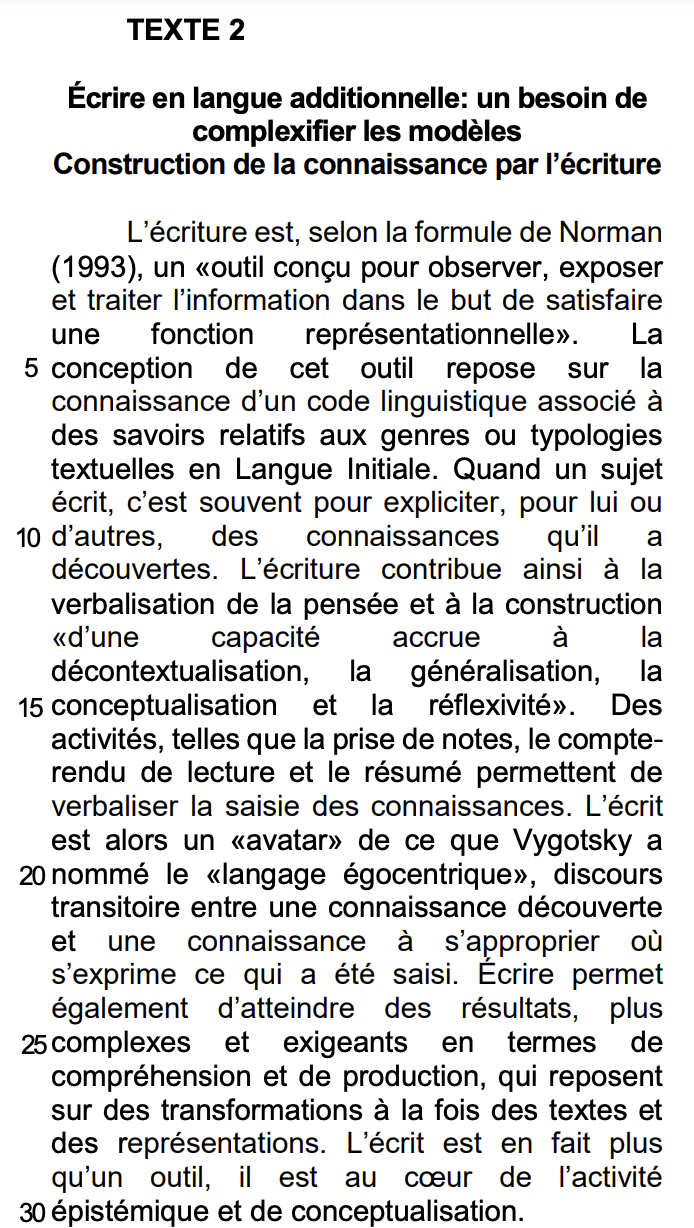
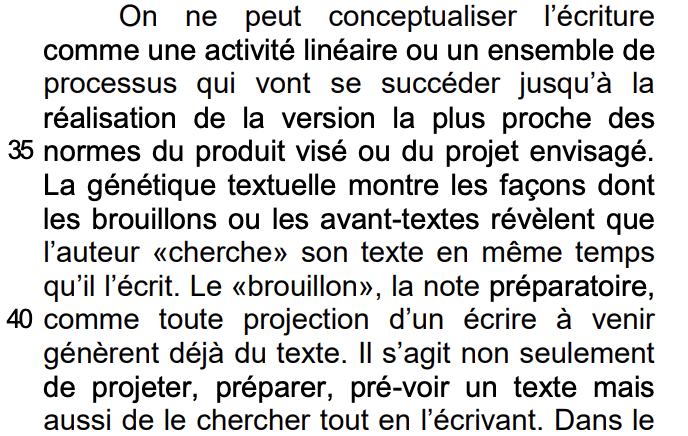
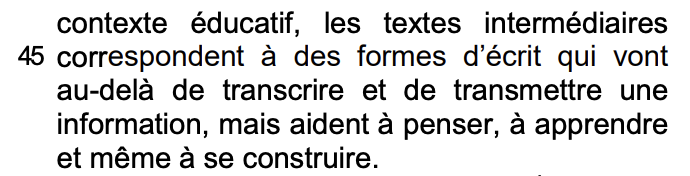
Bozhinova, K. ; Narcy-Combes, J. ; Mabrour A. Écrire en langue additionnelle : un besoin de complexifier les modèles in Revue TDFLE, 76, 2020. En intégralité sur : https://doi.org/10.34745/numerev_1286 Consulté le 30 jan. 2024.
L’expression soulignée pourrait être substituée, sans compromettre le sens, par:
Provas
Utilisez le Texte suivant pour répondre aux
question.
Bozhinova, K. ; Narcy-Combes, J. ; Mabrour A. Écrire en langue additionnelle : un besoin de complexifier les modèles in Revue TDFLE, 76, 2020. En intégralité sur : https://doi.org/10.34745/numerev_1286 Consulté le 30 jan. 2024.
Sélectionnez l'option à laquelle appartient la structure en gras de l'extrait.
Provas
Caderno Container