Foram encontradas 40 questões.
Os textos abaixo correspondem a fragmentos de fontes diversas, pertencentes a gêneros textuais também variados. As fontes dos textos foram omitidas propositalmente. Utilize-os para responder a questão a seguir
Text 1
The streets pounded with Baile funk, and flip-flopped men in dark glasses stood around the car, watching the five dirt roads that joined at the junction. The sun slipped down out of sight of the favela crater, below the line of the city. [...]
Renata left her legal aid office an hour later than normal. She’d been helping a man with a dispute over land. He was expecting another child and wanted to extend the rough house his family lived in. But a bar owner and a tyre shop were unhappy with the plans. Renata had slipped easily into the space of the disagreement, fluid, empathic, and negotiated a compromise. The man had just visited her office to bless her and offer his respects. He’d talked for a long time.
Text 2
Mario Leme is a low-ranking detective in the Sao Paulo civil police. Every day on the way to work he sets off early and drives through the favela known as Paraisopolis - Paradise City. It’s a pilgrimage: his wife Renata was gunned down at an intersection here a year ago, the victim of a stray bullet in a conflict between drug dealers. One morning, parked near the place where Renata died, he sees an SUV careen out of control and flip over. The driver Leo is killed, but before his body is removed, Leme is sure he sees bullet wounds. Leo’s death wasn’t an accident, he was murdered. Soon, his girlfriend turns up dead too. And if they were killed deliberately, perhaps Renata was too… Leme finds himself immersed further and further in the dark underbelly of Brazilian society, as corruption seeps from the highest to the lowest echelons, and the devastating truth about Renata begins to emerge.
Text 3
My book, Paradise City, is named after the Paraisópolis favela, where a key incident happens at the beginning. Sao Paulo’s a great setting for crime fiction because of the huge gulf between rich and poor – there’s a disenfranchised underclass and a sense of lawlessness. It’s a place rich in culture, dripping in cash and undermined by political lawlessness. A crime novel allows access to these different worlds. Crime in São Paulo is run by a gang called PCC – from jail. On the weekend before the World Cup in 2006, they demanded wide screen TVs to watch the game. When the authorities refused they said they’d cause chaos across the city – and they did for three days. Police were attacked, buses hijacked and set on fire – when they authorities finally agreed to the TVs the mayhem stopped. It was that weekend that the seed of the idea for my novel was planted.
Text 4
I was mightily impressed by Paradise City by Joe Thomas, which takes us deep into the throbbing heart of Sao Paulo, Brazil, and the violent favela known as Paraisopolis. Low ranking detective Mario Leme drives through this favela everyday, as this is where his wife, Renata, a lawyer, was gunned down a year previously, the victim of a bala perdida – a stray bullet. One morning at the same spot, Leme witnesses a car careering out of control, but sees that the driver has several bullet wounds, although the incident is written off as a traffic accident. Leme finds himself embroiled in a tale of murder and corruption at the highest level, which puts him at odds with his superiors, and onto a dangerous path. What I liked most about this book was the colour and exuberance that Thomas injects into his vivid realisation of the pulsating favela, albeit suffused by violence.
Observe o seguinte trecho extraído do Texto 1: Renata left (A) her legal aid office an hour later than normal. She’d been helping (B) a man with a dispute over land. He was expecting (C) another child and wanted (D) to extend the rough house his family lived in. Sobre as formas verbais sublinhadas, considere as seguintes afirmativas:
I. A sequência em que as formas verbais sublinhadas aparecem (A, B, C, D) é a mesma sequência em que ocorreram os eventos que expressam.
II. Substituir a forma B por had helped implicaria mudança de ênfase: da continuidade da atividade para uma ideia de término, conclusão.
III. Embora as formas C e D expressem concomitância, want trata-se de um verbo que expressa estado mental/ emocional, o que justifica seu uso no Past Simple em vez do Past Progressive no contexto em questão.
Estão corretas as afirmativas:
Provas
Questão presente nas seguintes provas

Para responder a questão, leia com atenção a tira abaixo de “Hagar, o Horrível” do cartunista Dik Browne.
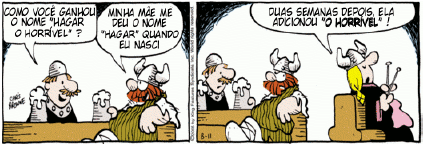
A partir da leitura da tira de “Hagar, o horrível” assinale a alternativa correta.
Provas
Questão presente nas seguintes provas
Os textos abaixo correspondem a fragmentos de fontes diversas, pertencentes a gêneros textuais também variados. As fontes dos textos foram omitidas propositalmente. Utilize-os para responder a questão a seguir
Text 1
The streets pounded with Baile funk, and flip-flopped men in dark glasses stood around the car, watching the five dirt roads that joined at the junction. The sun slipped down out of sight of the favela crater, below the line of the city. [...]
Renata left her legal aid office an hour later than normal. She’d been helping a man with a dispute over land. He was expecting another child and wanted to extend the rough house his family lived in. But a bar owner and a tyre shop were unhappy with the plans. Renata had slipped easily into the space of the disagreement, fluid, empathic, and negotiated a compromise. The man had just visited her office to bless her and offer his respects. He’d talked for a long time.
Text 2
Mario Leme is a low-ranking detective in the Sao Paulo civil police. Every day on the way to work he sets off early and drives through the favela known as Paraisopolis - Paradise City. It’s a pilgrimage: his wife Renata was gunned down at an intersection here a year ago, the victim of a stray bullet in a conflict between drug dealers. One morning, parked near the place where Renata died, he sees an SUV careen out of control and flip over. The driver Leo is killed, but before his body is removed, Leme is sure he sees bullet wounds. Leo’s death wasn’t an accident, he was murdered. Soon, his girlfriend turns up dead too. And if they were killed deliberately, perhaps Renata was too… Leme finds himself immersed further and further in the dark underbelly of Brazilian society, as corruption seeps from the highest to the lowest echelons, and the devastating truth about Renata begins to emerge.
Text 3
My book, Paradise City, is named after the Paraisópolis favela, where a key incident happens at the beginning. Sao Paulo’s a great setting for crime fiction because of the huge gulf between rich and poor – there’s a disenfranchised underclass and a sense of lawlessness. It’s a place rich in culture, dripping in cash and undermined by political lawlessness. A crime novel allows access to these different worlds. Crime in São Paulo is run by a gang called PCC – from jail. On the weekend before the World Cup in 2006, they demanded wide screen TVs to watch the game. When the authorities refused they said they’d cause chaos across the city – and they did for three days. Police were attacked, buses hijacked and set on fire – when they authorities finally agreed to the TVs the mayhem stopped. It was that weekend that the seed of the idea for my novel was planted.
Text 4
I was mightily impressed by Paradise City by Joe Thomas, which takes us deep into the throbbing heart of Sao Paulo, Brazil, and the violent favela known as Paraisopolis. Low ranking detective Mario Leme drives through this favela everyday, as this is where his wife, Renata, a lawyer, was gunned down a year previously, the victim of a bala perdida – a stray bullet. One morning at the same spot, Leme witnesses a car careering out of control, but sees that the driver has several bullet wounds, although the incident is written off as a traffic accident. Leme finds himself embroiled in a tale of murder and corruption at the highest level, which puts him at odds with his superiors, and onto a dangerous path. What I liked most about this book was the colour and exuberance that Thomas injects into his vivid realisation of the pulsating favela, albeit suffused by violence.
Os fragmentos foram extraídos de textos com diferentes propósitos sociocomunicativos. Assinale a alternativa que apresenta corretamente o gênero textual a que cada fragmento pertence.
Provas
Questão presente nas seguintes provas
Cada item a seguir diz respeito a uma abordagem ou método de ensino de língua:
I. In ___________, learners are viewed as organisms that can be directed by skilled training techniques to produce correct responses. Learners play a reactive role by responding to stimuli, and thus have little control over the content, pace of learning.
II. Teaching based on ____________ derives from the belief that the building blocks of language learning and communication are not grammar, functions, notions, or some other unit of planning and teaching but words and word combinations.
III. _____________ proposes activities that are carried out using language, such as finding a solution to a puzzle, reading a map and giving directions, making a telephone call, writing a letter, or reading a set of instructions and assembling a toy.
Assinale a alternativa que completa correta e respectivamente as lacunas.
Provas
Questão presente nas seguintes provas
Com base na leitura atenta de trechos do texto a seguir, responda a questão a seguir.
14 de JUNHO ...Está chovendo. Eu não posso ir catar papel. O dia que chove eu sou mendiga. Já ando mesmo trapuda e suja. Já uso uniforme dos indigentes. E hoje é sábado. Os favelados são considerados mendigos. Vou aproveitar a deixa. A Vera não vai sair comigo porque está chovendo. (...) Ageitei um guarda-chuva velho que achei no lixo e saí. Fui no Frigorifico, ganhei uns ossos. Já serve. Faço sopa. Já que a barriga não fica vazia, tentei viver com ar. Comecei desmaiar. Então resolvi trabalhar porque eu não quero desistir da vida.
Quero ver como é que eu vou morrer. Ninguem deve alimentar a ideia de suicidio. Mas hoje em dia os que vivem até chegar a hora da morte, é um heroi. Porque quem não é forte desanima.
...Vi uma senhora reclamar que ganhou só ossos no Frigorifico e que os ossos estavam limpos.
- E eu que gosto tanto de carne.
Fiquei nervosa ouvindo a mulher lamentar-se porque é duro a gente vir ao mundo e não poder nem comer. Pelo que observo, Deus é o rei dos sabios. Ele pois os homens e os animais no mundo. Mas os animais quem lhes alimenta é a Natureza porque se os animais fossem alimentados igual aos homens, havia de sofrer muito. Eu penso isto, porque quando eu não tenho nada para comer, invejo o animais.
...Enquanto eu esperava na fila para ganhar bolachas ia ouvindo as mulheres lamentar-se outra mulher reclamava que passou numa casa e pediu uma esmola. A dona da casa mandou esperar (...) A mulher continuou dizendo que a dona da casa surgiu com um embrulho e deu-lhe. Ela não quiz abrir o embrulho perto das colegas, com receio que elas pedissem. Começou pensar. Será um pedaço de queijo? Será carne? Quando ela chegou em casa, a primeira coisa que fez, foi desfazer o embrulho porque a curiosidade é amiga das mulheres. Quando
desfez o embrulho viu que eram ratos mortos.
Tem pessoas que zombam dos que pedem.
[...] Mas os mendigos já estão habituados a ganhar as bolachas todos os sabados.
Não ganhei bolacha e fui na feira, catar verduras. Encontrei com a dona Maria do José Bento e começamos a falar sobre o custo de vida.
Ref. JESUS, Carolina Maria. Quarto de Despejo, diário de uma favelada. São Paulo, Editora Ática, 2001 [1960], 8ª Edição, pg. 55-56.
Após a leitura atenta do trecho acima, assinale a alternativa correta.
Provas
Questão presente nas seguintes provas
Com base na leitura atenta de trechos do texto a seguir, responda a questão a seguir.
14 de JUNHO ...Está chovendo. Eu não posso ir catar papel. O dia que chove eu sou mendiga. Já ando mesmo trapuda e suja. Já uso uniforme dos indigentes. E hoje é sábado. Os favelados são considerados mendigos. Vou aproveitar a deixa. A Vera não vai sair comigo porque está chovendo. (...) Ageitei um guarda-chuva velho que achei no lixo e saí. Fui no Frigorifico, ganhei uns ossos. Já serve. Faço sopa. Já que a barriga não fica vazia, tentei viver com ar. Comecei desmaiar. Então resolvi trabalhar porque eu não quero desistir da vida.
Quero ver como é que eu vou morrer. Ninguem deve alimentar a ideia de suicidio. Mas hoje em dia os que vivem até chegar a hora da morte, é um heroi. Porque quem não é forte desanima.
...Vi uma senhora reclamar que ganhou só ossos no Frigorifico e que os ossos estavam limpos.
- E eu que gosto tanto de carne.
Fiquei nervosa ouvindo a mulher lamentar-se porque é duro a gente vir ao mundo e não poder nem comer. Pelo que observo, Deus é o rei dos sabios. Ele pois os homens e os animais no mundo. Mas os animais quem lhes alimenta é a Natureza porque se os animais fossem alimentados igual aos homens, havia de sofrer muito. Eu penso isto, porque quando eu não tenho nada para comer, invejo o animais.
...Enquanto eu esperava na fila para ganhar bolachas ia ouvindo as mulheres lamentar-se outra mulher reclamava que passou numa casa e pediu uma esmola. A dona da casa mandou esperar (...) A mulher continuou dizendo que a dona da casa surgiu com um embrulho e deu-lhe. Ela não quiz abrir o embrulho perto das colegas, com receio que elas pedissem. Começou pensar. Será um pedaço de queijo? Será carne? Quando ela chegou em casa, a primeira coisa que fez, foi desfazer o embrulho porque a curiosidade é amiga das mulheres. Quando
desfez o embrulho viu que eram ratos mortos.
Tem pessoas que zombam dos que pedem.
[...] Mas os mendigos já estão habituados a ganhar as bolachas todos os sabados.
Não ganhei bolacha e fui na feira, catar verduras. Encontrei com a dona Maria do José Bento e começamos a falar sobre o custo de vida.
Ref. JESUS, Carolina Maria. Quarto de Despejo, diário de uma favelada. São Paulo, Editora Ática, 2001 [1960], 8ª Edição, pg. 55-56.
Leia atentamente as alternativas abaixo e assinale a alternativa de acordo com as regras gramaticais da Língua Portuguesa que possui a justificativa incorreta.
Provas
Questão presente nas seguintes provas
Utilize o texto abaixo para responder a questão a seguir.
Grammatical cohesion and textuality
Grammar teachers have long been aware of recurring interference factors with pronouns and reference, such as the Japanese tendency to confuse he and she, the Spanish tendency to confuse his and your, and so on, and there is not much discourse analysts can say to ease those overgreen problems. What can be (and often is not) directly taught about a system such as that of English is the different ways of referring to the discourse itself by use of items such as it, this, and that, which do not seem to translate in a one-to-one way to other languages, even where these are closely cognate (cf. German, French, Spanish).
MCCARTHY, Michael. Discourse analysis for language teachers. Cambridge University Press, 1991.
Observe o fragmento inicial do texto:
Grammar teachers have long been aware of recurring interference factors with pronouns and reference, such as the Japanese tendency to confuse he and she, the Spanish tendency to confuse his and your, and so on [...]
Assinale a alternativa que apresenta uma possibilidade de exemplo equivalente aos exemplos sublinhados, levando em consideração os aspectos gramaticais e textuais em questão:
Provas
Questão presente nas seguintes provas
Utilize o texto abaixo para responder a questão a seguir.
Teachers and teachers in training need to be able to use approaches and methods flexibly and creatively based on their own judgment and experience. In this process, they should be encouraged to transform and adapt the methods they use to make their own. Training in the techniques and procedures of a specific method is probably essential for novice teachers entering teaching, because it provides them with the confidence they will need to face learners and it provides techniques and strategies for presenting lessons. In the early stages, teaching
is largely a matter of applying procedures and techniques developed by others.
RICHARDS, J. ; ROGERS, T. Approaches and methods in language teaching. Cambridge: CUP, 2001.
Observe o trecho final do fragmento: In the early stages, teaching is largely a matter of applying procedures and techniques developed by others.
Nas alternativas abaixo, foram reproduzidas diferentes entradas/definições da palavra matter publicadas como verbete(s) de um dicionário. Assinale a alternativa que apresenta a entrada/definição correspondente ao uso da palavra sublinhada.
Provas
Questão presente nas seguintes provas
A respeito da Lei de Diretrizes e Bases da Educação Nacional (Lei 9.394/96), analise as afirmativas abaixo, dê os valores Verdadeiro (V) ou Falso (F) sobre sua redação atualmente vigente:
( ) A classificação em qualquer série ou etapa, exceto a primeira do ensino fundamental, pode ser feita independentemente de escolarização anterior, mediante avaliação feita pela escola
( ) Poderão organizar-se classes, ou turmas, com alunos de séries distintas, com níveis equivalentes de adiantamento na matéria, para o ensino de línguas estrangeiras, artes, ou outros componentes curriculares
( ) Na parte diversificada do currículo do ensino fundamental será incluído, obrigatoriamente, a partir do sexto ano, o ensino de pelo menos uma língua estrangeira moderna, cuja escolha ficará a cargo da comunidade escolar, dentro das possibilidades da instituição.
( ) Os currículos do ensino médio incluirão, obrigatoriamente, o estudo da língua inglesa e poderão ofertar outras línguas estrangeiras, em caráter optativo, preferencialmente o espanhol, de acordo com a disponibilidade de oferta, locais e horários definidos pelos sistemas de ensino.
Assinale a alternativa que apresenta a sequência correta de cima para baixo.
Provas
Questão presente nas seguintes provas
Utilize o texto abaixo para responder a questão a seguir.
Grammatical cohesion and textuality
Grammar teachers have long been aware of recurring interference factors with pronouns and reference, such as the Japanese tendency to confuse he and she, the Spanish tendency to confuse his and your, and so on, and there is not much discourse analysts can say to ease those overgreen problems. What can be (and often is not) directly taught about a system such as that of English is the different ways of referring to the discourse itself by use of items such as it, this, and that, which do not seem to translate in a one-to-one way to other languages, even where these are closely cognate (cf. German, French, Spanish).
MCCARTHY, Michael. Discourse analysis for language teachers. Cambridge University Press, 1991.
A partir da leitura do texto sobre a aprendizagem da língua inglesa, analise as afirmativas abaixo:
I. Alguns desvios cometidos por falantes de outras línguas se dão por fatores de interferência de sua primeira língua no que diz respeito ao uso equivocado de pronomes no processo de referenciação.
II. O que frequentemente não é feito - mas deveria ser - é ensinar como funcionam os itens que pertencem ao sistema de referenciação em inglês, como it, this e that.
III. Falantes de línguas próximas do inglês (como alemão, francês e espanhol) não apresentam o mesmo tipo de problema de referenciação que falantes de línguas mais distantes.
Assinale a alternativa que apresenta as afirmativas corretas.
Provas
Questão presente nas seguintes provas
Cadernos
Caderno Container