Foram encontradas 354 questões.
Na espécie humana, o alimento entra no tubo digestório pela boca, onde se inicia a digestão, por meio da mastigação e do contato do alimento com a saliva. A saliva é formada, basicamente, por água (98%), enzimas e eletrólitos dissolvidos. Um eletrólito encontrado na saliva é o fosfato. A concentração considerada normal para esse íon, na saliva, situa-se entre 1,4 × 10⁻³ mol/L e 3,90 × 10⁻² mol/L.
A figura I, a seguir, mostra um crânio no qual o músculo masseter exerce uma força F no maxilar inferior, que é articulado. Durante a mastigação, com a mandíbula fechada, uma força G também atua sobre o maxilar inferior, conforme ilustrado. A situação é modelada utilizando-se o sistema cartesiano \( xOy \) da figura II, em que b = 3a = 7,5 cm, Fy corresponde à componente vertical da força F e O, o ponto em torno do qual o maxilar se articula.
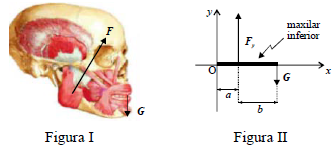
Considerando que, no instante em que a mandíbula está fechada, a componente Fy tenha módulo igual a 12 N e a área total de contato entre os dentes superiores e inferiores seja de 0,5 cm2, julgue o item.
Se o músculo que movimenta a mandíbula atuasse como uma mola, a força de mastigação seria proporcional ao tamanho do alimento.
Provas

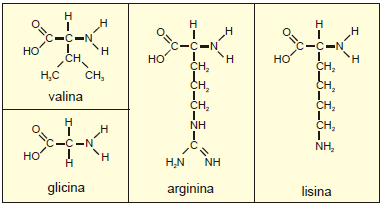
Considerando as estruturas dos aminoácidos mostradas acima, calcule, em g/mol, a massa molecular do peptídio constituído de uma glicina, uma valina, duas argininas e uma lisina. Para a marcação na folha de respostas, despreze a parte fracionária do resultado final obtido, após efetuar todos os cálculos solicitados.
(Como este item é do tipo B, não se esqueça de transcrever o resultado numérico para a folha de respostas.)
Provas
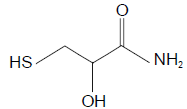
Considerando-se a constante eletrostática \( k = 9 · 10^9 N\cdot,m^2 \cdot C^{-2} \) e a carga elementar e = 1,6 × 10⁻¹⁹ C, é correto concluir que, na molécula de cisteína, o módulo do campo elétrico à distância de 0,2 nm da carga pontual do grupo amina é maior que \( 10^{10} N \cdot C^{-1}. \)
Provas
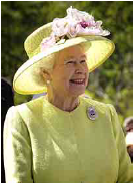 The head of state, theoretical and nominal source of executive, judicial and legislative 4 power in the UK, is the British monarch, currently Queen Elizabeth II. However, sovereignty in the UK 7 no longer rests with the monarch, since the English Bill of Rights in 1689, which established the principle 10 of Parliamentary sovereignty. Nonetheless, the monarch is still known as the sovereign.
13 The British sovereign possesses many hypothetical powers, including the right to choose any British citizen to be her Prime Minister (PM) and the right to call and dissolve 16 Parliament whenever she wishes. However, in accordance with the current uncodified constitution, the PM is the leader of the largest party in the House of Commons, and Parliament 19 is dissolved at the time suggested by the PM. The monarch retains the ability to deny giving a bill royal assent, although in modern times this becomes increasingly more unlikely, as 22 it would cause a constitutional crisis. Queen Anne was the last monarch to exercise this power, which she did on 11 March 1708 with regard to a bill “for the settling of Militia in 25 Scotland”. Other royal powers called royal prerogative, such as patronage to appoint ministers and the ability to declare war, are exercised by the PM and the Cabinet, with the formal 28 consent of the Queen.
Today the sovereign has an essentially ceremonial role restricted in exercise of power by convention and public 31 opinion. However the monarch does continue to exercise three essential rights: the right to be consulted, the right to advise and the right to warn. As a consequence of these 34 ideals, Prime Ministers hold weekly confidential meetings with the monarch in which the sovereign holds the right to express her opinions.
Internet: <en.wikipedia.org> (adapted).
According to the text, judge the following items.
When the Queen asks the British PM information about the country’s economy, she is exercising one of her essential rights mentioned in the text.
Provas
Caderno Container