Foram encontradas 45.242 questões.
- Vocabulário | Vocabulary
- Aspectos linguísticos | Linguistic aspects
- Análise sintática | Syntax Parsing
"Grammar describes how we combine, organize and change words and parts of words to make meaning.
We use rules for this description." (Spratt; Pulverness; Williams, 2005, p.5).
SPRATT, M.; PULVERNESS A.; WILLIAMS, M. The TKT – Teaching Knowledge Test Course. Cambridge University Press: Cambridge, 2005.
Based on the concept of grammar, choose the INCORRECT sentence.
SPRATT, M.; PULVERNESS A.; WILLIAMS, M. The TKT – Teaching Knowledge Test Course. Cambridge University Press: Cambridge, 2005.
Based on the concept of grammar, choose the INCORRECT sentence.
Provas
Questão presente nas seguintes provas

Interests in learning strategies began with the publication of papers collectively known as the "good language
learner" studies (Cohen; Weaver, 1998). Since then, hundreds of studies have been generated that look at
different aspects of learning strategies and their roles in language learning. In an effort to make sense of
the huge database and numerous research findings in this area, Oxford (1990, as cited in Cohen; Weaver,
1998) differentiates learning strategies into four categories: cognitive, metacognitive, affective and social
(Oxford, 2002, p.121).
Oxford. L.Language Learning Strategies in a Nutshell: Update and ESL Suggestions.In: RICHARDS, J. C. & RENANDYA. W.A. Methodology in Language Teaching: an Anthology of Current Practice. Cambridge: Cambridge University Press 2002. Chapter 11 - pages 121 -132.
Identify the learning strategies as exposed by Oxford (2002) by matching each definition to the CORRECT category.
1. Cognitive
2. Metacognitive
3. Affective
4. Social
( ) This strategy deals with the planning, monitoring, and evaluation of language learning activities. For example, students may develop a plan for monitoring their progress by constantly comparing their current level of proficiency with the course goals outlined in the curriculum.
( ) This strategy involves the identification, retention, and retrieval of language elements. For example, students may use memory-enhancing strategies (e.g., the keyword method) to help them remember new words.
( ) This strategy refers to actions learners take to interact with users of the language. For example, students may deliberately seek out opportunities to use the target language with native speakers of the language.
( ) This strategy serves to regulate emotions, attitudes, and motivation. For example, students may read linguistically simplified books to develop a positive attitude toward reading materials.
Choose the CORRECT sequence.
Oxford. L.Language Learning Strategies in a Nutshell: Update and ESL Suggestions.In: RICHARDS, J. C. & RENANDYA. W.A. Methodology in Language Teaching: an Anthology of Current Practice. Cambridge: Cambridge University Press 2002. Chapter 11 - pages 121 -132.
Identify the learning strategies as exposed by Oxford (2002) by matching each definition to the CORRECT category.
1. Cognitive
2. Metacognitive
3. Affective
4. Social
( ) This strategy deals with the planning, monitoring, and evaluation of language learning activities. For example, students may develop a plan for monitoring their progress by constantly comparing their current level of proficiency with the course goals outlined in the curriculum.
( ) This strategy involves the identification, retention, and retrieval of language elements. For example, students may use memory-enhancing strategies (e.g., the keyword method) to help them remember new words.
( ) This strategy refers to actions learners take to interact with users of the language. For example, students may deliberately seek out opportunities to use the target language with native speakers of the language.
( ) This strategy serves to regulate emotions, attitudes, and motivation. For example, students may read linguistically simplified books to develop a positive attitude toward reading materials.
Choose the CORRECT sequence.
Provas
Questão presente nas seguintes provas
"Teachers may wonder "which way they ought to go" before they enter a classroom. This usually means
that teachers need to plan what they want to do in their classrooms. So, lesson planning involves decisions
about the pedagogical dimensions of the lesson. But another important aspect of a lesson concerns the
management of learners during the lesson. This includes eliciting students´ attention, maintaining their
engagement in the lesson, and organizing them into pairs or groups." (Farrell, 2002, p.30)
FARRELL, T. S. C. Lesson Planning In: RICHARDS, J. C. & RENANDYA. W.A. Methodology in Language Teaching: an Anthology of Current Practice. Cambridge: Cambridge University Press 2002. Chapter 3 - pages 30-39.
After reading about the importance of lesson planning, match the CORRECT information to the number in the following Lesson Plan.
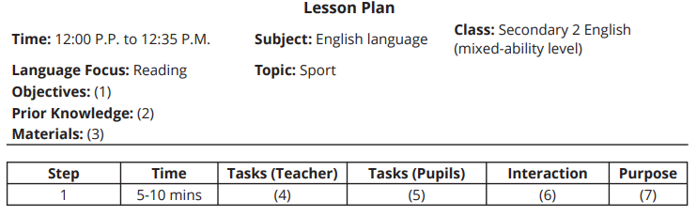
( ) 1. Reading materials - article from a book on sports 2. Television 3. Whiteboard
( ) To teach the students how to skim for main idea of the passage - identify key words.
( ) Students have learned how to locate information by reading and finding the main sentence of each paragraph.
( )
( )
( ) Arouse interest. Activate schema for sport
( )
Choose the CORRECT sequence.
FARRELL, T. S. C. Lesson Planning In: RICHARDS, J. C. & RENANDYA. W.A. Methodology in Language Teaching: an Anthology of Current Practice. Cambridge: Cambridge University Press 2002. Chapter 3 - pages 30-39.
After reading about the importance of lesson planning, match the CORRECT information to the number in the following Lesson Plan.
( ) 1. Reading materials - article from a book on sports 2. Television 3. Whiteboard
( ) To teach the students how to skim for main idea of the passage - identify key words.
( ) Students have learned how to locate information by reading and finding the main sentence of each paragraph.
( )
( )
( ) Arouse interest. Activate schema for sport
( )
Choose the CORRECT sequence.
Provas
Questão presente nas seguintes provas
Concerning the history of teaching English as a foreign language, in the 70s, teachers faced another approach to
teaching. Language was not seen as a set of sentences anymore, but as a set of communicative events.
PIAZZA, Paulo Thiago. The historical development of english as a foreign language teaching in brazilian schools: methods and legal documents. Revista Contribuciones a Las Ciencias Sociales, São José dos Pinhais, v.17, n.6, p. 01-23, 2024. Disponível em: https://ojs.revistacontribuciones.com/ojs/index.php/clcs. Acesso em: 10 mai. 2025.
Judge the items as ( T ) TRUE or ( F ) FALSE according to the Communicative Approach.
( ) Instead of organizing the syllabus based on grammar topics (simple past, simple present, if clauses, etc.), the organization is focused on developing students´ communicative competence.
( ) Classes based on Communicative Language Teaching (CLT) tend to be more teacher-centered, with a greater emphasis on teacher-student interactions and situations where the language must be used by students for communicative purposes.
( ) Errors are viewed as part of development, and most of the time are not corrected immediately. ( ) The role of the teacher in CLT is to promote situations where students need to communicate in their mother tongue.
( ) Students must be exposed to authentic materials, that is, language as it is actually used in daily routines in the real world.
Choose the CORRECT sequence.
PIAZZA, Paulo Thiago. The historical development of english as a foreign language teaching in brazilian schools: methods and legal documents. Revista Contribuciones a Las Ciencias Sociales, São José dos Pinhais, v.17, n.6, p. 01-23, 2024. Disponível em: https://ojs.revistacontribuciones.com/ojs/index.php/clcs. Acesso em: 10 mai. 2025.
Judge the items as ( T ) TRUE or ( F ) FALSE according to the Communicative Approach.
( ) Instead of organizing the syllabus based on grammar topics (simple past, simple present, if clauses, etc.), the organization is focused on developing students´ communicative competence.
( ) Classes based on Communicative Language Teaching (CLT) tend to be more teacher-centered, with a greater emphasis on teacher-student interactions and situations where the language must be used by students for communicative purposes.
( ) Errors are viewed as part of development, and most of the time are not corrected immediately. ( ) The role of the teacher in CLT is to promote situations where students need to communicate in their mother tongue.
( ) Students must be exposed to authentic materials, that is, language as it is actually used in daily routines in the real world.
Choose the CORRECT sequence.
Provas
Questão presente nas seguintes provas
"Teaching is characterized by many factors, such as teachers´ beliefs, preferences, personalities, and one of
the factors that mostly influences teaching is the method, which holds systematic procedures prescribed to
the teacher based on linguistic theory or legal documents." (Piazza, 2024, p.3)
PIAZZA, Paulo Thiago. The historical development of english as a foreign language teaching in brazilian schools: methods and legal documents. Revista Contribuciones a Las Ciencias Sociales, São José dos Pinhais, v.17, n.6, p. 01-23, 2024. Disponível em: https://ojs.revistacontribuciones.com/ojs/index.php/clcs. Acesso em: 10 mai. 2025.
According to Larsen-Freeman and Anderson (2011, p.38 apud PIAZZA, 2024, p. 5), in a class based on the GrammarTranslation method, the "fundamental purpose of learning a language is to be able to read literature written in the target language".
Choose the item that IS NOT applied to the Grammar-Translation method.
PIAZZA, Paulo Thiago. The historical development of english as a foreign language teaching in brazilian schools: methods and legal documents. Revista Contribuciones a Las Ciencias Sociales, São José dos Pinhais, v.17, n.6, p. 01-23, 2024. Disponível em: https://ojs.revistacontribuciones.com/ojs/index.php/clcs. Acesso em: 10 mai. 2025.
According to Larsen-Freeman and Anderson (2011, p.38 apud PIAZZA, 2024, p. 5), in a class based on the GrammarTranslation method, the "fundamental purpose of learning a language is to be able to read literature written in the target language".
Choose the item that IS NOT applied to the Grammar-Translation method.
Provas
Questão presente nas seguintes provas
READ THE TEXT AND ANSWER THE FOLLOWING QUESTION
Social Dimensions of Climate Change
Extreme weather events are deeply intertwined with global
patterns of inequality. The poorest and most vulnerable people
bear the brunt of climate change impacts yet contribute the least
to the crisis. As the impacts of climate change mount, millions of
vulnerable people face disproportionate challenges in terms of
loss of jobs; physical harm; disease; mental health effects; food
insecurity; access to water; migration and forced displacement;
loss of shelter, assets, and community ties, and other related risks.
Some people are more vulnerable to climate change than others.
For example, workers in sectors such as agriculture, fishing, and
tourism rely on natural resources that are particularly sensitive to
increasingly unpredictable weather and seasonal patterns.
Female-headed households, children, persons with
disabilities, Indigenous Peoples and ethnic minorities, landless
tenants, migrant workers, displaced persons, older people, and
other socially marginalized groups often have fewer financial and
other resources to cope with and recover from shocks which might
threaten their wellbeing and the wellbeing of their families. The
root causes of their vulnerability lie in a combination of their
geographical locations; their financial, socio-economic, cultural,
and social status; and their access to resources, services, and
decision-making power.
The poor are often not just among the most vulnerable to climate
change, but also disproportionately impacted by measures to
address it. These impacts can include increased costs of living, loss
of livelihoods, and limited access to resources and support
systems, which exacerbate existing inequalities and poverty
trends. In the absence of well-designed and citizen-centered
policies, efforts to tackle climate change can have unintended
consequences for the livelihoods of certain groups, including
placing a higher financial burden on poor households […].
While much progress has been made on the science and the types
of policies needed to support a transition to low carbon, climateresilient development, a challenge facing many countries is
engaging citizens who are concerned that they will be unfairly
impacted by climate policies. Citizen-centered programs play a
vital role in ensuring that resources are used efficiently. Engaging
people in shaping climate action is equally critical for achieving
lasting impact. This means ensuring transparency, access to
information, and active citizen engagement on climate risks and
green growth. Such involvement can help build public support to
reduce climate impacts, overcome behavioral and political barriers
to decarbonization, as well as foster both new ideas and a sense of
ownership over solutions.
Moreover, communities bring unique perspectives, skills, and a
wealth of knowledge to the challenge of strengthening resilience
and addressing climate change. They should be engaged as
partners in resilience-building rather than being regarded merely
as beneficiaries. Research and experience show that community
leaders can successfully set priorities, influence ownership, as well
as design and implement investment programs that are responsive
to their community’s own needs. A 2022 report by the
Intergovernmental Panel on Climate Change (IPCC) recognizes the
value of diverse forms of knowledge — such as scientific,
Indigenous, and local knowledge — in building climate resilience.
Innovations in the architecture of climate finance can connect
communities and marginalized groups to the policy, technical, and
financial assistance that they need for locally relevant and
effective development outcomes.
From: https://www.worldbank.org/en/topic/social-dimensions-of-climate-change
Provas
Questão presente nas seguintes provas
READ THE TEXT AND ANSWER THE FOLLOWING QUESTION
Social Dimensions of Climate Change
Extreme weather events are deeply intertwined with global
patterns of inequality. The poorest and most vulnerable people
bear the brunt of climate change impacts yet contribute the least
to the crisis. As the impacts of climate change mount, millions of
vulnerable people face disproportionate challenges in terms of
loss of jobs; physical harm; disease; mental health effects; food
insecurity; access to water; migration and forced displacement;
loss of shelter, assets, and community ties, and other related risks.
Some people are more vulnerable to climate change than others.
For example, workers in sectors such as agriculture, fishing, and
tourism rely on natural resources that are particularly sensitive to
increasingly unpredictable weather and seasonal patterns.
Female-headed households, children, persons with
disabilities, Indigenous Peoples and ethnic minorities, landless
tenants, migrant workers, displaced persons, older people, and
other socially marginalized groups often have fewer financial and
other resources to cope with and recover from shocks which might
threaten their wellbeing and the wellbeing of their families. The
root causes of their vulnerability lie in a combination of their
geographical locations; their financial, socio-economic, cultural,
and social status; and their access to resources, services, and
decision-making power.
The poor are often not just among the most vulnerable to climate
change, but also disproportionately impacted by measures to
address it. These impacts can include increased costs of living, loss
of livelihoods, and limited access to resources and support
systems, which exacerbate existing inequalities and poverty
trends. In the absence of well-designed and citizen-centered
policies, efforts to tackle climate change can have unintended
consequences for the livelihoods of certain groups, including
placing a higher financial burden on poor households […].
While much progress has been made on the science and the types
of policies needed to support a transition to low carbon, climateresilient development, a challenge facing many countries is
engaging citizens who are concerned that they will be unfairly
impacted by climate policies. Citizen-centered programs play a
vital role in ensuring that resources are used efficiently. Engaging
people in shaping climate action is equally critical for achieving
lasting impact. This means ensuring transparency, access to
information, and active citizen engagement on climate risks and
green growth. Such involvement can help build public support to
reduce climate impacts, overcome behavioral and political barriers
to decarbonization, as well as foster both new ideas and a sense of
ownership over solutions.
Moreover, communities bring unique perspectives, skills, and a
wealth of knowledge to the challenge of strengthening resilience
and addressing climate change. They should be engaged as
partners in resilience-building rather than being regarded merely
as beneficiaries. Research and experience show that community
leaders can successfully set priorities, influence ownership, as well
as design and implement investment programs that are responsive
to their community’s own needs. A 2022 report by the
Intergovernmental Panel on Climate Change (IPCC) recognizes the
value of diverse forms of knowledge — such as scientific,
Indigenous, and local knowledge — in building climate resilience.
Innovations in the architecture of climate finance can connect
communities and marginalized groups to the policy, technical, and
financial assistance that they need for locally relevant and
effective development outcomes.
From: https://www.worldbank.org/en/topic/social-dimensions-of-climate-change
Provas
Questão presente nas seguintes provas
- Interpretação de texto | Reading comprehension
- Gramática - Língua InglesaPalavras conectivas | Connective words
READ THE TEXT AND ANSWER THE FOLLOWING QUESTION
Social Dimensions of Climate Change
Extreme weather events are deeply intertwined with global
patterns of inequality. The poorest and most vulnerable people
bear the brunt of climate change impacts yet contribute the least
to the crisis. As the impacts of climate change mount, millions of
vulnerable people face disproportionate challenges in terms of
loss of jobs; physical harm; disease; mental health effects; food
insecurity; access to water; migration and forced displacement;
loss of shelter, assets, and community ties, and other related risks.
Some people are more vulnerable to climate change than others.
For example, workers in sectors such as agriculture, fishing, and
tourism rely on natural resources that are particularly sensitive to
increasingly unpredictable weather and seasonal patterns.
Female-headed households, children, persons with
disabilities, Indigenous Peoples and ethnic minorities, landless
tenants, migrant workers, displaced persons, older people, and
other socially marginalized groups often have fewer financial and
other resources to cope with and recover from shocks which might
threaten their wellbeing and the wellbeing of their families. The
root causes of their vulnerability lie in a combination of their
geographical locations; their financial, socio-economic, cultural,
and social status; and their access to resources, services, and
decision-making power.
The poor are often not just among the most vulnerable to climate
change, but also disproportionately impacted by measures to
address it. These impacts can include increased costs of living, loss
of livelihoods, and limited access to resources and support
systems, which exacerbate existing inequalities and poverty
trends. In the absence of well-designed and citizen-centered
policies, efforts to tackle climate change can have unintended
consequences for the livelihoods of certain groups, including
placing a higher financial burden on poor households […].
While much progress has been made on the science and the types
of policies needed to support a transition to low carbon, climateresilient development, a challenge facing many countries is
engaging citizens who are concerned that they will be unfairly
impacted by climate policies. Citizen-centered programs play a
vital role in ensuring that resources are used efficiently. Engaging
people in shaping climate action is equally critical for achieving
lasting impact. This means ensuring transparency, access to
information, and active citizen engagement on climate risks and
green growth. Such involvement can help build public support to
reduce climate impacts, overcome behavioral and political barriers
to decarbonization, as well as foster both new ideas and a sense of
ownership over solutions.
Moreover, communities bring unique perspectives, skills, and a
wealth of knowledge to the challenge of strengthening resilience
and addressing climate change. They should be engaged as
partners in resilience-building rather than being regarded merely
as beneficiaries. Research and experience show that community
leaders can successfully set priorities, influence ownership, as well
as design and implement investment programs that are responsive
to their community’s own needs. A 2022 report by the
Intergovernmental Panel on Climate Change (IPCC) recognizes the
value of diverse forms of knowledge — such as scientific,
Indigenous, and local knowledge — in building climate resilience.
Innovations in the architecture of climate finance can connect
communities and marginalized groups to the policy, technical, and
financial assistance that they need for locally relevant and
effective development outcomes.
From: https://www.worldbank.org/en/topic/social-dimensions-of-climate-change
Provas
Questão presente nas seguintes provas
READ THE TEXT AND ANSWER THE FOLLOWING QUESTION
Social Dimensions of Climate Change
Extreme weather events are deeply intertwined with global
patterns of inequality. The poorest and most vulnerable people
bear the brunt of climate change impacts yet contribute the least
to the crisis. As the impacts of climate change mount, millions of
vulnerable people face disproportionate challenges in terms of
loss of jobs; physical harm; disease; mental health effects; food
insecurity; access to water; migration and forced displacement;
loss of shelter, assets, and community ties, and other related risks.
Some people are more vulnerable to climate change than others.
For example, workers in sectors such as agriculture, fishing, and
tourism rely on natural resources that are particularly sensitive to
increasingly unpredictable weather and seasonal patterns.
Female-headed households, children, persons with
disabilities, Indigenous Peoples and ethnic minorities, landless
tenants, migrant workers, displaced persons, older people, and
other socially marginalized groups often have fewer financial and
other resources to cope with and recover from shocks which might
threaten their wellbeing and the wellbeing of their families. The
root causes of their vulnerability lie in a combination of their
geographical locations; their financial, socio-economic, cultural,
and social status; and their access to resources, services, and
decision-making power.
The poor are often not just among the most vulnerable to climate
change, but also disproportionately impacted by measures to
address it. These impacts can include increased costs of living, loss
of livelihoods, and limited access to resources and support
systems, which exacerbate existing inequalities and poverty
trends. In the absence of well-designed and citizen-centered
policies, efforts to tackle climate change can have unintended
consequences for the livelihoods of certain groups, including
placing a higher financial burden on poor households […].
While much progress has been made on the science and the types
of policies needed to support a transition to low carbon, climateresilient development, a challenge facing many countries is
engaging citizens who are concerned that they will be unfairly
impacted by climate policies. Citizen-centered programs play a
vital role in ensuring that resources are used efficiently. Engaging
people in shaping climate action is equally critical for achieving
lasting impact. This means ensuring transparency, access to
information, and active citizen engagement on climate risks and
green growth. Such involvement can help build public support to
reduce climate impacts, overcome behavioral and political barriers
to decarbonization, as well as foster both new ideas and a sense of
ownership over solutions.
Moreover, communities bring unique perspectives, skills, and a
wealth of knowledge to the challenge of strengthening resilience
and addressing climate change. They should be engaged as
partners in resilience-building rather than being regarded merely
as beneficiaries. Research and experience show that community
leaders can successfully set priorities, influence ownership, as well
as design and implement investment programs that are responsive
to their community’s own needs. A 2022 report by the
Intergovernmental Panel on Climate Change (IPCC) recognizes the
value of diverse forms of knowledge — such as scientific,
Indigenous, and local knowledge — in building climate resilience.
Innovations in the architecture of climate finance can connect
communities and marginalized groups to the policy, technical, and
financial assistance that they need for locally relevant and
effective development outcomes.
From: https://www.worldbank.org/en/topic/social-dimensions-of-climate-change
Provas
Questão presente nas seguintes provas
READ THE TEXT AND ANSWER THE FOLLOWING QUESTION
Social Dimensions of Climate Change
Extreme weather events are deeply intertwined with global
patterns of inequality. The poorest and most vulnerable people
bear the brunt of climate change impacts yet contribute the least
to the crisis. As the impacts of climate change mount, millions of
vulnerable people face disproportionate challenges in terms of
loss of jobs; physical harm; disease; mental health effects; food
insecurity; access to water; migration and forced displacement;
loss of shelter, assets, and community ties, and other related risks.
Some people are more vulnerable to climate change than others.
For example, workers in sectors such as agriculture, fishing, and
tourism rely on natural resources that are particularly sensitive to
increasingly unpredictable weather and seasonal patterns.
Female-headed households, children, persons with
disabilities, Indigenous Peoples and ethnic minorities, landless
tenants, migrant workers, displaced persons, older people, and
other socially marginalized groups often have fewer financial and
other resources to cope with and recover from shocks which might
threaten their wellbeing and the wellbeing of their families. The
root causes of their vulnerability lie in a combination of their
geographical locations; their financial, socio-economic, cultural,
and social status; and their access to resources, services, and
decision-making power.
The poor are often not just among the most vulnerable to climate
change, but also disproportionately impacted by measures to
address it. These impacts can include increased costs of living, loss
of livelihoods, and limited access to resources and support
systems, which exacerbate existing inequalities and poverty
trends. In the absence of well-designed and citizen-centered
policies, efforts to tackle climate change can have unintended
consequences for the livelihoods of certain groups, including
placing a higher financial burden on poor households […].
While much progress has been made on the science and the types
of policies needed to support a transition to low carbon, climateresilient development, a challenge facing many countries is
engaging citizens who are concerned that they will be unfairly
impacted by climate policies. Citizen-centered programs play a
vital role in ensuring that resources are used efficiently. Engaging
people in shaping climate action is equally critical for achieving
lasting impact. This means ensuring transparency, access to
information, and active citizen engagement on climate risks and
green growth. Such involvement can help build public support to
reduce climate impacts, overcome behavioral and political barriers
to decarbonization, as well as foster both new ideas and a sense of
ownership over solutions.
Moreover, communities bring unique perspectives, skills, and a
wealth of knowledge to the challenge of strengthening resilience
and addressing climate change. They should be engaged as
partners in resilience-building rather than being regarded merely
as beneficiaries. Research and experience show that community
leaders can successfully set priorities, influence ownership, as well
as design and implement investment programs that are responsive
to their community’s own needs. A 2022 report by the
Intergovernmental Panel on Climate Change (IPCC) recognizes the
value of diverse forms of knowledge — such as scientific,
Indigenous, and local knowledge — in building climate resilience.
Innovations in the architecture of climate finance can connect
communities and marginalized groups to the policy, technical, and
financial assistance that they need for locally relevant and
effective development outcomes.
From: https://www.worldbank.org/en/topic/social-dimensions-of-climate-change
( ) Harsh climate conditions exert a uniform impact across populations.
( ) Supporting citizen involvement is key to building commitment.
( ) At this stage, the challenges have been wholly addressed and handled.
The statements are, respectively:
Provas
Questão presente nas seguintes provas
Cadernos
Caderno Container