Foram encontradas 294 questões.
Com respeito aos testes de hipóteses pode-se afirmar que:
Item 2: Se !$ x_1, ..., x_n !$ é uma amostra aleatória de uma população normal com média !$ μ !$ e variância conhecida !$ σ^2 !$, para testar !$ H_0 : μ = μ_0 !$ contra !$ H_1 : μ \ne μ_0 !$ usa-se a distribuição t de Student.
Provas

Com respeito às distribuições de freqüência pode-se afirmar que:
Item 4: A diferença entre o terceiro e o primeiro quartil, chamada de intervalo interquartil, é uma medida de dispersão.
Provas
A lei dos retornos físicos marginais decrescentes diz que, quando a quantidade de um insumo variável é aumentada, dadas as quantidades dos demais insumos, um ponto é alcançado a partir do qual o produto marginal decresce. A curva abaixo representa a produtividade total.
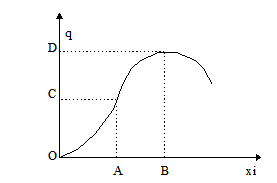
Item 2: A lei dos retornos físicos marginais decrescentes é equivalente ao conceito de retornos decrescentes de escala.
Provas
Em uma universidade, 30% dos homens e 20% das mulheres estudam matemática. Além disso, 45% dos estudantes são mulheres. Se um estudante é escolhido aleatoriamente:
Item 1: Se o estudante escolhido estuda matemática, então a probabilidade de que seja uma mulher é 0,09.
Provas
(Assinale “Falsa” ou “Verdadeira”)
De acordo com a “Teoria Geral”, de J.M.Keynes, para um dado nível de salário nominal, quando ha “desemprego involuntário”:
Item 0: Os salários reais são pro-cíclicos.
Provas
Em uma economia os balanços consolidados dos bancos comerciais e das autoridades comerciais e das autoridades monetárias apresentam os seguintes resultados:
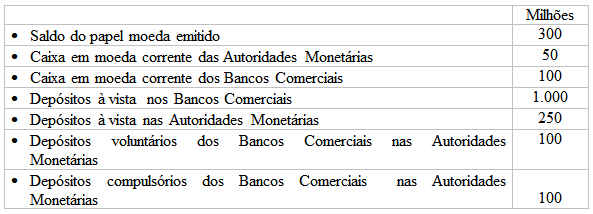
Item 1: O total dos meios de pagamentos é 1.400 milhões de cruzeiros.
Provas
THE EFFECTS OF DOMESTIC ENVIRONMENTAL POLICIES ON PATTERNS OF WORLD TRADE: AN EMPIRICAL TEST
James A. Tobey
In theory, environmental control costs encourage reduced specialization in the production of polluting outputs in countries with stringent environmental regulations (Pethig, 1976; Siebert, 1977; McGuire, 1982). In contrast, countries that fail to undertake an environmental protection program presumably increase their comparative advantage in the production of items that damage the invironment. This relationship between trade and environmental policy receives considerable attention whenever countries are in the process of passing new pollution control measures. Groups who oppose existing measures, of the implementation of stiffer measures, argue that they reduce the ability of polluting industries to compete internationally. With foreign trade an increasingly important sector in many of the world’s economies, the arguments of such groups are now frequently weighted very heavily.
The premise that trade suffers from the imposition of environmental policy has a strong element of a priori plausibility but, surprisingly, has little empirical support. Several macroeconometric models (D’Arge, 1974; Robison, 1986; OECD, 1985) have predicted that pollution control measures should lead to a small but discernible effect on the balance of trade, but there are few studies to confirm this prediction.
The location-of-industry studies (Leonard, 1988; Pearson, 1987, 1985; Walter, 1985) have explored the related ideas that stringent pollution control measures push industries out of the U.S. (the ‘industrial-flight’ hypothesis), and that less-developed countries compete to attract multinational industries by minimizing their own environmental policies (the ‘pollution-haven’ hypothesis). Their investigations, however, have been unable to find evidence in support of either hypothesis.
The present paper complement the results of the less rigorous location of industy studies by providing an empirical test of the hypothesis that stringent environmental policy has caused trade patterns to deviate in commodities produced by the world’s ‘dirty’ industries.
Extraído de: TOBEY, James A. The effects of domestic environmental policies on patterns of world trade: an empirical test. Kiklos; international review for social science, Basel, v.43, n.2, p.191-209.
As used in the second paragraph:
Item 4: “balance of trade” means “balança comercial”.
Provas
Sejam X e Y variáveis aleatórias independentes tais que: E(X) = 3, E(Y) = 2, E(X2) = 10 e E(Y2) = 7. Pode-se afirmar que:
Item 3: O coeficiente de correlação entre X e Y é igual a 1/9.
Provas
Com respeito às distribuições teóricas de probabilidade pode-se afirmar que:
Item 3: A distribuição geométrica corresponde ao número de vezes que se deve replicar experimentos de Bernoulli, supostos independentes, até que ocorra pela primeira vez um sucesso.
Provas
Considere uma economia do tipo IS-LM. Suponha que há déficit público no país. Pode-se afirmar que:
Item 1: O financiamento do déficit público pela expansão da dívida externa, em qualquer situação, é viável, desde que o governo aceite pagar juros reais mais elevados sobre seus títulos.
Provas
Caderno Container