Foram encontradas 294 questões.
A capacidade de produção instalada (Y), em toneladas, de uma firma, pode ser função da potência instalada (X), em 1000kW, ou da área construída (Z) em 100m2 .
Dados:
!$ \sum X = 38 !$, !$ \sum Y = 80 !$, !$ \sum Z = 100 !$, !$ \sum X^2 = 182 !$
!$ \sum y^2 = 736 !$, !$ \sum z^2 = 1048 !$, !$ \sum XY = 361 !$, !$ \sum YZ = 848 !$
Sendo n = 10, pode-se afirmar que:
Item 2: Ao fazer uma regressão da capacidade de produção instalada em função da área construída (X = !$ \alpha !$ + !$ \beta !$Z) obtém-se como estimativas de !$ \alpha !$ e !$ \beta !$, -2,00 e 1,00, respectivamente.
Provas

Classifique, como V ou F, as afirmativas abaixo:
Item 2: A transferência líquida de recursos para o exterior pode ser calculada pela diferença entre o saldo em transações correntes e o pagamento de amortizações.
Provas
Sejam X e Y variáveis aleatórias contínuas com função densidade de probabilidade (f.d.p.) conjunta f(x,y). Então podemos afirmar que:
Item 0: g(x) = !$ \int\limits_{-\infty}^{+\infty} !$ f(x,y)dy é sempre uma f.d.p. marginal de X.
Provas
THE EFFECTS OF DOMESTIC ENVIRONMENTAL POLICIES ON PATTERNS OF WORLD TRADE: AN EMPIRICAL TEST
James A. Tobey
In theory, environmental control costs encourage reduced specialization in the production of polluting outputs in countries with stringent environmental regulations (Pethig, 1976; Siebert, 1977; McGuire, 1982). In contrast, countries that fail to undertake an environmental protection program presumably increase their comparative advantage in the production of items that damage the invironment. This relationship between trade and environmental policy receives considerable attention whenever countries are in the process of passing new pollution control measures. Groups who oppose existing measures, of the implementation of stiffer measures, argue that they reduce the ability of polluting industries to compete internationally. With foreign trade an increasingly important sector in many of the world’s economies, the arguments of such groups are now frequently weighted very heavily.
The premise that trade suffers from the imposition of environmental policy has a strong element of a priori plausibility but, surprisingly, has little empirical support. Several macroeconometric models (D’Arge, 1974; Robison, 1986; OECD, 1985) have predicted that pollution control measures should lead to a small but discernible effect on the balance of trade, but there are few studies to confirm this prediction.
The location-of-industry studies (Leonard, 1988; Pearson, 1987, 1985; Walter, 1985) have explored the related ideas that stringent pollution control measures push industries out of the U.S. (the ‘industrial-flight’ hypothesis), and that less-developed countries compete to attract multinational industries by minimizing their own environmental policies (the ‘pollution-haven’ hypothesis). Their investigations, however, have been unable to find evidence in support of either hypothesis.
The present paper complement the results of the less rigorous location of industy studies by providing an empirical test of the hypothesis that stringent environmental policy has caused trade patterns to deviate in commodities produced by the world’s ‘dirty’ industries.
Extraído de: TOBEY, James A. The effects of domestic environmental policies on patterns of world trade: an empirical test. Kiklos; international review for social science, Basel, v.43, n.2, p.191-209.
As one may conclude by reading the text above:
Item 3: some authors still admit undesirable competitive effects of environmental policy on the trade pattern of polluting industries.
Provas
THE EFFECTS OF DOMESTIC ENVIRONMENTAL POLICIES ON PATTERNS OF WORLD TRADE: AN EMPIRICAL TEST
James A. Tobey
In theory, environmental control costs encourage reduced specialization in the production of polluting outputs in countries with stringent environmental regulations (Pethig, 1976; Siebert, 1977; McGuire, 1982). In contrast, countries that fail to undertake an environmental protection program presumably increase their comparative advantage in the production of items that damage the invironment. This relationship between trade and environmental policy receives considerable attention whenever countries are in the process of passing new pollution control measures. Groups who oppose existing measures, of the implementation of stiffer measures, argue that they reduce the ability of polluting industries to compete internationally. With foreign trade an increasingly important sector in many of the world’s economies, the arguments of such groups are now frequently weighted very heavily.
The premise that trade suffers from the imposition of environmental policy has a strong element of a priori plausibility but, surprisingly, has little empirical support. Several macroeconometric models (D’Arge, 1974; Robison, 1986; OECD, 1985) have predicted that pollution control measures should lead to a small but discernible effect on the balance of trade, but there are few studies to confirm this prediction.
The location-of-industry studies (Leonard, 1988; Pearson, 1987, 1985; Walter, 1985) have explored the related ideas that stringent pollution control measures push industries out of the U.S. (the ‘industrial-flight’ hypothesis), and that less-developed countries compete to attract multinational industries by minimizing their own environmental policies (the ‘pollution-haven’ hypothesis). Their investigations, however, have been unable to find evidence in support of either hypothesis.
The present paper complement the results of the less rigorous location of industy studies by providing an empirical test of the hypothesis that stringent environmental policy has caused trade patterns to deviate in commodities produced by the world’s ‘dirty’ industries.
Extraído de: TOBEY, James A. The effects of domestic environmental policies on patterns of world trade: an empirical test. Kiklos; international review for social science, Basel, v.43, n.2, p.191-209.
As found in the third and fourth paragraphs:
Item 1: the author confirms that less-developed countries have become the polluting industries’ paradise.
Provas
THE EFFECTS OF DOMESTIC ENVIRONMENTAL POLICIES ON PATTERNS OF WORLD TRADE: AN EMPIRICAL TEST
James A. Tobey
In theory, environmental control costs encourage reduced specialization in the production of polluting outputs in countries with stringent environmental regulations (Pethig, 1976; Siebert, 1977; McGuire, 1982). In contrast, countries that fail to undertake an environmental protection program presumably increase their comparative advantage in the production of items that damage the invironment. This relationship between trade and environmental policy receives considerable attention whenever countries are in the process of passing new pollution control measures. Groups who oppose existing measures, of the implementation of stiffer measures, argue that they reduce the ability of polluting industries to compete internationally. With foreign trade an increasingly important sector in many of the world’s economies, the arguments of such groups are now frequently weighted very heavily.
The premise that trade suffers from the imposition of environmental policy has a strong element of a priori plausibility but, surprisingly, has little empirical support. Several macroeconometric models (D’Arge, 1974; Robison, 1986; OECD, 1985) have predicted that pollution control measures should lead to a small but discernible effect on the balance of trade, but there are few studies to confirm this prediction.
The location-of-industry studies (Leonard, 1988; Pearson, 1987, 1985; Walter, 1985) have explored the related ideas that stringent pollution control measures push industries out of the U.S. (the ‘industrial-flight’ hypothesis), and that less-developed countries compete to attract multinational industries by minimizing their own environmental policies (the ‘pollution-haven’ hypothesis). Their investigations, however, have been unable to find evidence in support of either hypothesis.
The present paper complement the results of the less rigorous location of industy studies by providing an empirical test of the hypothesis that stringent environmental policy has caused trade patterns to deviate in commodities produced by the world’s ‘dirty’ industries.
Extraído de: TOBEY, James A. The effects of domestic environmental policies on patterns of world trade: an empirical test. Kiklos; international review for social science, Basel, v.43, n.2, p.191-209.
Still in the first paragraph:
Item 1: “passing new pollution control measures” can be understood as “medições dos controles de poluição aprovados”.
Provas
Tendo em vista o Balancete consolidado do Sistema Monetário, classifique V ou F as afirmativas abaixo:
Item 1: Uma variação na base monetária ou nos meios de pagamento deve apresentar como contrapartida uma variação das operações ativas ou do passivo não monetário das Autoridades Monetárias (no caso dos Meios de Pagamento) ou do sistema bancário como um todo (no caso de base).
Provas
O gráfico abaixo mostra uma curva de custo total de curto prazo.
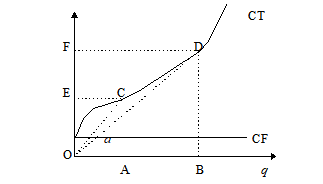
Item 1: O custo total médio atinge seu valor mínimo para a produção OB.
Provas
THE EFFECTS OF DOMESTIC ENVIRONMENTAL POLICIES ON PATTERNS OF WORLD TRADE: AN EMPIRICAL TEST
James A. Tobey
In theory, environmental control costs encourage reduced specialization in the production of polluting outputs in countries with stringent environmental regulations (Pethig, 1976; Siebert, 1977; McGuire, 1982). In contrast, countries that fail to undertake an environmental protection program presumably increase their comparative advantage in the production of items that damage the invironment. This relationship between trade and environmental policy receives considerable attention whenever countries are in the process of passing new pollution control measures. Groups who oppose existing measures, of the implementation of stiffer measures, argue that they reduce the ability of polluting industries to compete internationally. With foreign trade an increasingly important sector in many of the world’s economies, the arguments of such groups are now frequently weighted very heavily.
The premise that trade suffers from the imposition of environmental policy has a strong element of a priori plausibility but, surprisingly, has little empirical support. Several macroeconometric models (D’Arge, 1974; Robison, 1986; OECD, 1985) have predicted that pollution control measures should lead to a small but discernible effect on the balance of trade, but there are few studies to confirm this prediction.
The location-of-industry studies (Leonard, 1988; Pearson, 1987, 1985; Walter, 1985) have explored the related ideas that stringent pollution control measures push industries out of the U.S. (the ‘industrial-flight’ hypothesis), and that less-developed countries compete to attract multinational industries by minimizing their own environmental policies (the ‘pollution-haven’ hypothesis). Their investigations, however, have been unable to find evidence in support of either hypothesis.
The present paper complement the results of the less rigorous location of industy studies by providing an empirical test of the hypothesis that stringent environmental policy has caused trade patterns to deviate in commodities produced by the world’s ‘dirty’ industries.
Extraído de: TOBEY, James A. The effects of domestic environmental policies on patterns of world trade: an empirical test. Kiklos; international review for social science, Basel, v.43, n.2, p.191-209.
As put in the third paragraph:
Item 3: the ‘industrial-flight’ hypothesis and ‘pollution-haven’ hypothesis have proved to be correct.
Provas
Com respeito às distribuições de freqüência pode-se afirmar que:
Item 0: É sempre verdade que a média está localizada entre a mediana e a moda.
Provas
Caderno Container