Foram encontradas 200 questões.
Sobre a função pedagógica do Assistente Social, analise os itens abaixo:
I. Um pressuposto básico é que as distintas perspectivas societárias colocadas pelas classes sociais imprimem orientações diferenciadas quanto à organização/reorganização da cultura.
II. Até a primeira metade deste século, a função pedagógica fundava-se numa visão socialista da questão social na Europa e nos Estados Unidos.
III. A função pedagógica desenvolvida pelos Assistentes Sociais, no contexto do processo de ajuda, se sobrepõe às funções da administração da mesma ajuda.
Está CORRETO o que se afirma em
Provas
Questão presente nas seguintes provas

- Read the text below and answer the questions.
The Five Generations of Computers
Each generation of computer is characterized by a major technological development that fundamentally changed the way computers operate, resulting in increasingly smaller, cheaper, more powerful and more efficient and reliable devices.
The history of computer development is often referred to in reference to the different generations of computing devices. Each generation of computer is characterized by a major technological development that fundamentally changed the way computers operate, resulting in increasingly smaller, cheaper, more powerful and more efficient and reliable devices. Read about each generation and the developments that led to the current devices that we use today.
First Generation (1940-1956) Vacuum Tubes
The first computers used vacuum tubes for circuitry and magnetic drums for memory, and were often enormous, taking up entire rooms. They were very expensive to operate and in addition to using a great deal of electricity, generated a lot of heat, which was often the cause of malfunctions.
First generation computers relied on machine language, the lowest-level programming language understood by computers, to perform operations, and they could only solve one problem at a time. Input was based on punched cards and paper tape, and output was displayed on printouts.
The UNIVAC and ENIAC computers are examples of first-generation computing devices. The UNIVAC was the first commercial computer delivered to a business client, the U.S. Census Bureau in 1951.
Second Generation (1956-1963) Transistors
Transistors replaced vacuum tubes and ushered in the second generation of computers. The transistor was invented in 1947 but did not see widespread use in computers until the late 1950s. The transistor was far superior to the vacuum tube, allowing computers to become smaller, faster, cheaper, more energy-efficient and more reliable than their firstgeneration predecessors. Though the transistor still generated a great deal of heat that subjected the computer to damage, it was a vast improvement over the vacuum tube. Second-generation computers still relied on punched cards for input and printouts for output.
Second-generation computers moved from cryptic binary machine language to symbolic, or assembly, languages, which allowed programmers to specify instructions in words. High-level programming languages were also being developed at this time, such as early versions of COBOL and FORTRAN. These were also the first computers that stored their instructions in their memory, which moved from a magnetic drum to magnetic core technology.The first computers of this generation were developed for the atomic energy industry.
Third Generation (1964-1971) Integrated Circuits
The development of the integrated circuit was the hallmark of the third generation of computers. Transistors were miniaturized and placed on silicon chips, called semiconductors, which drastically increased the speed and efficiency of computers.
Instead of punched cards and printouts, users interacted with third generation computers through keyboards and monitors and interfaced with an operating system, which allowed the device to run many different applications at one time with a central program that monitored the memory. Computers for the first time became accessible to a mass audience because they were smaller and cheaper than their predecessors.
Fourth Generation (1971-Present) Microprocessors
The microprocessor brought the fourth generation of computers, as thousands of integrated circuits were built onto a single silicon chip. What in the first generation filled an entire room could now fit in the palm of the hand. The Intel 4004 chip, developed in 1971, located all the components of the computer—from the central processing unit and memory to input/output controls—on a single chip.
In 1981 IBM introduced its first computer for the home user, and in 1984 Apple introduced the Macintosh. Microprocessors also moved out of the realm of desktop computers and into many areas of life as more and more everyday products began to use microprocessors.
As these small computers became more powerful, they could be linked together to form networks, which eventually led to the development of the Internet. Fourth generation computers also saw the development of GUIs, the mouse and handheld devices.
Fifth Generation (Present and Beyond) Artificial Intelligence
Fifth generation computing devices, based on artificial intelligence, are still in development, though there are some applications, such as voice recognition, that are being used today. The use of parallel processing and superconductors is helping to make artificial intelligence a reality. Quantum computation and molecular and nanotechnology will radically change the face of computers in years to come. The goal of fifth-generation computing is to develop devices that respond to natural language input and are capable of learning and self-organization.
http://www.webopedia.com/DidYouKnow/Hardware_Software/2002/FiveGenerations.asp (consultado em 11/04/12)
In the context of computer, what does Artificial Intelligence mean?
Provas
Questão presente nas seguintes provas
Dada a tabela abaixo,
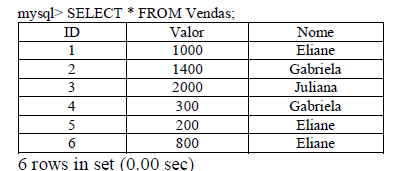
selecione a opção que apresenta a resposta CORRETA para a seguinte consulta SQL:
SELECT Nome, SUM(Valor) FROM Vendas
GROUP BY Nome HAVING AVG(Valor) < 1000;
GROUP BY Nome HAVING AVG(Valor) < 1000;
Provas
Questão presente nas seguintes provas
O debate sobre os direitos sempre esteve presente nas agendas de discussões da categoria profissional tanto que, em 2004, o XI Congresso Brasileiro de Assistentes Sociais teve como tema “O Serviço Social e a Esfera Pública no Brasil: O Desafio de Construir e Afirmar Direitos”. A vinculação do Serviço Social brasileiro ao universo dos direitos é
Provas
Questão presente nas seguintes provas
Sobre a metodologia qualitativa, é INCORRETO afirmar que
Provas
Questão presente nas seguintes provas
Dentre os tipos de medidas de dados geográficos, NÃO podemos citar a escala
Provas
Questão presente nas seguintes provas
1080723
Ano: 2012
Disciplina: TI - Desenvolvimento de Sistemas
Banca: UPENET/IAUPE
Orgão: EMPREL
Disciplina: TI - Desenvolvimento de Sistemas
Banca: UPENET/IAUPE
Orgão: EMPREL
Provas:
Sobre Requisitos Não Funcionais (RNF), analise as assertivas abaixo:
I. Os RNF desempenham um papel crítico durante o desenvolvimento de sistemas, e erros devido à não elicitação ou à elicitação incorreta destes estão entre os mais caros e difíceis de corrigir, uma vez que um sistema tenha sido implementado.
II. A não observância de RNFs pode resultar em: softwares com inconsistência e de baixa qualidade; clientes e desenvolvedores insatisfeitos; tempo e custo de desenvolvimento além dos previstos devido à necessidade de se consertarem softwares que não foram desenvolvidos sob a ótica da utilização de RNFs.
III. RNFs frequentemente interagem entre si, uma vez que a tentativa de satisfazer um RNF pode prejudicar ou ajudar a satisfazer outros RNFs.
IV. RNFs são geralmente subjetivos, uma vez que podem ser vistos, interpretados e conceituados de forma diferente por diferentes pessoas.
Assinale a alternativa que aponta a quantidade de assertiva(s) CORRETA(S).
Provas
Questão presente nas seguintes provas
- Read the text below and answer the questions.
The Five Generations of Computers
Each generation of computer is characterized by a major technological development that fundamentally changed the way computers operate, resulting in increasingly smaller, cheaper, more powerful and more efficient and reliable devices.
The history of computer development is often referred to in reference to the different generations of computing devices. Each generation of computer is characterized by a major technological development that fundamentally changed the way computers operate, resulting in increasingly smaller, cheaper, more powerful and more efficient and reliable devices. Read about each generation and the developments that led to the current devices that we use today.
First Generation (1940-1956) Vacuum Tubes
The first computers used vacuum tubes for circuitry and magnetic drums for memory, and were often enormous, taking up entire rooms. They were very expensive to operate and in addition to using a great deal of electricity, generated a lot of heat, which was often the cause of malfunctions.
First generation computers relied on machine language, the lowest-level programming language understood by computers, to perform operations, and they could only solve one problem at a time. Input was based on punched cards and paper tape, and output was displayed on printouts.
The UNIVAC and ENIAC computers are examples of first-generation computing devices. The UNIVAC was the first commercial computer delivered to a business client, the U.S. Census Bureau in 1951.
Second Generation (1956-1963) Transistors
Transistors replaced vacuum tubes and ushered in the second generation of computers. The transistor was invented in 1947 but did not see widespread use in computers until the late 1950s. The transistor was far superior to the vacuum tube, allowing computers to become smaller, faster, cheaper, more energy-efficient and more reliable than their firstgeneration predecessors. Though the transistor still generated a great deal of heat that subjected the computer to damage, it was a vast improvement over the vacuum tube. Second-generation computers still relied on punched cards for input and printouts for output.
Second-generation computers moved from cryptic binary machine language to symbolic, or assembly, languages, which allowed programmers to specify instructions in words. High-level programming languages were also being developed at this time, such as early versions of COBOL and FORTRAN. These were also the first computers that stored their instructions in their memory, which moved from a magnetic drum to magnetic core technology.The first computers of this generation were developed for the atomic energy industry.
Third Generation (1964-1971) Integrated Circuits
The development of the integrated circuit was the hallmark of the third generation of computers. Transistors were miniaturized and placed on silicon chips, called semiconductors, which drastically increased the speed and efficiency of computers.
Instead of punched cards and printouts, users interacted with third generation computers through keyboards and monitors and interfaced with an operating system, which allowed the device to run many different applications at one time with a central program that monitored the memory. Computers for the first time became accessible to a mass audience because they were smaller and cheaper than their predecessors.
Fourth Generation (1971-Present) Microprocessors
The microprocessor brought the fourth generation of computers, as thousands of integrated circuits were built onto a single silicon chip. What in the first generation filled an entire room could now fit in the palm of the hand. The Intel 4004 chip, developed in 1971, located all the components of the computer—from the central processing unit and memory to input/output controls—on a single chip.
In 1981 IBM introduced its first computer for the home user, and in 1984 Apple introduced the Macintosh. Microprocessors also moved out of the realm of desktop computers and into many areas of life as more and more everyday products began to use microprocessors.
As these small computers became more powerful, they could be linked together to form networks, which eventually led to the development of the Internet. Fourth generation computers also saw the development of GUIs, the mouse and handheld devices.
Fifth Generation (Present and Beyond) Artificial Intelligence
Fifth generation computing devices, based on artificial intelligence, are still in development, though there are some applications, such as voice recognition, that are being used today. The use of parallel processing and superconductors is helping to make artificial intelligence a reality. Quantum computation and molecular and nanotechnology will radically change the face of computers in years to come. The goal of fifth-generation computing is to develop devices that respond to natural language input and are capable of learning and self-organization.
http://www.webopedia.com/DidYouKnow/Hardware_Software/2002/FiveGenerations.asp (consultado em 11/04/12)
Old vacuum tubes and ushered were substituted by
Provas
Questão presente nas seguintes provas
Sobre os conceitos relacionados à Internet e Intranet, analise os itens abaixo:
i. A Internet é uma rede pública, formada por um conjunto de computadores interligados. O acesso à Internet pode
ser realizado a partir de um meio de comunicação, tais como linha telefônica, rádio, cabo, satélite e fibra óptica.
ser realizado a partir de um meio de comunicação, tais como linha telefônica, rádio, cabo, satélite e fibra óptica.
ii. A Intranet é uma rede privada, localizada em uma empresa, formada de uma ou mais redes locais interligadas e
não pode ser acessada remotamente, a partir de um computador localizado fora da empresa.
não pode ser acessada remotamente, a partir de um computador localizado fora da empresa.
iii. É comum interligar a Intranet à Internet; esta ligação traz vantagens indiscutíveis, aumenta a segurança da Intranet.
Assinale a alternativa CORRETA.
Provas
Questão presente nas seguintes provas
Atualmente, a Internet vive um momento de transição do IPv4 para o IPv6 devido à escassez de endereços na primeira versão do protocolo. O ICMPv6 (Internet Control Message Protocol version 6) evoluiu do ICMPv4. Sobre as mensagens do ICMPv4, NÃO podemos afirmar que
Provas
Questão presente nas seguintes provas
Cadernos
Caderno Container