Foram encontradas 50 questões.
Seja X uma variável aleatória discreta com função de probabilidade:
P(X = −0,1) = 0,5 ; P(X = 0) = 0,3 , P(X = 0,1) = 0,1 e P(X = 0,3) = 0,1
A função de probabilidade de Y = X2 + 0,16 é:
Provas

A figura abaixo apresenta um trecho de uma planilha do Microsoft Excel 2007 com dados fictícios.
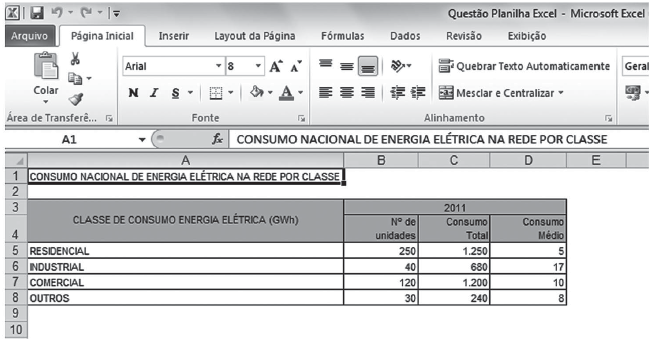
As três fórmulas
=CONCATENAR(A5;” / “;A8)
=SOMA(D5;D8)
=CONT.NÚM(B4:C8)
fornecem como resultado, respectivamente,
Provas
A correta determinação do volume de fluido em uma acumulação de petróleo, e, especificamente, a quantidade que dela pode ser extraída, desempenha um papel fundamental na decisão de se implantar ou não um projeto. Tais estimativas são feitas não só por ocasião da descoberta da acumulação, mas também no decorrer de sua vida produtiva.
Associe os diferentes termos utilizados na Estimativa de Reserva aos seus respectivos significados.
| I - Reserva | P - Quociente entre o volume recuperável e o volume original. |
| II - Fator de recuperação | Q - Volume de óleo ou gás que pode ser obtido de um reservatório de petróleo, em um momento qualquer de sua vida produtiva. |
| III - Fração recuperada | R - Quantidade de óleo ou de gás que se espera produzir de uma acumulação de petróleo. |
| IV - Volume recuperável | S - Quantidade de fluido de um reservatório, desde quando foi produzida até uma determinada época. |
| T - Percentual do fluido original que foi produzido até um determinado instante. |
As associações corretas são
Provas
- Fundamentos de ProgramaçãoAlgoritmosConstrução de Algoritmos
- Fundamentos de ProgramaçãoEstruturas de Repetição
- Fundamentos de ProgramaçãoLógica de Programação
- Fundamentos de ProgramaçãoPseudocódigo
O algoritmo que escreve a sequência 1, 1, 2, 3, 5, 8, 13 é
Provas
No modelo da tectônica global (tectônica de placas), as regiões de bordos de placa são extremamente dinâmicas, pois, nessas áreas, ocorrem processos e feições geológicas característicos.
Associe corretamente os diferentes tipos de limites de placa aos respectivos processos e feições geológicas.
| I - Limite Convergente | P - É marcado por amplas áreas cratônicas, que apresentam uma grande estabilidade sísmica e tectônica. |
| II - Limite Transformante | Q - Associa-se a atividade vulcânica e terremotos nas cristas dos dorsais meso-oceânicas |
| III - Limite Divergente | R - As placas deslizam uma em relação à outra, a litosfera não é criada nem destruída, sendo reconhecido por formas lineares de relevo e atividades de terremoto. |
| S - Associa-se a fossas de mar profundo, cinturões de montanha, vulcões e terremotos. |
As associações corretas são:
Provas
Para se avaliar o custo de produção de uma empresa, utilizou-se um modelo de regressão linear simples:
Yi = β0 + β1Xi + εi ,
sendo
Yi o custo diário de produção (em unidades monetárias)
Xi a quantidade diária produzida (em dezenas).
Uma amostra aleatória de tamanho 50 foi selecionada, e o modelo obtido foi: !$ \hat {Y} = 1,9 + 2,5 X_i !$
Se for adicionada uma constante igual a 0,5 unidade monetária a cada valor de Yi, o coeficiente de inclinação linear do modelo será:
Provas
Has Higgs been really discovered?
by Scientific American
Top physicists have recently reached a frenzy over the announcement that the Large Hadron Collider in Geneva is planning to release what is widely expected to be tantalizing - although no conclusive - evidence for the existence of the Higgs boson, the elementary particle hypothesized to be the origin of the mass of all matter.
Many physicists have already swung into action, swapping rumors about the contents of the announcement and proposing grand ideas about what those rumors would mean, if true. “It’s impossible to be excited enough,” says Gordon Kane, a theoretical physicist at the University of Michigan at Ann Arbor.
The spokespeople of the collaborations using the cathedral-size ATLAS and CMS detectors(a) to search for the Higgs boson and other phenomena(b) at the 27-kilometer-circumference proton accelerator of the Large Hadron Collider (LHC) are scheduled to present updates based on analyses of the data collected to date(c). “There won’t be a discovery announcement, but it does promise to be interesting(d), since there are rumors that scientists have seen hints of the elusive Higgs boson(e)” says James Gillies, spokesperson for CERN (European Organization for Nuclear Research), which hosts the LHC.
Joe Lykken, a theoretical physicist at Fermi National Accelerator Laboratory in Batavia, Ill, and a member of the CMS collaboration, says: “Whatever happens eventually with the Higgs, I think we’ll look back on this meeting and say. ‘This was the beginning of something.’” (As a CMS member, Lykken says he is not yet sure himself what results ATLAS would unveil; he is bound by his collaboration’s rules not to reveal what CMS has in hand.)
Available at: <http://news.cnet.com/8301-11386_3-57341543-76/has-higgs-been-discovered-rumors--of-watershed-news-build/?tag=mncol;topStories>. Retrieved on: 11 Dec. 2011. Adapted.
In Text, Joe Lykken states thatProvas
Has Higgs been really discovered?
by Scientific American
Top physicists have recently reached a frenzy over the announcement that the Large Hadron Collider in Geneva is planning to release what is widely expected to be tantalizing - although no conclusive - evidence for the existence of the Higgs boson, the elementary particle hypothesized to be the origin of the mass of all matter.
Many physicists have already swung into action, swapping rumors about the contents of the announcement and proposing grand ideas about what those rumors would mean, if true. “It’s impossible to be excited enough,” says Gordon Kane, a theoretical physicist at the University of Michigan at Ann Arbor.
The spokespeople of the collaborations using the cathedral-size ATLAS and CMS detectors(a) to search for the Higgs boson and other phenomena(b) at the 27-kilometer-circumference proton accelerator of the Large Hadron Collider (LHC) are scheduled to present updates based on analyses of the data collected to date(c). “There won’t be a discovery announcement, but it does promise to be interesting(d), since there are rumors that scientists have seen hints of the elusive Higgs boson(e)” says James Gillies, spokesperson for CERN (European Organization for Nuclear Research), which hosts the LHC.
Joe Lykken, a theoretical physicist at Fermi National Accelerator Laboratory in Batavia, Ill, and a member of the CMS collaboration, says: “Whatever happens eventually with the Higgs, I think we’ll look back on this meeting and say. ‘This was the beginning of something.’” (As a CMS member, Lykken says he is not yet sure himself what results ATLAS would unveil; he is bound by his collaboration’s rules not to reveal what CMS has in hand.)
Available at: <http://news.cnet.com/8301-11386_3-57341543-76/has-higgs-been-discovered-rumors--of-watershed-news-build/?tag=mncol;topStories>. Retrieved on: 11 Dec. 2011. Adapted.
The following fragment of Text is NOT completed correctly in
Provas
Has Higgs been really discovered?
by Scientific American
Top physicists have recently reached a frenzy over the announcement that the Large Hadron Collider in Geneva is planning to release what is widely expected to be tantalizing - although no conclusive - evidence for the existence of the Higgs boson, the elementary particle hypothesized to be the origin of the mass of all matter.
Many physicists have already swung into action, swapping rumors about the contents of the announcement and proposing grand ideas about what those rumors would mean, if true. “It’s impossible to be excited enough,” says Gordon Kane, a theoretical physicist at the University of Michigan at Ann Arbor.
The spokespeople of the collaborations using the cathedral-size ATLAS and CMS detectors to search for the Higgs boson and other phenomena at the 27-kilometer-circumference proton accelerator of the Large Hadron Collider (LHC) are scheduled to present updates based on analyses of the data collected to date. “There won’t be a discovery announcement, but it does promise to be interesting, since there are rumors that scientists have seen hints of the elusive Higgs boson” says James Gillies, spokesperson for CERN (European Organization for Nuclear Research), which hosts the LHC.
Joe Lykken, a theoretical physicist at Fermi National Accelerator Laboratory in Batavia, Ill, and a member of the CMS collaboration, says: “Whatever happens eventually with the Higgs, I think we’ll look back on this meeting and say. ‘This was the beginning of something.’” (As a CMS member, Lykken says he is not yet sure himself what results ATLAS would unveil; he is bound by his collaboration’s rules not to reveal what CMS has in hand.)
Available at: <http://news.cnet.com/8301-11386_3-57341543-76/has-higgs-been-discovered-rumors--of-watershed-news-build/?tag=mncol;topStories>. Retrieved on: 11 Dec. 2011. Adapted.
The excerpt “Many physicists have already swung into action” could be properly completed in
Provas
Has Higgs been really discovered?
by Scientific American
Top physicists have recently reached a frenzy over the announcement that the Large Hadron Collider in Geneva is planning to release what is widely expected to be tantalizing - although no conclusive - evidence for the existence of the Higgs boson, the elementary particle hypothesized to be the origin of the mass of all matter.
Many physicists have already swung into action, swapping rumors about the contents of the announcement and proposing grand ideas about what those rumors would mean, if true. “It’s impossible to be excited enough,” says Gordon Kane, a theoretical physicist at the University of Michigan at Ann Arbor.
The spokespeople of the collaborations using the cathedral-size ATLAS and CMS detectors to search for the Higgs boson and other phenomena at the 27-kilometer-circumference proton accelerator of the Large Hadron Collider (LHC) are scheduled to present updates based on analyses of the data collected to date. “There won’t be a discovery announcement, but it does promise to be interesting, since there are rumors that scientists have seen hints of the elusive Higgs boson” says James Gillies, spokesperson for CERN (European Organization for Nuclear Research), which hosts the LHC.
Joe Lykken, a theoretical physicist at Fermi National Accelerator Laboratory in Batavia, Ill, and a member of the CMS collaboration, says: “Whatever happens eventually with the Higgs, I think we’ll look back on this meeting and say. ‘This was the beginning of something.’” (As a CMS member, Lykken says he is not yet sure himself what results ATLAS would unveil; he is bound by his collaboration’s rules not to reveal what CMS has in hand.)
Available at: <http://news.cnet.com/8301-11386_3-57341543-76/has-higgs-been-discovered-rumors--of-watershed-news-build/?tag=mncol;topStories>. Retrieved on: 11 Dec. 2011. Adapted.
Text reports that
Provas
Caderno Container