Foram encontradas 50 questões.
As perturbações que resultam em flutuações dinâmicas de estado, podendo essas serem denominadas genericamente de transitório, em um sistema elétrico de potência, podem ser agrupadas em função da velocidade em que ocorrem.
Nesse sentido, pode ser classificado como um transitório meio-rápido a ocorrência de um(a)
Provas

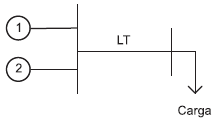
A figura acima apresenta um sistema elétrico de potência hipotético, que é composto por duas unidades geradoras, denominadas 1 e 2, que alimentam uma carga, através de uma linha de transmissão LT.
Considere que os custos de produção de energia para as unidades 1 e 2 valem, respectivamente:
- CG1 = 100 + 2PG1 + 0,02PG1 2, onde PG1 é a potência gerada por 1 em MW
- CG2 = 75 + PG2 + 0,03PG2 2, onde PG2 é a potência gerada por 2 em MW
O sistema é responsável por suprir uma carga de 300 MW, e, nessas condições de operação, a perda no sistema é 50 MW.
Sabendo-se que o sistema opera com seu custo mínimo, a potência gerada pela unidade 2, em MW, é
Provas
Considere as informações a seguir para responder à questão.
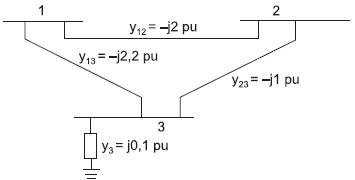
A figura acima apresenta um sistema elétrico de potência, hipotético, constituído pelas barras 1, 2 e 3, três linhas de transmissão representadas por suas admitâncias série y12, y13 e y23 e pelo elemento shunt y3, conectado na barra 3.
Suponha que as tensões nas barras 1 e 2 do sistema apresentado sejam, respectivamente, iguais a 1,0 !$ \angle !$ 0 e 0,9 !$ \angle !$ −30 pu. Qual o valor em pu do fluxo de potência ativa P12 entre as barras 1 e 2?
Provas
Considere as informações a seguir para responder à questão.
A figura acima apresenta um sistema elétrico de potência, hipotético, constituído pelas barras 1, 2 e 3, três linhas de transmissão representadas por suas admitâncias série y12, y13 e y23 e pelo elemento shunt y3, conectado na barra 3.
Considerando a matriz de admitância nodal (Ybarra) do sistema apresentado, o elemento Y33 dessa matriz, em pu, é
Provas
Em um sistema de transmissão, ocorre uma falta para o terra da sua fase A (curto-circuito entre a fase A e o terra). Sabendo-se que a corrente de falta assume o valor I !$ \angle !$ α p.u. pode-se concluir, a respeito de seus componentes, que a sequência
Provas
Has Higgs been really discovered?
by Scientific American
Top physicists have recently reached a frenzy over the announcement that the Large Hadron Collider in Geneva is planning to release what is widely expected to be tantalizing - although no conclusive - evidence for the existence of the Higgs boson, the elementary particle hypothesized to be the origin of the mass of all matter.
Many physicists have already swung into action, swapping rumors about the contents of the announcement and proposing grand ideas about what those rumors would mean, if true. “It’s impossible to be excited enough,” says Gordon Kane, a theoretical physicist at the University of Michigan at Ann Arbor.
The spokespeople of the collaborations using the cathedral-size ATLAS and CMS detectors(a) to search for the Higgs boson and other phenomena(b) at the 27-kilometer-circumference proton accelerator of the Large Hadron Collider (LHC) are scheduled to present updates based on analyses of the data collected to date(c). “There won’t be a discovery announcement, but it does promise to be interesting(d), since there are rumors that scientists have seen hints of the elusive Higgs boson(e)” says James Gillies, spokesperson for CERN (European Organization for Nuclear Research), which hosts the LHC.
Joe Lykken, a theoretical physicist at Fermi National Accelerator Laboratory in Batavia, Ill, and a member of the CMS collaboration, says: “Whatever happens eventually with the Higgs, I think we’ll look back on this meeting and say. ‘This was the beginning of something.’” (As a CMS member, Lykken says he is not yet sure himself what results ATLAS would unveil; he is bound by his collaboration’s rules not to reveal what CMS has in hand.)
Available at: <http://news.cnet.com/8301-11386_3-57341543-76/has-higgs-been-discovered-rumors--of-watershed-news-build/?tag=mncol;topStories>. Retrieved on: 11 Dec. 2011. Adapted.
In Text, Joe Lykken states thatProvas
Has Higgs been really discovered?
by Scientific American
Top physicists have recently reached a frenzy over the announcement that the Large Hadron Collider in Geneva is planning to release what is widely expected to be tantalizing - although no conclusive - evidence for the existence of the Higgs boson, the elementary particle hypothesized to be the origin of the mass of all matter.
Many physicists have already swung into action, swapping rumors about the contents of the announcement and proposing grand ideas about what those rumors would mean, if true. “It’s impossible to be excited enough,” says Gordon Kane, a theoretical physicist at the University of Michigan at Ann Arbor.
The spokespeople of the collaborations using the cathedral-size ATLAS and CMS detectors(a) to search for the Higgs boson and other phenomena(b) at the 27-kilometer-circumference proton accelerator of the Large Hadron Collider (LHC) are scheduled to present updates based on analyses of the data collected to date(c). “There won’t be a discovery announcement, but it does promise to be interesting(d), since there are rumors that scientists have seen hints of the elusive Higgs boson(e)” says James Gillies, spokesperson for CERN (European Organization for Nuclear Research), which hosts the LHC.
Joe Lykken, a theoretical physicist at Fermi National Accelerator Laboratory in Batavia, Ill, and a member of the CMS collaboration, says: “Whatever happens eventually with the Higgs, I think we’ll look back on this meeting and say. ‘This was the beginning of something.’” (As a CMS member, Lykken says he is not yet sure himself what results ATLAS would unveil; he is bound by his collaboration’s rules not to reveal what CMS has in hand.)
Available at: <http://news.cnet.com/8301-11386_3-57341543-76/has-higgs-been-discovered-rumors--of-watershed-news-build/?tag=mncol;topStories>. Retrieved on: 11 Dec. 2011. Adapted.
The following fragment of Text is NOT completed correctly in
Provas
Has Higgs been really discovered?
by Scientific American
Top physicists have recently reached a frenzy over the announcement that the Large Hadron Collider in Geneva is planning to release what is widely expected to be tantalizing - although no conclusive - evidence for the existence of the Higgs boson, the elementary particle hypothesized to be the origin of the mass of all matter.
Many physicists have already swung into action, swapping rumors about the contents of the announcement and proposing grand ideas about what those rumors would mean, if true. “It’s impossible to be excited enough,” says Gordon Kane, a theoretical physicist at the University of Michigan at Ann Arbor.
The spokespeople of the collaborations using the cathedral-size ATLAS and CMS detectors to search for the Higgs boson and other phenomena at the 27-kilometer-circumference proton accelerator of the Large Hadron Collider (LHC) are scheduled to present updates based on analyses of the data collected to date. “There won’t be a discovery announcement, but it does promise to be interesting, since there are rumors that scientists have seen hints of the elusive Higgs boson” says James Gillies, spokesperson for CERN (European Organization for Nuclear Research), which hosts the LHC.
Joe Lykken, a theoretical physicist at Fermi National Accelerator Laboratory in Batavia, Ill, and a member of the CMS collaboration, says: “Whatever happens eventually with the Higgs, I think we’ll look back on this meeting and say. ‘This was the beginning of something.’” (As a CMS member, Lykken says he is not yet sure himself what results ATLAS would unveil; he is bound by his collaboration’s rules not to reveal what CMS has in hand.)
Available at: <http://news.cnet.com/8301-11386_3-57341543-76/has-higgs-been-discovered-rumors--of-watershed-news-build/?tag=mncol;topStories>. Retrieved on: 11 Dec. 2011. Adapted.
The excerpt “Many physicists have already swung into action” could be properly completed in
Provas
Has Higgs been really discovered?
by Scientific American
Top physicists have recently reached a frenzy over the announcement that the Large Hadron Collider in Geneva is planning to release what is widely expected to be tantalizing - although no conclusive - evidence for the existence of the Higgs boson, the elementary particle hypothesized to be the origin of the mass of all matter.
Many physicists have already swung into action, swapping rumors about the contents of the announcement and proposing grand ideas about what those rumors would mean, if true. “It’s impossible to be excited enough,” says Gordon Kane, a theoretical physicist at the University of Michigan at Ann Arbor.
The spokespeople of the collaborations using the cathedral-size ATLAS and CMS detectors to search for the Higgs boson and other phenomena at the 27-kilometer-circumference proton accelerator of the Large Hadron Collider (LHC) are scheduled to present updates based on analyses of the data collected to date. “There won’t be a discovery announcement, but it does promise to be interesting, since there are rumors that scientists have seen hints of the elusive Higgs boson” says James Gillies, spokesperson for CERN (European Organization for Nuclear Research), which hosts the LHC.
Joe Lykken, a theoretical physicist at Fermi National Accelerator Laboratory in Batavia, Ill, and a member of the CMS collaboration, says: “Whatever happens eventually with the Higgs, I think we’ll look back on this meeting and say. ‘This was the beginning of something.’” (As a CMS member, Lykken says he is not yet sure himself what results ATLAS would unveil; he is bound by his collaboration’s rules not to reveal what CMS has in hand.)
Available at: <http://news.cnet.com/8301-11386_3-57341543-76/has-higgs-been-discovered-rumors--of-watershed-news-build/?tag=mncol;topStories>. Retrieved on: 11 Dec. 2011. Adapted.
Text reports that
Provas
The Microbial Puppet-Master
by Valerie Ross
from Discover Magazine:
Mind & Brain / Memory, Emotions & Decisions
When Timothy Lu was in medical school, he treated a veteran whose multiple sclerosis was so severe that she had to use a urinary catheter. As often happens with invasive medical devices, the catheters became infected with biofilms: gooey, antibioticresistant layers of bacteria. Now the 30-year-old MIT professor, who first trained as an engineer, designs viruses that destroy biofilms, which cause everything from staph infections to cholera outbreaks and that account for 65 percent of human infections overall.
Discover: You started as an electrical engineer. Was it a difficult transition becoming a biologist?
Lu: I came into the lab not really understanding how to do biology experiments and deal with chemicals. I’m not a great experimentalist with my hands, and one night I set the lab on fire.
Discover: How does a biofilm work, from an engineering perspective?
Lu: A biofilm is essentially a three-dimensional community of bacteria that live together, kind of like a bacterial apartment building or city. Biofilms are made up of the bacterial cells as well as all sorts of other material — carbohydrates, proteins, and so on — that the bacteria build to protect themselves.
Discover: And those communities make bacteria especially dangerous?
Lu: Before I started medical school, I didn’t think bacterial infections were a big deal, because I assumed antibiotics had taken care of them, but then I started seeing patients with significant biofilm infections that couldn’t be cured.
Discover: What is your strategy to destroy biofilms?
Lu: We use viruses called phages that infect bacteria but not human cells. We cut the phages’ DNA and insert a synthetic gene into the phage genome. That gene produces enzymes that can go out into the biofilm and chew it up.
Discover: If you had just $10 for entertainment, how would you spend your day?
Lu: What can you even buy with $10? Maybe I would buy a magnifying glass and just peer around in the soil to see what other life was going on down there. That would actually be fun.
Available at: <http://discovermagazine.com/2011/sep/05-questions-for-microbial-puppet-master>.Retrieved on: 11 Sep. 2011. Adapted.
In Text, the word in parentheses describes the idea expressed by the expression in boldface type inProvas
Caderno Container