Foram encontradas 50 questões.
Nos processos de soldagem por eletrodo revestido (SMAW), a união dos metais é obtida pelo seu aquecimento através de um arco estabelecido entre um eletrodo revestido e a peça a ser soldada. Existem vários tipos de revestimentos para os eletrodos utilizados, e cada tipo de revestimento se adequa a determinadas aplicações. Acerca dos tipos de revestimentos e suas características, marque V para as afirmativas verdadeiras e F para as falsas.
( ) Eletrodos celulósicos: possuem quantia elevada de materiais orgânicos em seu revestimento, cuja decomposição pelo arco geram gases que protegem o metal líquido.
( ) Eletrodos rutílicos: possuem revestimento constituído sobretudo por óxidos de ferro e manganês. Este tipo de eletrodo gera uma escória abundante e de fácil destacamento.
( ) Eletrodos básicos: possuem quantidades significativas de carbonatos e fluorita, que geram uma escória capaz de dessulfurar e reduzir o risco de formação de trincas de solidificação.
A sequência está correta em
Provas

Os tratamentos térmicos têm características específicas de resfriamento, conforme o resultado que se deseja obter, de acordo com as propriedades e os constituintes a serem gerados através do tratamento. Analise, a seguir, a representação gráfica de um tratamento térmico, com a respectiva curva de resfriamento temperatura (oC) x tempo (escala logarítmica).
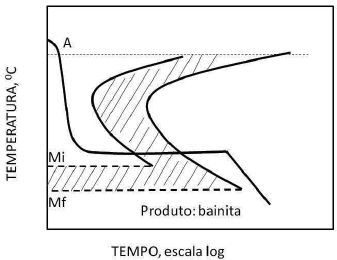
Assinale a alternativa que corresponde ao tratamento térmico representado
Provas
Os tratamentos térmicos são empregados com o objetivo de aumentar certas propriedades dos materiais, de acordo com as necessidades de aplicação. Relacione o tratamento térmico com a propriedade mecânica que este visa a aumentar.
1. Recozimento.
2. Revenimento.
3. Têmpera.
( ) Dureza.
( ) Tenacidade.
( ) Ductibilidade.
A sequência está correta em
Provas
Fundição é um processo de fabricação em que o metal ou liga metálica, no estado líquido, é vazado em um molde com formatos e medidas correspondentes aos da peça a ser produzida. Entretanto, alguns fenômenos ocorrem neste processo, e devem ser controlados para se evitar ou minimizar defeitos. Relacione os fenômenos aos respectivos defeitos.
1. Cristalização.
2. Contração.
3. Concentração de impurezas.
( ) Planos de maior fragilidade.
( ) Segregação.
( ) Aparecimento de tensões residuais.
A sequência está correta em
Provas
A têmpera e o revenimento são tratamentos térmicos aplicados principalmente em ligas ferrosas, cujo objetivo é produzir estruturas nos materiais de modo a adequar suas propriedades a certas operações. Sobre esses tratamentos, é INCORRETO afirmar que
Provas
Nasa successfully tests hypersonic heat shield
July 25, 2012.
The development of a large inflatable heat shield by the Space Technology Program at NASA has a number of implications for the oft-criticized space agency, as successful tests of the technology have led to speculation about its potential to support long-distance travel.
Science Daily reported that the Inflatable Reentry Vehicle Experiment (IRVE-3) was launched from NASA's Wallops Flight Facility on Wallops Island, Virginia. The heat shield reached speeds up to 7,600 miles per hour, successfully, and travelled at this rate for a significant period during the test.
The purpose of the test was to show that a space capsule can rely upon the heat shield to protect itself as it enters an atmosphere, according to the news outlet. Planetary entry and descent, including both a return to Earth from the International Space Station and any prospective missions to Mars, were targeted as potential uses for the outer shell.
“It's great to see the initial results indicate we had a successful test of the hypersonic inflatable aerodynamic decelerator”, James Reuther, deputy director of NASA's Space Technology Program, said in a statement. “This demonstration flight goes a long way toward showing the value of these technologies to serve as atmospheric entry heat shields for future space.”
NASA's engineering research team used a cone of uninflated high-tech rings covered by a thermal blanket of layers of heat resistant materials for IRVE-3, as the heat shield was launched for its suborbital flight from a three-stage Black Brant Rocket, according to Science Daily.
The heat shield was inflated by a system that pumped nitrogen into the aero shell until it expanded to a shape with a diameter of 10 feet. Engineers at the Wallops site monitored IRVE-3 by watching four onboard cameras and onboard instruments, as the temperature and pressure levels of the craft were closely observed to ensure the success of the test.
From takeoff to splashdown, the flight lasted roughly 20 minutes, but the implications of the test could have a far-reaching impact on NASA's ability to support space travel.
“A team of NASA engineers and technicians spent the last three years preparing for the IRVE-3 flight,” said Lesa Roe, director of NASA's Langley Research Center in Hampton, Va. “We are pushing the boundaries with this flight. We look forward to future test launches of even bigger inflatable aero shells.”
Space.com reported that NASA engineers want this test to serve as a springboard for later efforts, including the use of these heat shields for larger payloads, such as ships that contain large amounts of materials or even human passengers.
“We want to go to higher latitudes at that mass, or use this technology for larger payloads, such as humans”, Neal Cheatwood, the principal engineer for the test, told the news outlet
Cheatwood noted that the engineering research team is trying to outline the myriad potential uses for the heat shield, but the first application is likely to be a support role for the removal of garbage for the International Space Station.
Robotic spacecraft are sent to remove trash from the ISS, but can only carry a small amount of supplies on these trips. However, the successful IRVE-3 test showed that there is a potential for the heat shield to increase the productivity of these trips.
“When we send up re-supply [spacecraft] to the station, there's no portable on-demand storage up there,” Cheatwood told Space.com. “When they bring up 'x' number of cubic feet of stuff, we need to get rid of that much as well.”
(http://why.knovel.com/all-engineering-news/1746-nasa-successfully-tests-hypersonic-heat-shield.html – Com adaptações.)
The utterance by Neal Cheatwood “We want to go to higher latitudes at that mass, or use this technology for larger payloads, such as humans” in the indirect speech is
Provas
Nasa successfully tests hypersonic heat shield
July 25, 2012.
The development of a large inflatable heat shield by the Space Technology Program at NASA has a number of implications for the oft-criticized space agency, as successful tests of the technology have led to speculation about its potential to support long-distance travel.
Science Daily reported that the Inflatable Reentry Vehicle Experiment (IRVE-3) was launched from NASA's Wallops Flight Facility on Wallops Island, Virginia. The heat shield reached speeds up to 7,600 miles per hour, successfully, and travelled at this rate for a significant period during the test.
The purpose of the test was to show that a space capsule can rely upon the heat shield to protect itself as it enters an atmosphere, according to the news outlet. Planetary entry and descent, including both a return to Earth from the International Space Station and any prospective missions to Mars, were targeted as potential uses for the outer shell.
“It's great to see the initial results indicate we had a successful test of the hypersonic inflatable aerodynamic decelerator”, James Reuther, deputy director of NASA's Space Technology Program, said in a statement. “This demonstration flight goes a long way toward showing the value of these technologies to serve as atmospheric entry heat shields for future space.”
NASA's engineering research team used a cone of uninflated high-tech rings covered by a thermal blanket of layers of heat resistant materials for IRVE-3, as the heat shield was launched for its suborbital flight from a three-stage Black Brant Rocket, according to Science Daily.
The heat shield was inflated by a system that pumped nitrogen into the aero shell until it expanded to a shape with a diameter of 10 feet. Engineers at the Wallops site monitored IRVE-3 by watching four onboard cameras and onboard instruments, as the temperature and pressure levels of the craft were closely observed to ensure the success of the test.
From takeoff to splashdown, the flight lasted roughly 20 minutes, but the implications of the test could have a far-reaching impact on NASA's ability to support space travel.
“A team of NASA engineers and technicians spent the last three years preparing for the IRVE-3 flight,” said Lesa Roe, director of NASA's Langley Research Center in Hampton, Va. “We are pushing the boundaries with this flight. We look forward to future test launches of even bigger inflatable aero shells.”
Space.com reported that NASA engineers want this test to serve as a springboard for later efforts, including the use of these heat shields for larger payloads, such as ships that contain large amounts of materials or even human passengers.
“We want to go to higher latitudes at that mass, or use this technology for larger payloads, such as humans”, Neal Cheatwood, the principal engineer for the test, told the news outlet
Cheatwood noted that the engineering research team is trying to outline the myriad potential uses for the heat shield, but the first application is likely to be a support role for the removal of garbage for the International Space Station.
Robotic spacecraft are sent to remove trash from the ISS, but can only carry a small amount of supplies on these trips. However, the successful IRVE-3 test showed that there is a potential for the heat shield to increase the productivity of these trips.
“When we send up re-supply [spacecraft] to the station, there's no portable on-demand storage up there,” Cheatwood told Space.com. “When they bring up 'x' number of cubic feet of stuff, we need to get rid of that much as well.”
(http://why.knovel.com/all-engineering-news/1746-nasa-successfully-tests-hypersonic-heat-shield.html – Com adaptações.)
The word highlighted in “The purpose of the test was to show that a space capsule can rely upon the heat shield to protect itself as it enters an atmosphere,…” can be substituted, with no change of meaning, for
Provas
Nasa successfully tests hypersonic heat shield
July 25, 2012.
The development of a large inflatable heat shield by the Space Technology Program at NASA has a number of implications for the oft-criticized space agency, as successful tests of the technology have led to speculation about its potential to support long-distance travel.
Science Daily reported that the Inflatable Reentry Vehicle Experiment (IRVE-3) was launched from NASA's Wallops Flight Facility on Wallops Island, Virginia. The heat shield reached speeds up to 7,600 miles per hour, successfully, and travelled at this rate for a significant period during the test.
The purpose of the test was to show that a space capsule can rely upon the heat shield to protect itself as it enters an atmosphere, according to the news outlet. Planetary entry and descent, including both a return to Earth from the International Space Station and any prospective missions to Mars, were targeted as potential uses for the outer shell.
“It's great to see the initial results indicate we had a successful test of the hypersonic inflatable aerodynamic decelerator”, James Reuther, deputy director of NASA's Space Technology Program, said in a statement. “This demonstration flight goes a long way toward showing the value of these technologies to serve as atmospheric entry heat shields for future space.”
NASA's engineering research team used a cone of uninflated high-tech rings covered by a thermal blanket of layers of heat resistant materials for IRVE-3, as the heat shield was launched for its suborbital flight from a three-stage Black Brant Rocket, according to Science Daily.
The heat shield was inflated by a system that pumped nitrogen into the aero shell until it expanded to a shape with a diameter of 10 feet. Engineers at the Wallops site monitored IRVE-3 by watching four onboard cameras and onboard instruments, as the temperature and pressure levels of the craft were closely observed to ensure the success of the test.
From takeoff to splashdown, the flight lasted roughly 20 minutes, but the implications of the test could have a far-reaching impact on NASA's ability to support space travel.
“A team of NASA engineers and technicians spent the last three years preparing for the IRVE-3 flight,” said Lesa Roe, director of NASA's Langley Research Center in Hampton, Va. “We are pushing the boundaries with this flight. We look forward to future test launches of even bigger inflatable aero shells.”
Space.com reported that NASA engineers want this test to serve as a springboard for later efforts, including the use of these heat shields for larger payloads, such as ships that contain large amounts of materials or even human passengers.
“We want to go to higher latitudes at that mass, or use this technology for larger payloads, such as humans”, Neal Cheatwood, the principal engineer for the test, told the news outlet
Cheatwood noted that the engineering research team is trying to outline the myriad potential uses for the heat shield, but the first application is likely to be a support role for the removal of garbage for the International Space Station.
Robotic spacecraft are sent to remove trash from the ISS, but can only carry a small amount of supplies on these trips. However, the successful IRVE-3 test showed that there is a potential for the heat shield to increase the productivity of these trips.
“When we send up re-supply [spacecraft] to the station, there's no portable on-demand storage up there,” Cheatwood told Space.com. “When they bring up 'x' number of cubic feet of stuff, we need to get rid of that much as well.”
(http://why.knovel.com/all-engineering-news/1746-nasa-successfully-tests-hypersonic-heat-shield.html – Com adaptações.)
If the word “American” and the word “successful” were inserted in the phrase “the heat shield”, the right sequence of words would be
Provas
Nasa successfully tests hypersonic heat shield
July 25, 2012.
The development of a large inflatable heat shield by the Space Technology Program at NASA has a number of implications for the oft-criticized space agency, as successful tests of the technology have led to speculation about its potential to support long-distance travel.
Science Daily reported that the Inflatable Reentry Vehicle Experiment (IRVE-3) was launched from NASA's Wallops Flight Facility on Wallops Island, Virginia. The heat shield reached speeds up to 7,600 miles per hour, successfully, and travelled at this rate for a significant period during the test.
The purpose of the test was to show that a space capsule can rely upon the heat shield to protect itself as it enters an atmosphere, according to the news outlet. Planetary entry and descent, including both a return to Earth from the International Space Station and any prospective missions to Mars, were targeted as potential uses for the outer shell.
“It's great to see the initial results indicate we had a successful test of the hypersonic inflatable aerodynamic decelerator”, James Reuther, deputy director of NASA's Space Technology Program, said in a statement. “This demonstration flight goes a long way toward showing the value of these technologies to serve as atmospheric entry heat shields for future space.”
NASA's engineering research team used a cone of uninflated high-tech rings covered by a thermal blanket of layers of heat resistant materials for IRVE-3, as the heat shield was launched for its suborbital flight from a three-stage Black Brant Rocket, according to Science Daily.
The heat shield was inflated by a system that pumped nitrogen into the aero shell until it expanded to a shape with a diameter of 10 feet. Engineers at the Wallops site monitored IRVE-3 by watching four onboard cameras and onboard instruments, as the temperature and pressure levels of the craft were closely observed to ensure the success of the test.
From takeoff to splashdown, the flight lasted roughly 20 minutes, but the implications of the test could have a far-reaching impact on NASA's ability to support space travel.
“A team of NASA engineers and technicians spent the last three years preparing for the IRVE-3 flight,” said Lesa Roe, director of NASA's Langley Research Center in Hampton, Va. “We are pushing the boundaries with this flight. We look forward to future test launches of even bigger inflatable aero shells.”
Space.com reported that NASA engineers want this test to serve as a springboard for later efforts, including the use of these heat shields for larger payloads, such as ships that contain large amounts of materials or even human passengers.
“We want to go to higher latitudes at that mass, or use this technology for larger payloads, such as humans”, Neal Cheatwood, the principal engineer for the test, told the news outlet
Cheatwood noted that the engineering research team is trying to outline the myriad potential uses for the heat shield, but the first application is likely to be a support role for the removal of garbage for the International Space Station.
Robotic spacecraft are sent to remove trash from the ISS, but can only carry a small amount of supplies on these trips. However, the successful IRVE-3 test showed that there is a potential for the heat shield to increase the productivity of these trips.
“When we send up re-supply [spacecraft] to the station, there's no portable on-demand storage up there,” Cheatwood told Space.com. “When they bring up 'x' number of cubic feet of stuff, we need to get rid of that much as well.”
(http://why.knovel.com/all-engineering-news/1746-nasa-successfully-tests-hypersonic-heat-shield.html – Com adaptações.)
The “ch” in the word technology as in “… the technology have led to...” has the same sound of the word in, EXCEPT,
Provas
Nasa successfully tests hypersonic heat shield
July 25, 2012.
The development of a large inflatable heat shield by the Space Technology Program at NASA has a number of implications for the oft-criticized space agency, as successful tests of the technology have led to speculation about its potential to support long-distance travel.
Science Daily reported that the Inflatable Reentry Vehicle Experiment (IRVE-3) was launched from NASA's Wallops Flight Facility on Wallops Island, Virginia. The heat shield reached speeds up to 7,600 miles per hour, successfully, and travelled at this rate for a significant period during the test.
The purpose of the test was to show that a space capsule can rely upon the heat shield to protect itself as it enters an atmosphere, according to the news outlet. Planetary entry and descent, including both a return to Earth from the International Space Station and any prospective missions to Mars, were targeted as potential uses for the outer shell.
“It's great to see the initial results indicate we had a successful test of the hypersonic inflatable aerodynamic decelerator”, James Reuther, deputy director of NASA's Space Technology Program, said in a statement. “This demonstration flight goes a long way toward showing the value of these technologies to serve as atmospheric entry heat shields for future space.”
NASA's engineering research team used a cone of uninflated high-tech rings covered by a thermal blanket of layers of heat resistant materials for IRVE-3, as the heat shield was launched for its suborbital flight from a three-stage Black Brant Rocket, according to Science Daily.
The heat shield was inflated by a system that pumped nitrogen into the aero shell until it expanded to a shape with a diameter of 10 feet. Engineers at the Wallops site monitored IRVE-3 by watching four onboard cameras and onboard instruments, as the temperature and pressure levels of the craft were closely observed to ensure the success of the test.
From takeoff to splashdown, the flight lasted roughly 20 minutes, but the implications of the test could have a far-reaching impact on NASA's ability to support space travel.
“A team of NASA engineers and technicians spent the last three years preparing for the IRVE-3 flight,” said Lesa Roe, director of NASA's Langley Research Center in Hampton, Va. “We are pushing the boundaries with this flight. We look forward to future test launches of even bigger inflatable aero shells.”
Space.com reported that NASA engineers want this test to serve as a springboard for later efforts, including the use of these heat shields for larger payloads, such as ships that contain large amounts of materials or even human passengers.
“We want to go to higher latitudes at that mass, or use this technology for larger payloads, such as humans”, Neal Cheatwood, the principal engineer for the test, told the news outlet
Cheatwood noted that the engineering research team is trying to outline the myriad potential uses for the heat shield, but the first application is likely to be a support role for the removal of garbage for the International Space Station.
Robotic spacecraft are sent to remove trash from the ISS, but can only carry a small amount of supplies on these trips. However, the successful IRVE-3 test showed that there is a potential for the heat shield to increase the productivity of these trips.
“When we send up re-supply [spacecraft] to the station, there's no portable on-demand storage up there,” Cheatwood told Space.com. “When they bring up 'x' number of cubic feet of stuff, we need to get rid of that much as well.”
(http://why.knovel.com/all-engineering-news/1746-nasa-successfully-tests-hypersonic-heat-shield.html – Com adaptações.)
Match the two columns to classify the “ing forms” and mark the alternative which presents the right sequence.
1. “ing form” used as a verb.
2. “ing form” used as a noun.
3. “ing form” used as an adjective.
( ) “This demonstration flight goes a long way toward showing the value...”
( ) “Engineers at the Wallops site monitored IRVE-3 by watching four onboard cameras…”
( ) “… but the implications of the test could have a far-reaching impact on NASA's ability to support space travel.”
( ) “We are pushing the boundaries with this flight.”
( ) “… the engineering research team is trying to outline the myriad potential uses for the heat shield,…”
Provas
Caderno Container