Foram encontradas 1.750 questões.
Disciplina: Inglês (Língua Inglesa)
Banca: VUNESP
Orgão: Pref. Aparecida-SP
Leia o bilhete do aluno e o texto de Celce-Murcia, a seguir, para responder às questões de 42 a 48.
Dear teacher,
I am writing this in the intermission between classes to tell you of my extolment for your class. Your group work rouses a deep sense of admiration and joy within me. I enjoy every step of the work in your class. It comes without speaking that your class is the best. I don’t know how to give vent to my feelings. You help me with the difficultness of English. I know other guys and I suggest them to take your class. I’m so much happy to be student of a sagely teacher such as you and getting your advices. Your help is beyond valuability.
Bye for now,
Teo
What is it about the word use in Teo’s expressive letter that does not sound quite right, even though we understand the message? It appears that he knows enough about the words to communicate, but there are gaps in his word knowledge. For example, to know a word means to know a considerable amount about its meaning; Teo uses the word intermission (a short period of time between the parts of a play, film, concert, etc.) to apply to the break between classes. He knows the literal meaning of to give vent to his feelings but misses the subtle distinction that vent is usually used with negative feelings (I vented my anger). In addition, to know a word or phrase means to know its collocations, or how it is used in combination with other words; for example, every step of the way is a recognizable collocation, every step of the work is not. Knowing your word also means to know its grammatical function (e.g., suggest is a transitive verb; advice is an uncountable noun) and its word parts (e.g., difficulty rather than *difficultness, and value rather than *valuability). Finally, knowing your word means to know its register, or a level of formality. Extolment is a noun (meaning “enthusiastic praise and admiration”), but it is very formal and infrequently used.
This letter demonstrates the enormity of the word learning task. There are many words to know and many details to be known about each word.
(Celce-Murcia, M. 2001)
Ao solicitar aos alunos uma leitura rápida e global do texto com o objetivo de compreender o propósito principal do autor, o professor estará ajudando-os a desenvolver a estratégia de leitura denominada
Provas

Disciplina: TI - Sistemas Operacionais
Banca: VUNESP
Orgão: Pref. Aparecida-SP
- Fundamentos de Sistemas OperacionaisAbstração de Hardware
- Fundamentos de Sistemas OperacionaisDrivers de Dispositivos
Para que se possa utilizar, correta e adequadamente, um microcomputador e dispositivos externos, como impressoras, é necessário instalar drivers adequados a tais dispositivos, sendo correto afirmar que um driver de dispositivo é um programa que
Provas
Arribas (2004) escreve a respeito do conhecimento do corpo e da descoberta dos sentidos, a autora afirma que para que o corpo possa se converter em instrumento de expressão, será necessário
Provas
Portadores de transtorno do espectro do autismo (TEA) via de regra apresentam
Provas
Na etapa de formulação das questões específicas de uma pesquisa empírica, é essencial que tais questões
Provas
Bassedas (1999) afirma que na educação infantil o contato entre família e educadores é uma questão primordial que convém cuidar. A respeito dessa relação, a autora afirma e defende que
Provas
A professora Roseli forneceu uma mesma sequência rascunho de figuras para seus alunos, pedindo que eles encontrassem uma fórmula que indicasse o número de bolinhas pretas na posição N, sendo N o número da figura. A professora orientou que eles buscassem regularidades e padrões cercando convenientemente as bolinhas de cada figura. Na finalização da atividade, a professora selecionou respostas corretas de três alunas, escritas de formas diferentes, para mostrar a equivalência entre as três expressões algébricas encontradas por elas.
Veja como cada uma das três alunas cercou as bolinhas de cada figura:
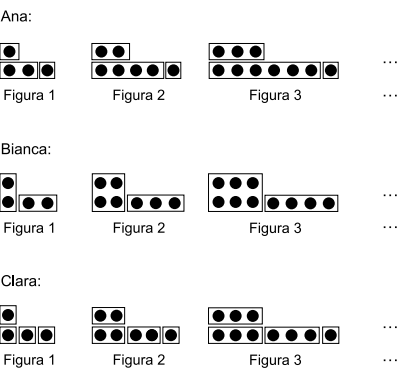
As prováveis expressões escritas por Ana, Bianca e Clara a partir das linhas que fizeram para cercar as bolinhas de cada figura foram, respectivamente,
Provas
Na visão de Jean Piaget, o mecanismo de aprender pode ser entendido como
Provas
Disciplina: Inglês (Língua Inglesa)
Banca: VUNESP
Orgão: Pref. Aparecida-SP
Leia o bilhete do aluno e o texto de Celce-Murcia, a seguir, para responder às questões de 42 a 48.
Dear teacher,
I am writing this in the intermission between classes to tell you of my extolment for your class. Your group work rouses a deep sense of admiration and joy within me. I enjoy every step of the work in your class. It comes without speaking that your class is the best. I don’t know how to give vent to my feelings. You help me with the difficultness of English. I know other guys and I suggest them to take your class. I’m so much happy to be student of a sagely teacher such as you and getting your advices. Your help is beyond valuability.
Bye for now,
Teo
What is it about the word use in Teo’s expressive letter that does not sound quite right, even though we understand the message? It appears that he knows enough about the words to communicate, but there are gaps in his word knowledge. For example, to know a word means to know a considerable amount about its meaning; Teo uses the word intermission (a short period of time between the parts of a play, film, concert, etc.) to apply to the break between classes. He knows the literal meaning of to give vent to his feelings but misses the subtle distinction that vent is usually used with negative feelings (I vented my anger). In addition, to know a word or phrase means to know its collocations, or how it is used in combination with other words; for example, every step of the way is a recognizable collocation, every step of the work is not. Knowing your word also means to know its grammatical function (e.g., suggest is a transitive verb; advice is an uncountable noun) and its word parts (e.g., difficulty rather than *difficultness, and value rather than *valuability). Finally, knowing your word means to know its register, or a level of formality. Extolment is a noun (meaning “enthusiastic praise and admiration”), but it is very formal and infrequently used.
This letter demonstrates the enormity of the word learning task. There are many words to know and many details to be known about each word.
(Celce-Murcia, M. 2001)
In the words of Celce-Murcia, “knowing your word means to know its register, or a level of formality”.
In the sentences below, the one with the appropriate degree of formality is
Provas
Disciplina: TI - Organização e Arquitetura dos Computadores
Banca: VUNESP
Orgão: Pref. Aparecida-SP
Em um microcomputador tipo IBM-PC, a interface USB é hot-swappable, o que significa que os dispositivos que a ela se ligam
Provas
Caderno Container